Empowerment
Philippe Villeval argues for autonomisation in virtual spaces:
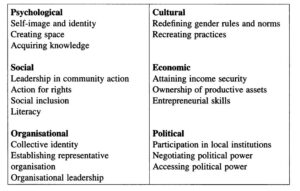
Philosophical: defining autonomy as a virtuality projected in the future. It is based and built on the involvement, conscious choice, or decision of the stakeholders.
Psychological: considering autonomy as a process and not only a state of individualisation in building one’s personality. In this perspective, it is a real and permanent ‘conquest’.
Social: analysing the relation between individuals and groups and among groups – from a perspective similar to the one developed to analyse the ‘object’ of the empowerment: an organisation, a network, a movement or/and, of course, an individual. The capacity to act
alone is, or should be, an intrinsic part of interdependence (as opposed to independence), and must involve our responsibility.
How can you empower virtual students in your classroom?
How can marginal students from introverts, sexual minorities, racialised peoples, and students with disabilities be empowered in your face to face and virtual teaching practices?
What are the strengths, weaknesses, opportunities, and threats produced by learner autonomy in a multimodal classroom that could affect your teaching practice?
Villeval, P. (2008). Towards a policy framework for the empowerment of social movements. Development in Practice, 18(2), 245-257. Retrieved from: https://www.tandfonline.com/doi/abs/10.1080/09614520801899085