
Lesson 2 – Gen AI Mindset
In her anatomy and physiology course, Sandra’s nursing students complete an assignment in which they write definitions for terminology related to certain biological processes. Within one submission, a student had provided a definition of a valve that related to plumbing rather than biology. When Sandra spoke to the student, they admitted to using Gen AI to complete the assignment.
Consider these highlights from a 2024 KPMG study:
- 59% of surveyed Canadian students use Gen AI in their schoolwork
- 75% said that Gen AI has improved the quality of their work
- 67% do not think they are learning or retaining as much knowledge.
Research is showing that over-reliance on AI tools can impact critical thinking and reduce cognitive effort (Gerlich, 2025; Kosmyna, 2025).
Higher confidence in Gen AI has been associated with applying less critical thinking during knowledge work. (Lee et. al, 2025).
When designing assignments that integrate Gen AI use, supporting students to develop an active learning mindset is important. Reinforcing engaged, critical interaction with Gen AI allows students to evolve from passive users to active collaborators.
Gen AI Mindset Spectrum

Passive User
A passive absorber of information.
Does not consider how the way the tool works impacts the results.
Only interested in getting results quickly and easily.
Are less critical of results.
Passive Learning
Active Collaborator
An active searcher with a curious mindset.
Interested in understanding how Gen AI works and how to use it best.
Experiments and reflects to understand Gen AI’s limitations and potential.
Critical of the results. Questions and verifies results.
Active Learning and AI Literacy
Adapted from: Microdosing GPTs: Scaffolding a Positive Pedagogy to AI Technologies. Meyer & Woulfin (2024), as described in Generative AI Guidebook for Teaching & Learning at Conestoga
Preparing Students for an AI-Integrated Future
Students will need AI literacy skills to succeed in their careers (Bates et al., 2020). This includes the ability to:
- understand the basics of how AI works
- evaluate the benefits, costs, and quality of AI tools and output
- use AI intentionally and ethically for different contexts
When used well, AI can support learning by helping students to ask better questions, improve their work, and think more critically (Dron, 2023).
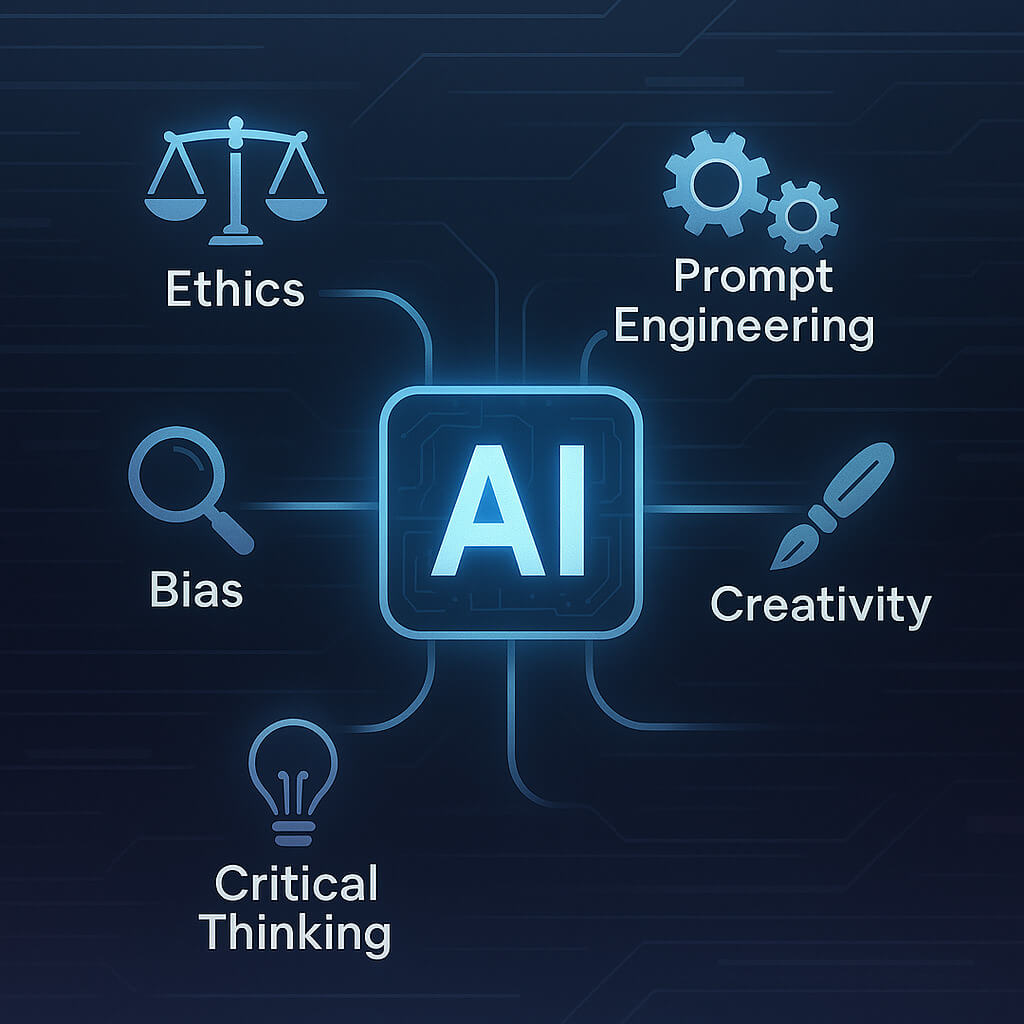
Image generated with Microsoft Copilot
By fostering curiosity and ownership over their learning, we can encourage students to intentionally collaborate with Gen AI rather than passively accept its output.
As faculty, we do not need to become AI experts. But we do need to prepare with purpose. That means modeling how to engage with AI ethically, creatively, and with a mindset of inquiry. (Austin et. al, 2025).
In their article, Austin et al. (2025) describe teacher roles we can adopt when integrating Gen AI into courses and assessments. Taking on all of these roles is not necessary. Based on your discipline and teaching style, you can try out practices that work for you.
The AI Mentor and Data Literacy Facilitator
As mentors, teachers can demystify how AI works to create a critical context for its use. By understanding that Gen AI creates content by prediction rather than human-like reasoning, students can be encouraged to question its results.
Ideas: At the beginning of the term, try a short activity in which students experience Gen AI producing an incorrect response or one that has contextual gaps. You can also model critical use of Gen AI by doing in-class Gen AI queries and asking: “Here is what Copilot says about this. Does this sound right? Is there anything missing?”
The AI Ethics Advocate
Use of Gen AI is often framed in terms of cheating. There is an opportunity to have broader ethical conversations about who owns and designs AI tools, where Gen AI data comes from, and how biases may arise.
Ideas: Explore case studies about real-world applications and consequences of Gen AI use to support conscientious use of AI.
The Prompt Engineer for Learning
By providing opportunities to practice prompting, students can be encouraged to experiment and iterate to get better results.
Ideas: Have students prepare two different prompts on the same topic, compare the results during small-group discussion, and reflect on the changes. In their assignments, they can document their Gen AI conversation and reflect on the iterative changes they made to improve the final outcome.
For a marketing course, students could have Gen AI create a product launch plan and then complete a SWOT (strengths, weaknesses, opportunities, and threats) analysis of the results.
The Curator of AI-enhanced Tools and Resources
As you get to know AI tools, you will notice how some tools support more flexible engagement and nuanced responses while others are more limited. For instance, certain grammar support platforms may make editing suggestions that are grammatically correct but lose tone, semantic nuance, and inclusivity.
Ideas: Have students try writing their own paragraphs. Then, have students use two different GenAI tools to edit the same paragraph. In pairs, students can compare the results and reflect on how each tool handled the editing or paragraph creation task. Students can consider: “What gets added or lost to their own thoughts by accepting the changes?”
To explore how AI summarizes content, students can read an article or watch a video and prepare their own summary. Then, they can have two Gen AI tools summarize the content. As a reflection, students can discuss how the summary is similar or different to their own. Did the Gen AI miss important details or contextual nuance?
The Human-in-the-Loop Designer
It is tempting to use Gen AI to speed up grading and prepare feedback. Relying on Gen AI for grading is discouraged since it may hinder your relationship with students. They may perceive you as lacking care and credibility as a teacher. We want to avoid situations that lead to AI-generated assignments being graded by AI. We also need to be mindful to not inadvertently share confidential student information. While using Gen AI to prepare feedback comments can be helpful, it may generate generic responses that lack emotional nuance and make our teaching presence feel shallow.
Ideas: Gen AI can help you craft a variety of supporting comments to which you can add personalized notes. This allows students to still feel seen and acknowledged as an individual student.
Explore Further
The Case for Slow-Walking Our Use of Generative AI. This article advocates for a cautious, reflective approach to integrating generative AI in higher education, providing four guiding principles to thoughtfully consider the role of AI tools in teaching, ensuring ethical and effective use.
AI in the Classroom: Panic, Possibility, and the Pedagogy in Between This short Faculty Focus article acknowledges the discomfort that Gen AI brings to education but invites teachers to embrace it as “the beginning of clarity”. “Our students don’t need us to have all the answers. They need us to model how to live with the questions. They need to see that thoughtful, ethical, human learning is still possible, especially in a world full of algorithms.”