
Lesson 5 – Culture of Academic Integrity
Adam Davidson-Harden, an Ontario English and social studies teacher who was interviewed by CBC, described how a student had submitted an assignment on Shakespeare’s The Tempest that included non-existent citations. When questioned, the student admitted to using Gen AI “to avoid the messy and slower process” of sifting through the play. Davidson-Harden lamented the lost opportunity to “engage with the content, formulate an opinion, find support for their perspective and string together sentences to express it”.
Cognitive Offloading to Gen AI
With Gen AI’s ubiquitousness and ease of use, it is very tempting to offload cognitive work to these tools. Learning is a slow, messy process. It is the productive struggle hat yields deeper, richer learning. The reality is, students may lean on quick, frictionless ways to get the assignment done for various reasons. By understanding these, we can design assessments and reinforcing learning activities that seek to engage students in their learning process rather than simply finish the task.
What this sounds like:
“I didn’t know it was considered cheating!”
How GenAI “Helps”:
Gen AI, like the “Help me Write” button in Google Docs, seems harmless, like using spell or grammar check.
What this sounds like:
“I am confused by the assignment and don’t understand what I need to do and why.”
How Gen AI “Helps”:
If students find the assignment instructions to be unclear and the process overwhelming, they may offload work to Gen AI.
What this sounds like:
“There’s no way I can do this.”
How Gen AI “Helps”:
Does the task for them and may give them the false sense that they know what they’re doing.
What this sounds like:
“This is a stupid assignment that I don’t care about anyway.”
How Gen AI “Helps”:
When students don’t find value or meaning in the assessment, they offload most of the work to Gen AI.
What this sounds like:
“My friends are using it, so that must mean it’s okay!”
How Gen AI “Helps”:
Gen AI feels like just another friend that students can turn to when they’re struggling.
What this sounds like:
“I don’t have time to finish this assignment!”
How Gen AI “Helps”:
Gen AI can quickly generate a product that the student can submit as their own.
Detecting Use of Gen AI
Professors can often detect telltale signs of Gen AI content within submitted student assignments. These include:
- Flowery, academic language
- Long sentences
- Consistent use of the oxford comma
- Frequent use of words such as delve and pivotal
- Insertion of citations whose sources do not exist
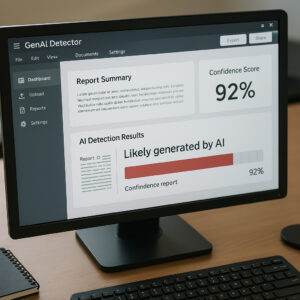
As students become savvier at camouflaging their use, use inclusion of Gen AI content will become less obvious. This is where technology can come to our rescue, right? Aren’t there detector tools that can identify when submitted work by a student includes Gen AI content?
The trouble with Gen AI detectors is that they are not reliable.
AI detectors show false positives and false negatives. They can identify the written work of neurodivergent students and speakers of English as an additional language as being created by Gen AI (Elkhatat, 2023; Weber-Wulff et. al, 2023; Perkins et. al, 2024). Not only are false accusations of Gen AI distressing for students, they are a barrier to fair, inclusive assessment. Also, paraphrasing and prompting that changes the voice and style of Gen AI text also hinders detection accuracy.
Culture of Academic Integrity
Our best option is to support a culture of academic integrity – especially through positive reinforcement of good learning habits and a growth mindset. Consider an assessment approach that supports students to:
- understand the value of productive struggle for learning
- develop their metacognitive skills (e.g. awareness and management of one’s own learning)
- develop their critical thinking and evaluative judgement skills
- retain their personal voice, agency, independent thought, and creativity
- be responsible and accountable for the quality and accuracy of their Gen AI assisted work
- instill an ethos of attribution in which they acknowledge and cite Gen AI use
To develop as active collaborators with Gen AI, students need guided opportunities to practice how to intentionally engage with Gen AI.
A Process Mindset
Traditionally, assessments are structured to prioritize completion of a final product – like a written report or a working client web site. The pressure on students to complete high quality, high-stakes, one-and-done summative assessments – especially within the context of their busy lives, can result in Gen AI overuse.
An alternative approach would be to focus learning and assessments more on the learning process than the product (Gulya, 2025). Doing so would:
- Show the value in the learning process
- Guide students through creating their own processes
- Emphasize the importance of reflection and metacognitive skills (e.g. one’s awareness of how they learn)
“The first step is to recognize that this is about more than just creating some process-oriented assignments. It’s more than just saying “process over product” over and over. It’s a mindset shift, in which we need to reassert the value of messiness and of the process itself…The messiness isn’t something to jump past. That’s when we learn.”
Jason Gulya, Bringing a Process Mindset to Higher Ed, April, 2025
Shifting the focus of assessments on the learning process is not simply a change in assignment structure.
It is about creating an active learning environment that encourages practice, mistakes, feedback, discussion and reflection.
Self-Empowering Writing Process (SEWP)
Jason Gulya, a professor of English and applied media at Berkley College, has adopted a process-focused assessment design strategy that focuses on:
- Iteration
- Reflection
- Metacognition
- Design Thinking
- The Value of Messiness
He uses portfolio assignments in which students:
- Decide on their project.
- Design a multi-step plan to complete the project. This includes making decisions on, if and how they will use Gen AI to complete it.
A Spectrum of Student Gen AI Use in the Classroom
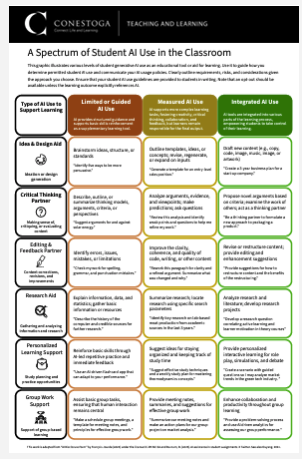
This guide from Conestoga College outlines six types of AI-assisted learning tasks. Teachers can use this resource to help decide when and how AI use is allowed, and to shape communication of AI-related policies. Students can also use it to consider ways that Gen AI can support their work without compromising their learning.
If students engage in a self-empowered learning process assignment, this Spectrum document can serve as a reference for deciding when and how to use Gen AI.
Be sure to clearly explain any expectations, potential risks, and important considerations based on your chosen approach. Provide your AI use guidelines to students in written form.
If AI use is not directly tied to a learning outcome, students should have the option to opt out.
Reflection Questions
When students rely on GenAI to do the thinking for them, it is often a sign of stress, low confidence, or feeling disconnected from the work. These questions invite you to think about how your assessment design could support stronger engagement and reduce the need to offload. Consider:
- Setting the stage for Gen AI use isn’t just about rules or permissions. These questions help you think through how your expectations, assignment design, and communication can shape how students engage with Gen AI tools. Consider:
- Where could you be more transparent about why Gen AI is permitted or restricted? What might help students understand the reasoning behind your choices?
- How might you focus assignment and supporting activity attention onto the learning process rather than the product that is submitted?
- Where could issues of equity show up in Gen AI use in your class? How do you make sure students have fair access and clear support?
- What tools or prompts could help students reflect on their Gen AI use and document it clearly?
Explore Further
Bringing a Process Mindset to Higher Ed, Highter Education Digest, Jason Gulya
Jason, a professor of English and Applied Media, posts regularly on social media about his thoughts and experimentation with AI-informed assessments. This short read makes the case for reorganizing learning to focus on the process rather than the product.
Designing AI-Resilient Assessments in Online and Distance Education, eLearning Rules, Stephen Wheeler
This article provides actionable strategies to integrate AI ethically and effectively into teaching practices, ensuring a focus on student growth and learning outcomes.
Enhancing Student Learning and Assessment with AI: 5 Innovative Strategies (video), Dr. Tarseem Singh Cooner.
This short video provides a succinct overview of key ways to design and support AI-integrated assessments.