
Lesson 4 – Introduction to the Flipped Classroom
There are endless ways to design blended learning and no agreement about which is the “best” way. Each method has its own considerations. Here, we will focus on the flipped classroom method.
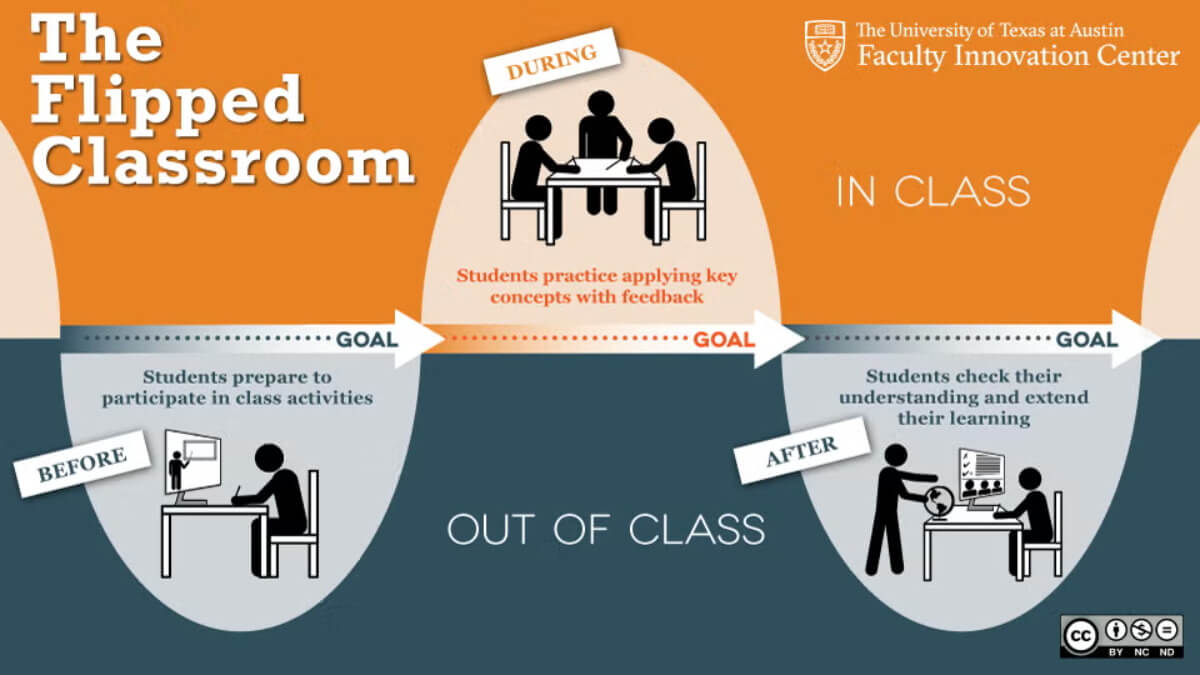
Before going into the specifics, take a look at the following image of The Flipped Classroom. What do you notice? What advantage(s) might this method have? Consider writing down what questions you might have right now and seeing if they are answered by the end of this sub-module.
If you would like a preview of other options, check out D2L’s page The Complete Guide to Blended Learning or if you would like a deeper dive presented in an alternative format, check out the Cult of Pedagogy podcast episode Blended Learning: 4 Models that Work (37 minutes).
The flipped classroom method is a specific way of designing blended learning that has the bulk of foundational learning content delivered online, while the in-person class time is used to foster a deeper understanding of concepts, application of knowledge, and teacher- and peer-support. In essence, the traditional approach is “flipped”: lecture-style teaching is reduced or delivered in alternative methods online and students are more actively engaged in learning during class time.
Watch this short video (58s) for additional details on the flipped classroom method:
As you might imagine, there are always advantages and challenges with different teaching methods. In Module 1, we covered benefits and challenges of blended learning from a broad sense. Compare the benefits and challenges specific to the flipped method below.
| Benefits | Challenges |
|---|---|
|
Students learn more deeply due to increased meaningful engagement with content, peers, and instructor |
Increased workload in planning intentional and thoughtful curriculum (like all blended learning methods) |
|
Students are more active in their learning rather than ‘passive recipients’ |
Some students may come to class unprepared |
|
More opportunities for feedback from peers and instructor as well as it being more timely |
In-class activities may be restricted by large class sizes |
|
Use of technology and choice can provide multiple means of engagement and can reduce barriers in traditional learning environments |
There may be issues with access or use of technology |