
Lesson 2 – Integrating Indigenous Values and Knowledge
Respect Indigenous values
“Indigenous” is an umbrella term for three distinct groups of peoples recognized in the Canadian constitution: First Nations, Inuit, and Métis. However, this term fails to convey the rich variety of Indigenous peoples in Canada as each of these groups has its own unique history, languages, cultural practices, and spiritual beliefs. For instance, there are over 630 First Nations communities in Canada, from 50 distinct First Nations, speaking over 50 languages. Nonetheless, we can see some common threads in their approaches to education, including an emphasis on teaching collective values to guide decisions and actions.
Mino Bimaadiziwin (to live in a good way)
Mino Bimaadiziwin, roughly translated as to live “in a good way”, is an Anishnaabe teaching that describes how balancing the physical, mental, emotional, and spiritual aspects of ourselves (body, mind, heart, and spirit) is essential to leading a good life. Source: Manitoba Ministry of Education and Early Childhood, “Mino-pomatisiwin — The Good Life”
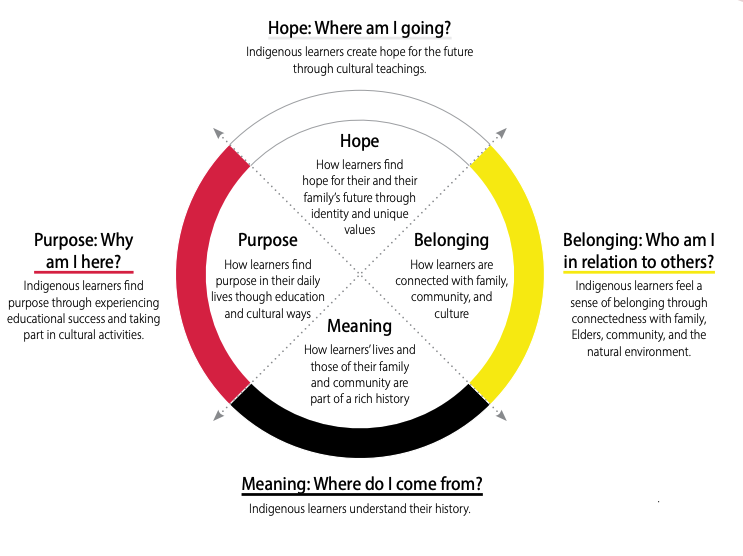
- The body — Meaning: Where do I come from? Learning comes from an individual’s connection to the natural world, which provides rich opportunities for intellectual and spiritual development and growth. Learners receive knowledge by listening, observing, touching, and connecting to the land and reflecting on her teachings.
- The mind — Purpose: Why am I here? As learners build knowledge, they develop their awareness of the processes and strategies they use to make sense of the world around them.
- The heart — Belonging: Who am I in relation to others? Learners come to understand their unique talents and skills and are aware of their roles and responsibilities in connection to the Creator, the land, their community, their family, and themselves.
- The spirit — Hope: Where am I going? The goal of education is to help learners develop an understanding of their strengths and how they might use their unique gifts to live a life filled with purpose.
Learning how to achieve this balance is a lifelong endeavour that teaches us how to live with respect and reciprocity in relationship with oneself, with others, and with the natural world, by recognizing our interconnectedness.
Adapted from Manitoba Ministry of Education and Early Childhood. “Mino-pomatisiwin — The Good Life”
“Understanding that we all have a purpose — and that it is the individual’s and the community’s obligation to reveal that purpose — can help learners on their path through life as they accumulate knowledge and understanding…. An individual must be mindful of their connection to other things. Most important is the Creator, then the earth (aki), then all living things, then the community, and then the self. This means that the purpose of the individual is to connect to and support the family and the community and all other things before the self; it is never about serving oneself.” — Teachings of the community elders of Turtle Mountain College, Anishnaabe. Belcourt, North Dakota.
- Mino-Pimatisiwin (Cree)
- Mino-pimatisiwin (Ininew)
- Mino Bimaadiziwin (Anishinabemowin)
- honso aynai (Dene)
- tokatakiya wichoni washte (Dakota)
- minopimatitheewin (Anisininimowin)
- Miyo-pimatishiwin (Michif-Cree)
Seven Grandfather Teachings
The Seven Grandfather Teachings are a set of guiding principles that give people the tools to live a good life, mino bimaadiziwin. These teachings offer a lens for designing assessment that prioritizes relationships, fairness, and personal growth.
 Wisdom (Kagitawendemowin): Wisdom is the ability to make sound decisions based on knowledge and experience. It involves considering the consequences of our actions and making decisions that benefit the community, including future generations.
- Love (Sàgihidìwin): To truly love others, one must first love and respect oneself. This includes accepting your identity, your gifts, and your place in the world. If you can demonstrate Love to yourself and others through the acts of kindness, generosity, nurturing, and protection, you will be at peace with yourself. Love connects the natural world, both humans and non-humans.
- Respect (Mànadjìhidiwin): Respect means recognizing the inherent worth of every person, animal, plant, and element of the natural world. Everything and everyone has a role and purpose. Respect means acknowledging that others carry knowledge and experience. Respect is shown through listening, patience, and treating others with dignity.
- Courage (Songemindizòwin): Courage is the ability to face fear, danger, or adversity with integrity. It’s about standing up for what is right, even when this is difficult. Courage involves defending those who cannot defend themselves, including the land, the water, the language, and the traditions.
- Honesty (Tebwe): Honesty is about being truthful with yourself and others. Honesty begins with self-awareness and acceptance; it means acknowledging your strengths and weaknesses and not pretending to be someone you’re not. Honesty is practiced by aligning your actions with your words and values and being accountable for your choices.
- Humility (Tabasenindizòwin): Humility means recognizing that all beings are interconnected and that no one is more important than another. It’s about living in balance with others and with the natural world. Humility allows you to be open to learning as wisdom can come from many sources — from Elders, from children, from the land.
- Truth (Tebwewin): Truth is knowing the value in these teachings, practicing them consistently and with integrity, and sharing these teachings with others. Living in truth is expressed in how you treat others, how you care for the land, and how you carry your responsibilities.
Inuit Qaujimajatuqangit
The Inuit also have a framework of Traditional Knowledge that guide them on how to “live a good life”. Inuit peoples express their system of beliefs in the Inuit Qaujimajatuqangit (IQ), which means “that which Inuit have always known to be true.”
- ᐃᓅᖃᑎᒌᑦᓯᐊᕐᓂᖅ – Inuuqatigiitsiarniq: Respecting others, relationships and caring for people.
- ᑐᙵᓇᕐᓂᖅ – Tunnganarniq: Fostering good spirit by being open, welcoming and inclusive.
- ᐱᔨᑦᓯᕐᓂᖅ – Pijitsirniq: Serving and providing for family and/or community.
- ᐋᔩᖃᑎᒌᓐᓂᖅ – Aajiiqatigiinniq: Decision making through discussion and consensus.
- ᐱᓕᒻᒪᒃᓴᕐᓂᖅ – Pilimmaksarniq: Development of skills through observation, mentoring, practice, and effort.
- ᐃᑲᔪᖅᑎᒌᓐᓂᖅ – Ikajuqtigiinniq: Working together for a common cause.
- ᖃᓄᖅᑑᕐᓂᖅ – Qanuqtuurniq: Being innovative and resourceful.
- ᐊᕙᑎᑦᑎᓐᓂᒃ ᑲᒪᑦᓯᐊᕐᓂᖅ – Avatittinnik Kamatsiarniq: Respect and care for the land, animals and the environment.
Source: Nunavut Impact Review Board, Inuit Qaujimajatuqangit.