Lesson 3 – Your Assessments
Assessment Types and Purposes
Reflect: Identify one assessment you currently use in your course. Reflect on the purpose of your assessment – does it:
- identify students’ existing knowledge, skills, and any learning gaps before instruction begins?
- monitor student learning and provide ongoing feedback to improve teaching and learning?
- evaluate learning at the end of an instructional period?
Diagnostic, Formative, Summative Assessments
Based on your responses to the above question, you may find that the assessment you’re providing to students is diagnostic, formative, or summative.
Purpose: To identify students’ existing knowledge, skills, and any learning gaps before instruction begins.
Examples: pre-tests, surveys, skills inventories, initial reflections
Purpose: To monitor student learning and provide ongoing feedback to improve teaching and learning.
Examples: Exercises, Quizzes, Active learning, Peer reviews, Draft submissions
Purpose: To evaluate learning at the end of an instructional period.
Examples: Final exams, End-of-term projects or presentations, Capstone projects, Standardized tests
Assessment Of, For, and As Learning
Another way of thinking about assessment is based on the role it plays in the learning process: assessment of, for, and as learning.
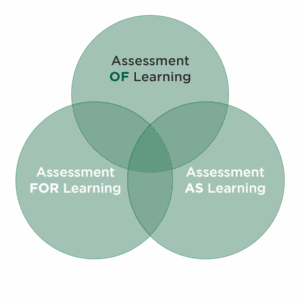
Focuses on measuring what your students have learned, often through summative tools like tests and final projects. It tends to prioritize grades and comparisons, serving as a checkpoint for what your students can do at a fixed moment in time. But here’s the catch: does it measure learning or just performance (Carless, 2015)?
Often summative, but sometimes diagnostic.
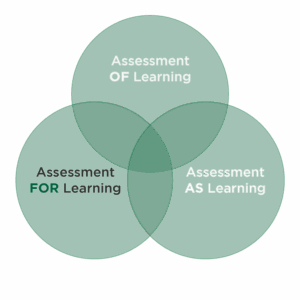
A formative approach designed to support learning while it happens. Feedback isn’t a stamp of approval or failure; it’s a tool for growth. Done right, it helps your students adjust, rethink, and improve (Black & Wiliam, 1998).
Mostly formative, but can include diagnostic elements.
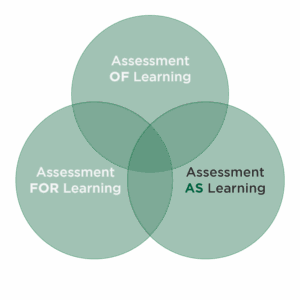
Moves beyond evaluation to put your students in the driver’s seat. It’s about reflection, self-assessment, and metacognition — students not just doing the work but thinking about how and why they learn (Dann, 2014).
Primarily formative, but could also be an alternative approach to summative assessment.
Reflection: Reflect on the purpose and type of assessment you’ve previously identified – can you easily label it as diagnostic, formative, or summative? Do you rely only on one type of assessment? Do these assessments provide learners with the opportunity to demonstrate the learning that they have done?
Alternatively, review this example assessment and identify opportunities to enhance it with the knowledge you have from these sections. Can students choose their topic, format, or approach? Could peer feedback, collaboration, or reflection make the assessment more meaningful?
Click here to reveal potential changes after reflection
Here’s a revised version highlighting some potential changes.
You may notice in the revised version of the assessment that there is an option to relate the topic to their own experiences, interests, and identities, as a way to make the assessment relevant and to reflect students in the learning process. When assessments acknowledge students’ backgrounds and perspectives, learning can feel more relevant and inclusive (Nortvedt et al., 2020).
Effective assessments help students see why their learning matters. Ashford-Rowe et al. (2014) describe authentic assessments as tasks that are complex and open-ended. Fink (2013) adds that students should be asked to “negotiate a complex task” and “solve unstructured problems [that] involve more than following a set routine or procedure or plugging in knowledge” (p. 96).
These tasks encourage students to apply what they know in ways that are meaningful beyond the classroom.
Authentic assessments allow students to:
- connect to the world they live in,
- offer choice, and
- help students build skills they can carry forward.
Activity:
Explore the suggestions and strategies for creating authentic assessments and think about how some of them can be used in your courses.
Use Real-World Examples
Give students case studies, news articles, or industry reports to connect what they’re learning to real situations.
Give Open-Ended Problems
Give students real-life challenges where they have to make decisions and explain their reasoning.
Connect Learning to Their Lives
Ask students to reflect on how what they’re learning applies to their future careers, interests, or everyday life.
Get Outside the Classroom
Have students collect data, conduct interviews, or observe real-world situations to apply what they’re learning.
Make Work Public
Have students create blog posts, infographics, podcasts, or presentations that could be shared outside the classroom.
Invite Community Partners into the Classroom
Bring in guest speakers from the field, set up projects with local businesses or organizations, or have students solve real problems for a community partner.
The remaining sections will further address the importance of designing assessments with learners in mind, how such assessments can support student belonging and motivation, and invite you to think about ways in which you can create these assessments.