Overdose Prevention
It is important to know that when drugs are illegal, they are unregulated. This means there is no way to know exactly what the drug contents are or the strength of the drugs. Drugs like fentanyl and carfentanil are extremely strong and can cause overdoses in very small amounts. They can be mixed with any other drug and there is no easy way to know if fentanyl or carfentanil is in the drugs you are using because you can’t see, smell or taste it.
Because of the high risk of overdose if fentanyl or carfentanil are present, consider getting the drugs you are planning to use checked:
- By calling Ottawa Public Health mobile van at 613.232.3232 for a take home drug checking kit
- Through AIDS Committee of Ottawa
If you are using unregulated drugs, here are some ways to help prevent overdoses:
Avoid Using Alone
If you use alone and experience an overdose, nobody will be there to respond. If you are using with someone else, don’t use at the exact same time.
If you do use alone: Tell someone before you use. Have a safety plan which includes having someone come check on you. You can also call the National Overdose Response Service Line any time any day at 1-888-688-NORS (6677). They will stay on the phone with you to respond immediately if there is an overdose or a bad trip. The service is 100% confidential, anonymous and judgement free. Learn more about how NORS works here.
Carry Naloxone
Naloxone is a medication that can temporarily reverse the effects of an opioid overdose. Naloxone kits are available at no cost in Ontario. To find out how to get a naloxone kit at no-cost, click here.
Naloxone Kits and Training on Campus
Nasal spray Naloxone kits have been purchased for distribution throughout the Algonquin College campuses in locations that are high volume hubs for services and large public venues. These locations include:
| Ottawa Campus | Pembroke Campus |
|
In partnership with Security Services, the Ottawa Campus maintains two Emergency Naloxone Boxes installed to support timely overdose response. Where to find them:
How it works: Each wall-mounted box features a yellow panel labeled “PULL.” In an emergency:
Additional support: Campus Security also carries naloxone and should be contacted in the event of an emergency (Algonquin extension 5000). |
|
Training Video
Don’t Mix Drugs
Using more than one drug at a time puts you at a higher risk of overdose.
Know Your Tolerance
Your risk of overdose increases if you are a new user or haven’t used in more than three days. Your tolerance will also change depending on:
- Weight
- Illness
- Stress
- Lower immune system (from hepatitis, for example)
- Lack of sleep
- Other drugs/medications being used
- General health
Start Low and Go Slow
The quality of unregulated drugs is unpredictable. Anything can be cut with fentanyl or carfentanil. By starting with a low dose and going slow, you are better able to get a sense of the strength and use in a way to prevent a potential overdose.
An overdose may look different from one person to the next and depending on the drugs involved. It is a medical emergency and the first step is always to call 9-1-1.
An overdose can occur with the use of alcohol, stimulants, hallucinogens, and opioids. Here are common signs and symptoms of an overdose:
| Type of drug: |
Common signs and symptoms of an overdose:
|
How to respond to an overdose:
|
|
Opioids (Examples: heroin, morphine, fentanyl, methadone, OxyContin) |
|
If you see any of these signs:
If they are not breathing, provide rescue breathing and/or chest compressions. Rescue breathing:
If there is no improvement after 2-3 minutes, give another dose of naloxone, followed by rescue breathing and/or chest compressions. If the person begins breathing on their own, or if you have to leave them on their own, put them in the recovery position. 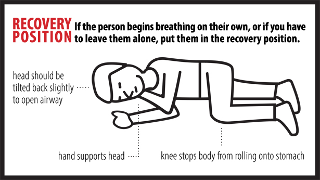
|
|
Stimulants (Examples: cocaine, speed, crystal meth, MDMA/ecstasy) |
|
If you see any of these signs: Call 9-1-1 immediately, and stay with the person if it is safe to do so. Help them remain calm and relaxed in a safe, quiet, dark space, if possible. Apply ice to the back of the person’s neck and encourage them to drink water if they are conscious and able to swallow. If in doubt, give naloxone. Stimulants can be cut with fentanyl or carfentanil. |
|
Hallucinogens (Examples: acid, LSD, ketamine, magic mushrooms) |
|
If you see any of these signs:
|
| Alcohol |
|
Alcohol poisoning is extremely dangerous and can cause coma and death. If you see any of these signs, call 9-1-1 immediately if you cannot wake the person, especially if they are vomiting or have vomited. Stay with the person if it is safe to do so. When someone is passed out from alcohol poisoning, put them in the recovery position. Gently roll the person on his or her side, tilting the head back and tucking the top hand under the chin to keep the mouth open and the airway clear. This helps to reduce the risk of choking if the person vomits. Bend the person’s top leg and bottom arm to support this position: 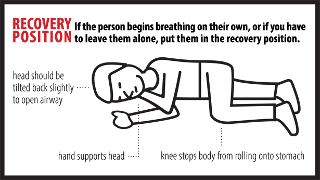
Do not leave the person alone. |
Important to know:
The Good Samaritan Drug Overdose Act protects you, the person who is overdosing, and anyone at the scene from being charged with:
- Possession of controlled substances (example, drugs)
- Breaches in pre-trial release, probation orders, conditional sentences, or parole related to simple possession
The Good Samaritan Drug Overdose Act does not provide protection against charges for:
- Outstanding arrest warrants
- Making and selling of controlled substances (example, drugs)
- All other crimes not outlined within the Act
To learn more, click here.
Additional resources: