Jenny Tenasco – Changing Lives Award 2026
Alumni of Distinction Awards > 2026 > Jenny Tenasco
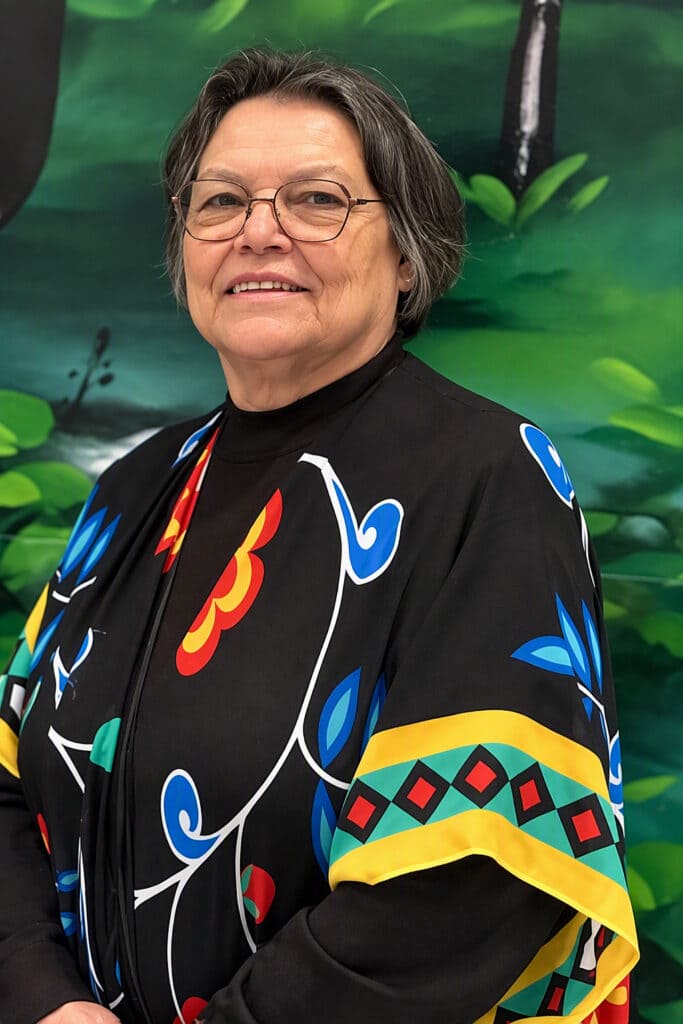
Educator and Elder
Kitigan Zibi Anishinabeg
Child and Youth Worker, 2005
In 1958, six-year-old Jenny Buckshot was taken from her family in Kitigan Zibi (then known as River Desert) in western Quebec and put on a three-day train trip. The destination was St. Mary’s Residential School in Kenora, ON, nearly 2,000 km away.
Being sent to a residential school so far from home at such a young age was no accident. The goal of the residential school system was to isolate Indigenous children like Jenny and have them conform to a system that sought to erase their Indigenous identity. The children were not allowed to speak their languages or practice their cultural traditions and were largely restricted from contacting their families.
It didn’t take long for the system to have its intended effect. By the end of her first year at St. Mary’s, Jenny had forgotten her language and lost touch with her culture. Still, through it all, she never forgot who she was or where she came from. She was always proud to be Anishinàbe Algonquin.
In time, Jenny went back home, got married, and raised a family. She was now Jenny Tenasco. When her youngest child started going to school, she decided it was a good time to build a career. At first, she took a part-time job as a hotel housekeeper in nearby Maniwaki, QC, to supplement her family’s income. But she knew this would be temporary. Her true calling was to serve her community, reclaim their history, and inspire future generations of Indigenous people.
The Kitigan Zibi Education Sector was established in 1980, which entailed the foundation of a school in the community. Soon thereafter, Tenasco became involved with the school. In the 1980s and 1990s, she taught as a supply teacher, worked in the school library, and headed cultural summer camps for school-age children.
“Oh, the students loved the camps,” Tenasco said. “They’d run to the fire first thing in the morning after our morning prayer. We boiled beans in the ground while they were swimming, we baked bread in the ground, we even made sea-pies, which have moose meat, in the ground. We’d bring in a language teacher, too. The students really enjoyed the camps.”
Supported by Joan Commanda Tenasco, her sister-in-law and linguistic expert, Tenasco promoted the revitalization of Anishinàbemowin, the traditional language of her people. The same language she had once been forbidden to speak at St. Mary’s was now a point of pride for her community and diligently taught to children in school.
During these years, Tenasco began a lifelong dedication to researching historical records. One of her areas of interest is the history of her community. She has travelled across the country, consulting churches and government archives to piece together a more complete history of Kitigan Zibi. Sometimes her efforts were met with prejudice and blocked by the people who kept the records, but she persisted and continued to uncover the stories of her ancestors.
“I wasn’t alone doing the research,” Tenasco said. “It was maybe ten of us. We’ve made booklets from all the information we found on the history of Kitigan Zibi, and they’ve accessed this resource in the [Kitigan Zibi] school.”
Tenasco’s findings have also fuelled further research projects, such as Dennis Leo Fisher’s 2023 book, Resistance and Recognition at Kitigan Zibi.
Another force that drives Tenasco’s research work is her experience in the residential school system. In one of her earliest research trips, she attended a reunion for residential school survivors where she discovered a collection of photos of children from Kitigan Zibi and Rapid Lake, a neighbouring Algonquin community.
She brought home copies of these photos, digitized them, and made them available as an educational resource. By the time the Indian Residential Schools Settlement Agreement was reached in 2005, the pictures and documents Tenasco and her fellow researchers had found were used by some people to apply for and receive settlement payments.
“When people from Rapid Lake heard about my pictures, they came over to our cultural centre and got copies of their class pictures when they were as young as six years old,” Tenasco said. “That went off with their paperwork and helped them get their settlements. I was glad I did that.”
In 2002, Tenasco decided to attend Algonquin College. She had been receiving training in early childhood education from Lisa Lamarre, an Algonquin College professor who drove up from Ottawa to Maniwaki a few times per month. This training complemented her decades of experience teaching children as a mother, grandmother, and educator, and she wanted to keep building on this foundation. Encouraged by her daughter, who had herself studied at Algonquin College, Tenasco enrolled in the Child and Youth Worker program.
“There’s always somebody from home here at Algonquin College,” Tenasco said. “Whenever someone from Kitigan Zibi graduated from high school and wanted to study at Algonquin College, we’d always support them.”
Algonquin College provided the ideal academic environment for Tenasco to expand her skills and learn how to best support vulnerable children, youth, and families. After graduation, she found many opportunities to serve her community as a child and youth worker in Kitigan Zibi.
One case that stands out to her to this day is that of an elementary school girl whose developmental functioning was at the level of a two-year-old. For 11 years, Tenasco did activities with her, joined her in visits to the doctor, and did her best to support her complex needs. This girl is now a young woman in an adult program, living a life as fulfilling as she is able to, thanks in large part to Tenasco’s work to prepare her for this stage of her life.
Nowadays, Tenasco dedicates much of her time advising people and organizations as an Anishinàbe Algonquin Elder. She works with the Canadian Medical Association to promote health policies that improve conditions for Indigenous people. Through the National Capital Commission, she has educated newcomers to Canada and advised on appropriate Indigenous toponymy for projects around the National Capital Region.
“There’s a street in Gatineau with a new name called Rue Wìgwàs,” said Tenasco. “We felt very proud of that. When things like this happens, we come together and have a feast to celebrate.”
Tenasco has been involved with government organizations at the municipal, provincial, and federal levels to offer her insight as an Indigenous Elder and help steer major initiatives. Some of the projects she has recently advised include the Alexandra Bridge replacement project and Ādisōke, the new Ottawa Public Library – Library and Archives Canada joint facility.
She also remains deeply connected to Algonquin College, where she mentors Indigenous students and contributes to events and programs facilitated by the Mamidosewin Centre, the College’s hub for Indigenous students. For the past two years, she has participated in monthly meetings with Knowledge Keeper Kirby Whiteduck and Claude Brulé, President and CEO of Algonquin College, to discuss the College’s Indigenization efforts and advise how the College can better serve its Indigenous students.
Like her fellow residential school survivors, Tenasco has had to deal with the lifelong effects of her time in the residential school system. Her choice has been to transform her lived experience into a force for good. For over half a century, she has served her family and her community, uplifting people as an educator, researcher, child worker, and tireless advocate.
Tenasco’s legacy is tangible in the lives of multiple generations of Indigenous people. As Canada strives to remedy historical injustices against the original peoples of this country, people like Tenasco are leading the charge to advance healing, reconciliation, and positive, enduring change.