
Lesson 1 – Understanding UDL’s Role in Academic Accommodations
We can use our knowledge of student variability to help us plan courses that are inclusive and accessible. The UDL guidelines help us accomplish this in manageable steps and provide many examples we can refer to when we make decisions for our courses.
When we use Universal Design for Learning as our teaching and learning framework, we reduce barriers to learning. This means that there are fewer obstacles for all students. When we use UDL, we design our materials, lessons, activities, and assignments to be flexible, offer choice, and honour various ways of being and learning. This supports the college’s goal for a more inclusive learner experience.
The image below is commonly used to represent accessibility and inclusion. Select the green information icon in the image to play an audio description.
In the first of three images, representing equality, soccer fans watch a game from behind a wooden fence. This barrier makes it impossible for some spectators to see the game, despite all having access to the same tools, a box to stand on. There is a false assumption that everyone benefits from the same support. In the second image, representing equity, the spectators can access individualized tools – more boxes – to stack and see over the barrier. But the barrier is still there, and it took extra effort to reduce its impact. In the third image, representing accessibility and justice, the wooden fence is removed and replaced with a chain link fence. The spectators don’t need extra support and accommodations because the cause of the inequity has been removed.
Using UDL as your teaching framework reduces barriers to learning and also helps to reduce the need for students to request academic accommodations from the college.
What are academic accommodations?
Academic accommodations “refer to educational supports intended to provide equal access to program and/or course requirements and reduce the impact of functional challenges posed by an individual’s disability. [They] do not undermine or compromise the essential course learning outcomes of a course or a program” (Algonquin College, 2025).
How are accommodations connected to UDL?
Education is not inclusive when students must ask for their needs to be met through accommodations. There are many reasons why a student might not be able to access academic accommodations. We’ll review those below. But here’s the good news – when we design our courses using UDL principles, students may not need to request academic accommodations. This is because UDL inherently provides many of those accommodations through inclusive design.
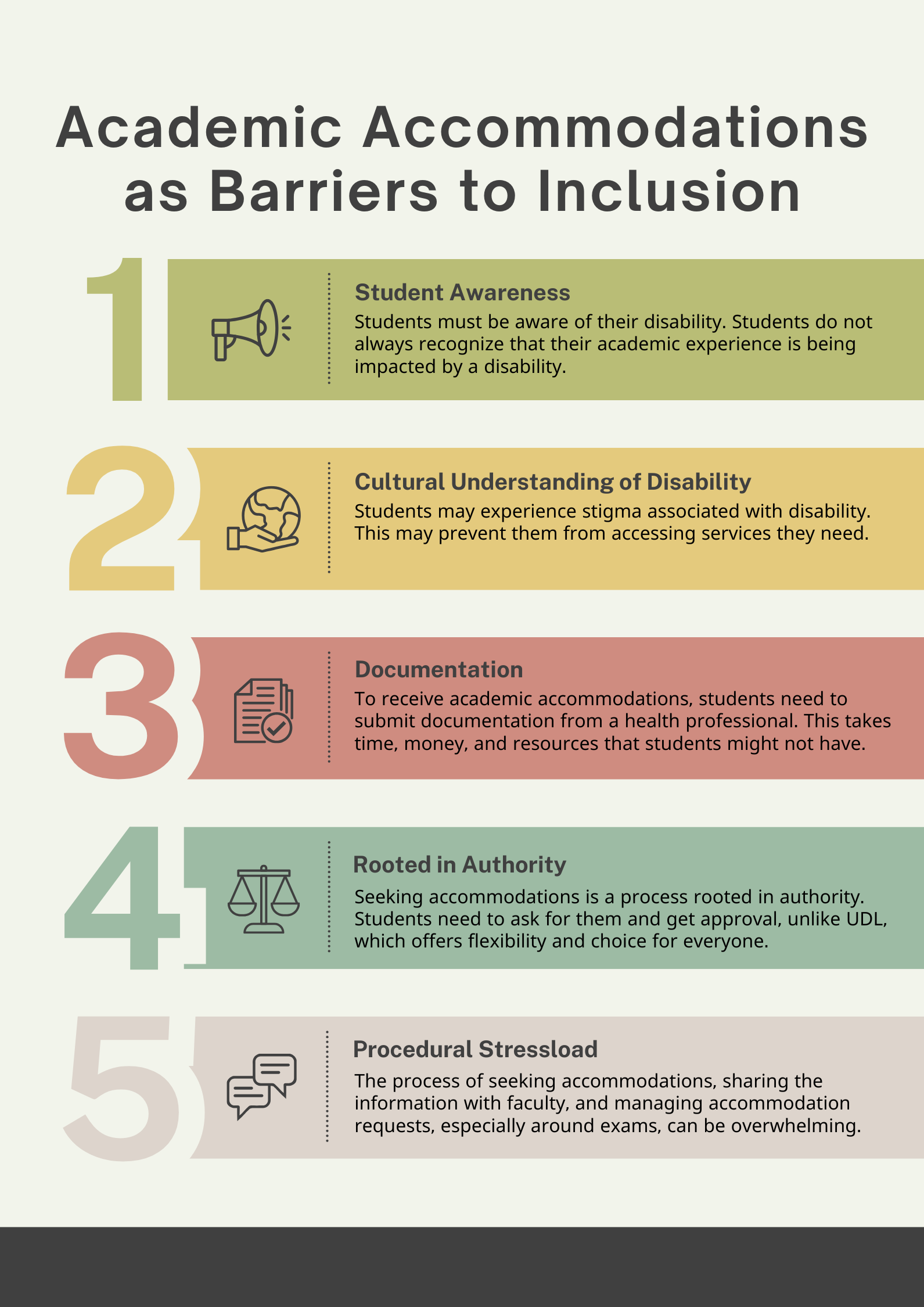
Academic Accommodations as Barriers to Inclusion
Why is this important?
Student variability means some students need accommodations, yet there are barriers to obtaining accommodations, so we need another plan. This is where UDL can help. If a teacher provides options for assessment of skills and knowledge, then a student might not need an accommodation for in-class presentations. If a teacher posts short video lectures for students to review anytime they need, then a student might not require accommodations for a note taker, tutor, or extra clarification. If a teacher designs their course materials to be usable by assistive technologies, then a student might not need additional accommodations.
UDL is not a solution to every accommodation request, however, inclusive teaching and learning strategies make learning more approachable and possible for many students. UDL teaching practices can also lighten pressure on staff in the Accessible Learning Office by reducing requests for formal academic accommodations. This means that students don’t need to wait to be accommodated.