Student Experience
The outdoors is our biggest lab
Students in the Forestry Technician program at Algonquin College benefit from Pembroke’s rich timber history and location in the heart of forestry mills and operations. Students participate in first-hand learning in winter and summer through their many field trips and visits to parks and forestry operations. Algonquin Park, Petawawa (National) Research Forest, Renfrew County Forests, and Shaw ‘Old Growth’ Woods are among the many parks and forests found nearby.
Want to be a forest firefighter in Ontario? Read CBC News article.
Eligibility for certification
The education and skills students learn in the Forestry Technician program qualify them for a number of provincial, College and other certificates and licences.
| First Aid and CPR | Bear Awareness | Chainsaw Operators |
| Forest Operations Inspection | Installing Culverts | TDG |
| SP-102 Forest Fire Fighter | Land Management Training | Tree Marking |
| Air Brake Endorsement | Aircraft Safety & Awareness | Night Orienteering |
| Cold Weather Survival | GIS | Leave No Trace |
| Warm Weather Survival | Prospector’s | Firearms Acquisition |
| SP-100 Forest Fire Fighter | WHMIS | Log Scaler |
| Ropes and Knots | Helicopter Operation and Safety | Radio Operator |
Meet Maya Rosandic, Forestry Technician and Urban Forestry – Arboriculture Grad
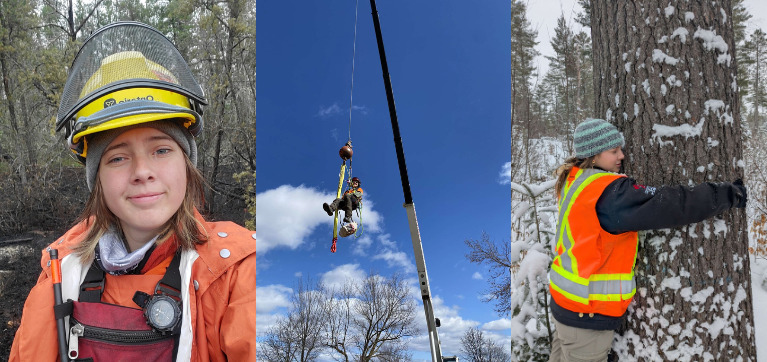
Sept. 20–26, 2026 marks National Forest Week (NFW) across Canada. Coordinated nationally by the Canadian Institute of Forestry (CIF-IFC), this annual event celebrates Canada’s forest heritage and raises awareness about sustainable forest management.
Algonquin College’s Pembroke Campus has a long-standing history of training forestry industry leaders through the Urban Forestry – Aboriculture and Forestry Technician programs, partnering with several organizations in the Ottawa Valley to create hands-on experiences for learners.
“The CIF-IFC is a voice for forestry practitioners across Canada, and we are proud of our longstanding relationships with colleges and universities, including Algonquin College and its forestry program. Through initiatives such as the Silver Ring Ceremony and by welcoming graduates into local sections, such as the Algonquin Section, we help connect emerging professionals with the broader forestry community and the institute at large. During National Forest Week, we celebrate our forests and the people who will help shape their future. Maya Rosandic is one of those emerging professionals, whom we are proud to see embark on a challenging and rewarding career in forestry,” said Dean Assinewe, President, Canadian Institute of Forestry.
Maya Rosandic is a graduate of both the Urban Forestry- Aboriculture and Forestry Technician programs.
“I love being outside and working outside. Growing up in the Ottawa Valley, my childhood home was on a piece of land, so I was interested in learning more about how to manage it, and the Pembroke Campus is not far from home,” she explained.
Although she is early in her career, Rosandic has racked up impressive and varied experience working in the industry. After starting the Urban Forestry program in 2023, Rosandic has since worked as an arborist, a technician in the Urban Forestry on-campus and coached the school’s logger sports team, who took home first place in several events at a competition earlier this year. She returned to school to continue her education and complete the 2-year Forestry Technician program and has worked as a Wildland Firefighter in the town of Wawa, Ontario.
“It’s very fulfilling to coordinate the Forestry Technician Program at Algonquin College for a number of reasons. I get to interact with engaged and passionate students that understand the positive difference they can make to our forest by learning the skills to be good stewards of it. Maya is an excellent example of the type of student that graduates from the program-smart, curious and highly skilled,” said Peter Arbour, Program Coordinator, Forestry Technician program, Algonquin College Pembroke Campus.
“Before I started in the Urban Forestry program, 2023 was a big year for wildfire presence in and around the Ottawa Valley. I saw the impact. Once I started school, I had other friends in the program who were interested in fighting wildfires and learning more about it,” she explained.
Rosandic explained that some of the certificates needed to work in wildland firefighting, SP102 and SP100, are blended into the Fire Management Course in the program.
“The firefighting industry and education continue to evolve. In the past few years, the approach has shifted from fire prevention to prescribed fires as a management tool,” she said. “Ontario is struggling retain qualified firefighters., I wanted to help and be involved.”
Forestry is a male-dominated field, but Rosandic shares the biggest barrier is one’s own attitude.
“It may be intimidating, but anyone can do it. Anyone can learn these skills if you push yourself and believe in yourself. The industry has been welcoming,” she explained.
The Urban Forestry-Arboriculture and Forestry Technician programs are offered through Algonquin College’s Pembroke Campus.
To learn more about National Forestry Week visit the Canadian Institute of Forestry.
Rosandic was featured in an Urban Forestry – Arboriculture program video in 2024.
Watch the video below:
Written by Megan Fraser, 2026
Technology
Forestry is changing. Our program is dedicated to making students workplace ready. To do this, it is the College’s responsibility to deliver not only the key skills traditionally taught to understand and interpret the forest, but also stay astride of emerging technologies that will be driving forestry into the future. A recent example of this is the program’s adoption of an iPad-based suite of silvicultural apps developed by Marty Martelle at MITIG Forestry Services Ltd. Used by government, non-profit organizations and forestry industry professionals.
These apps offer students the opportunity to learn crucial assessment skills relative to tree marking, silvicultural effectiveness, and enhanced FRI data collection with real-time results in the forest. The apps are incredibly intuitive and easy to use, which allows students more time to practice the concepts required to be successful forestry technicians without being distracted by a complicated software learning curve. Using the apps is also very satisfying for both the professors and students in knowing that what is being taught serves as an industry standard, as these apps are used by many of the Sustainable Forest Licensees in the Great Lakes-St. Lawrence Forest Region.
Applied Research
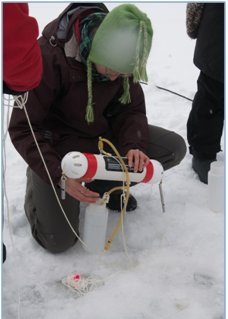 Algonquin College students from both the Pembroke and Woodroffe campuses have collaborated on two applied research projects related to Muskrat Lake and its surrounding watershed. As part of their study, Forestry Technician students from Algonquin’s Pembroke Campus participated in this research by locating, mapping and collecting winter water samples and compiling water quality depth profiles. The information is gathered for a study of algal blooms in partnership with the local Ministry of Natural Resources and industry partner Algal Taxonomy Inc.
Put your diploma towards further education
Graduates of the Forestry Technician program can apply their diploma credits towards a university degree at partnering universities. We have articulation agreements with the Forestry program at the University of New Brunswick, as well as with several Bachelor of Science degrees at Lakehead University.
Experience a unique varsity sport of forestry skills
Loggersports, a unique varsity sport offered at the Pembroke Campus, recall the skills and traditions of foresters of the past. Both the men’s and women’s teams compete against other college teams in a variety of events, including the axe throw, pole climb, water boil, horizontal and vertical chop, cross-cut saw, chain saw, and log decking. Read more about Algonquin’s Loggersports activities here. To find out more about the Canadian Intercollegiate Lumberjacking Association (CILA) see website: www.cilawoodsmen.ca/