Environmental Management and Assessment (Co-op and Non Co-op Version)
Join those at the forefront of environmental management practice.
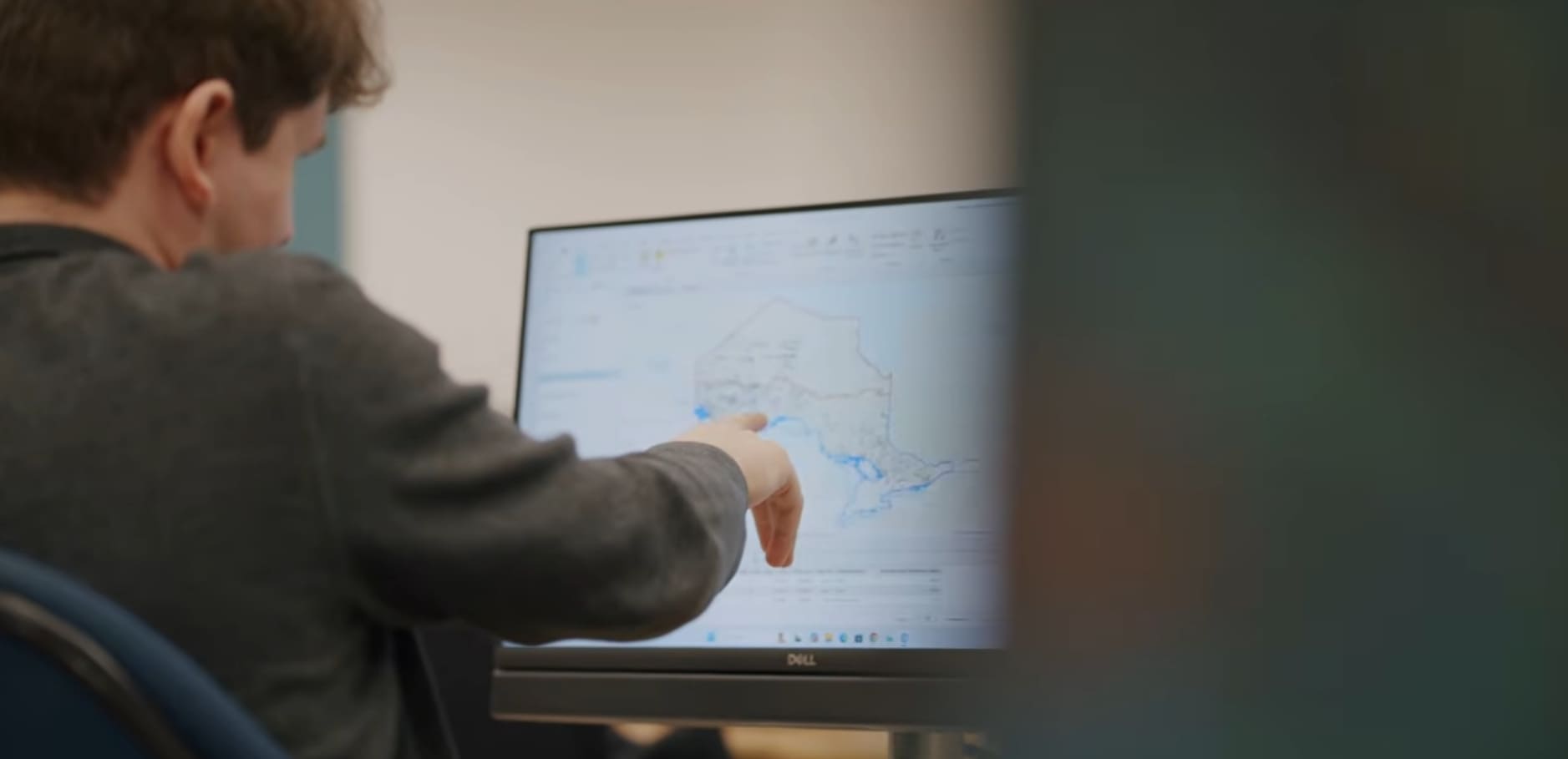
- Explore a range of disciplines including ecological conservation, project management, environmental policy, reporting contaminant control, GIS, and environmental map design.
- Field experiences throughout the program give you integrative skills that employers of this expanding field are looking for.
- Courses include hydrology, environmental modelling and environmental policies.
Program Availability and Schedule
Availability
Open
Closed
Waitlisted
Start Term
Availability
International
Availability
Competitive?
Fall 2026
No
Spring 2027
No
Fall 2027
No
Schedule
Program Summary
Credential
Program Delivery
Program Code
Area of Interest
School
Campus
Work Integrated Learning
Eligible for Post-Graduation
Work Permit?
CIP Code(s): 03.0201
This one-year Environmental Management and Assessment Ontario College Graduate Certificate program provides students with a comprehensive understanding of environmental sciences through hands-on experiences and personalized learning activities. Graduates acquire advanced knowledge and skills, making them highly competitive in the environmental sector....(read more)
Overview
Join those at the forefront of environmental management practice.
This one-year Environmental Management and Assessment Ontario College Graduate Certificate program provides students with a comprehensive understanding of environmental sciences through hands-on experiences and personalized learning activities. Graduates acquire advanced knowledge and skills, making them highly competitive in the environmental sector.
Gain essential knowledge and skills by studying a range of disciplines throughout this program, including:
- environmental site assessment
- regulatory compliance
- designated substance surveys
- climate change assessment
- waste management
- water quality management
- air, soil, and quality assessment
- sampling and analytical work
- policy analysis, development, and planning
- environmental health and safety
- natural resources planning and management
- environmental research, data analysis, and technology
- environmental health and safety compliance
- environmental business and management
Field experiences throughout the program give you integrative skills that employers in this expanding field are looking for.
Over two terms (eight months), you develop transferrable knowledge and skills in hydrology, field techniques, sample processing and analysis, biodiversity and conservation, environmental modelling, environmental auditing and assessment, Geographic Information Systems (GIS), scientific communication for public policy, and environmental policy analysis and implementation. Your skill-set enables you to assess human impacts on the environment, develop and enforce regulations, complete environmental site assessments, conduct research, and effectively implement strategies to address environmental challenges.
Students also have the option to gain real-world experience through a paid co-operative education (co-op) work term (see Additional Information for more details). Please note that places in the co-op work term are subject to availability and academic eligibility. Please note admission to the co-op program does not guarantee a co-op placement.
Graduates are well-equipped for various roles in government, for profit and not-for-profit organizations, and consulting agencies, focusing on areas such as environmental compliance, sustainable development, conservation, or corporate environmental responsibility.
Courses
Programs at Algonquin College are delivered using a variety of instruction modes. Courses may be offered in the classroom or lab, entirely online, or in a hybrid mode which combines classroom sessions with virtual learning activities. Upon registration, each full-time student is provided an Algonquin email account which is used to communicate important information about program or course events.
Code:
ENV4010
Course Name:
Environmental Legislation
Course Description:
In the environmental sector, practitioners apply policy, law, and regulations to design and evaluate actions for environmental protection. S... + Read More
Hours:
42.0
Code:
ENV4013
Course Name:
Waste Management
Course Description:
Comprehensive waste management systems are designed to minimize waste and to enhance reuse, and recycling opportunities in support of social... + Read More
Hours:
42.0
Code:
ENV4016
Course Name:
Field Techniques and Sample Acquisition
Course Description:
Environmental professionals require a variety of hands-on, practical skills in order to succeed in this diverse and dynamic sector. Students... + Read More
Hours:
56.0
Code:
GEP1001
Course Name:
Cooperative Education and Job Readiness
Course Description:
Students are guided through a series of activities that prepare them to conduct a professional job search and succeed in the workplace. Thro... + Read More
Hours:
21.0
Code:
GIS4010
Course Name:
GIS and Spatial Data Foundations
Course Description:
Knowledge of projections and geographic coordinate systems is essential for environmental professionals. Students learn the fundamentals of ... + Read More
Hours:
42.0
Code:
SCI4000
Course Name:
Sample Processing and Analysis
Course Description:
Environmental professionals should be able to follow a project from idea through the sampling, analysis and reporting stages. Students use i... + Read More
Hours:
42.0
Code:
SCI4001
Course Name:
Biodiversity and Conservation
Course Description:
Understanding the importance of biodiversity and the impacts of human-induced changes like urbanization and industrial growth on the functio... + Read More
Hours:
42.0
Code:
SCI4003
Course Name:
Scientific Communication for Public Policy
Course Description:
Clear, concise and effective communication is required for success in this industry. Students explore and apply industry-specific technical ... + Read More
Hours:
42.0
Code:
ENV4008
Course Name:
Environmental Modelling and Risk Assessment
Course Description:
Understanding the underlying assumptions of environmental models, and their impact on decision-making processes is essential to determine th... + Read More
Hours:
42.0
Code:
ENV4014
Course Name:
Hazardous Materials
Course Description:
Effective hazardous waste management is crucial to preserve and protect healthy ecosystems and to support biodiversity. Students analyze the... + Read More
Hours:
42.0
Code:
ENV4015
Course Name:
Environmental Management and Assessment Applied Research Project
Course Description:
Environmental assessment and management professionals work with organizations to create strategies to protect the environment and human heal... + Read More
Hours:
56.0
Code:
ENV4017
Course Name:
Environmental Auditing and Site Assessment
Course Description:
Students acquire the tools to perform high-level environmental audits and site assessments. Students gain an in-depth understanding of Ontar... + Read More
Hours:
42.0
Code:
GEP2001
Course Name:
Co-Op Job Search 1
Course Description:
Students are guided through a self-directed co-op job search using Algonquin's web-based resource centre, HireAC, as well as independent res... + Read More
Hours:
10.0
Code:
GIS4011
Course Name:
Environmental Map Design
Course Description:
Students develop skills in environmental map design through laboratory assignments. Students explore the relationship between common statist... + Read More
Hours:
42.0
Code:
SCI4002
Course Name:
Sustainable Hydrology
Course Description:
Students apply scientific knowledge and mathematical principles to solve water-related problems in society. Students acquire a better unders... + Read More
Hours:
42.0
Code:
WKT1517X
Course Name:
Environmental Management and Assessment Work Term
Course Description:
Students gain valuable on-the-job experience. This Cooperative Education work-term develops further technical expertise for students.... + Read More
Hours:
0.0
Careers & Pathways
Careers
Graduates may find employment as:
- Assistant Resource Management Technician
- Environment and Social Governance Compliance Assistant
- Environmental Assistant/Scientist
- Environmental Consultant
- Environmental Field Technician
- Environmental Management Assessment Assistant
- Environmental Technician/Technologist
- Environmental/Health Safety Technician
- Geoscience Assessment Officer
- GIS Assistant/Technician/Analyst
- Hazardous Materials Assessor
- Junior Geotechnical Field Technician
- Lab Technician
- Materials Testing Facility Technician
- Quality Assurance Engineering Assistant
- Research Assistant
- Site/Field Project Coordinator
- Survey technician
- Sustainability Project Assistant/Manager
- Water Analysis/Treatment Technician
- Water Resources Technician
Pathways
Please use our Pathways tool to search for pathway options.
Learning Outcomes
The graduate has reliably demonstrated the ability to:
- Prepare and present technical reports in a scientific format, including figures, tables and interpretation of results.
- Design and implement sampling protocols using industry techniques to ensure appropriate statistical design.
- Analyze the various regulations that govern federal, provincial and municipal legislation as they apply to project specific requirements.
- Collect and analyze field samples using appropriate air, water and soil quality testing equipment.
- Apply modeling technology to simulate and predict environmental damage in a variety of situations.
- Create strategies for waste minimization and/or remediation in the industrial, commercial, institutional and residential sectors.
- Investigate the effects of various environmental contaminants on plant, animal and human health.
- Develop plans to mitigate the environmental impact of current industrial processes.
- Explain and analyze the ecological role of biodiversity and conservation.
- Identify and apply discipline-specific practices that contribute to the local and global community through social responsibility, economic commitment and environmental stewardship.
Tuition & Fees
Get an idea of how much each semester will cost with our Tuition and Fee Estimator.
Textbook and course material costs are available on the Algonquin College bookstore website.
2026/2027 Academic Year
Tuition and related ancillary fees for this program can be viewed by using the Tuition and Fees Estimator tool at www.algonquincollege.com/fee-estimator
Further information on fees can be found by visiting the Registrar's Office website at www.algonquincollege.com/ro
Fees are subject to change.
Additional program related expenses include:
- Books cost approximately $400 per year.
- Students will need to purchase one full-length lab coat, one pair of CSA-approved safety glasses, and rent a locker to keep all their personal items during the laboratories. Students will also be required to work in the field in the summer and/or fall seasons, and should have denim pants or coveralls, long sleeves, CSA-approved steel toe boots, puncture-resistant work gloves, CSA-approved hardhat, eye protection, and a high visibility vest. The estimated cost of this equipment for the program is $500.
- Students need to bring their own computer (Bring Your Own Device BYOD) with an integrated video camera (or external video camera), microphone and speaker system for the program.
Admissions Requirements
Program Eligibility
- Ontario College Diploma, Ontario College Advanced Diploma, Degree or equivalent in areas of science, applied science, engineering.
- An arts degree in environmental studies will also be considered.
- Applicants with international transcripts must provide proof of the subject specific requirements noted above and may be required to provide proof of language proficiency. Domestic applicants with international transcripts must be evaluated through the International Credential Assessment Service of Canada (ICAS) or World Education Services (WES).
- IELTS-International English Language Testing Service (Academic) Overall band of 6.5 with a minimum of 6.0 in each band; OR TOEFL Internet-based (iBT) tests taken prior to January 21, 2026 overall 88, with a minimum in each component: Reading 22; Listening 22; Speaking 22; Writing 22; OR TOEFL Internet-based (iBT) tests taken after January 21, 2026 overall 4.5, with a minimum in each component: Reading 4.5; Listening 4.5; Speaking 4.5; Writing 4.5; OR Duolingo English Test (DET) Overall 120, minimum of 120 in Literacy and no score below 105.
Application Information
ENVIRONMENTAL MANAGEMENT AND ASSESSMENT
Program Code 1517X03FWO
Applications to full-time day programs must be submitted with official transcripts showing completion of the academic admission requirements through:
ontariocolleges.ca
60 Corporate Court
Guelph, Ontario N1G 5J3
1-888-892-2228
Applications are available online at www.ontariocolleges.ca.
Applications received by February 1 will be given equal consideration. Applications received after February 1 will be processed on a first-come, first-served basis as long as places are available.
International applicants please visit this link for application
process information: https://algonquincollege.my.site.com/myac360/s/
For further information on the admissions process, please visit:
Admissions - Registrar's Office https://algonquincollege.com/ro/admissions/
Additional Information
Program Resources
The program at Algonquin College's Ottawa campus achieved full accreditation from Canadian Environmental Accreditation Commission (CEAC) since September 2024, for a seven-year term.
This prestigious recognition underscores the program's commitment to delivering excellence in environmental education.
CO-OP INFORMATION
All applicants apply to the co-op version of the program through OntarioColleges.ca or our International Application Portal. After admission, students who do not wish to pursue the co-op option may opt out before the first scheduled co-op work term.
Co-operative education (Co-op) provides students with the opportunity to integrate classroom learning with real-world experience through paid, program-related work terms. Two academic terms before their first co-op work term, students must actively participate in and complete a self-directed co-op preparation course, including required readiness activities and workshops.
Students are responsible for conducting a guided, self-directed job search and securing approved, paid co-op employment related to their program of study. Co-op students compete for positions alongside students from Algonquin College and other Canadian and international colleges and universities. While Algonquin College's Co-op Career Centre supports students by developing co-op opportunities and providing guidance throughout the process, employment is not guaranteed.
Co-op work opportunities may require students to relocate. All costs associated with participation-including travel, accommodation, work permits, visa applications, and other related expenses-are the responsibility of the student.
Co-op work terms are typically 14 weeks in duration and are completed during academic terms when students are not enrolled in classes. For details about the number and timing of co-op work terms in your program, please refer to the Courses tab on your program's webpage.
International students are responsible for ensuring they meet all co-op work permit requirements before participating in a co-op work term. Additional information is available at: www.algonquincollege.com/international/student-handouts
For more information about co-op programs, expectations, and general and program-specific co-op eligibility criteria, visit: www.algonquincollege.com/coop-career-centre