Uncategorized

Learn about colonization with interactive Indigenous timeline

Kerry Potts wants people to learn about colonization. Formerly a professor atLogo for colonization road indigenous interactive timeline Humber College, Potts began co-creating an interactive timeline in 2022 to help fellow teachers share the ongoing history of colonialism in Ontario, Indigenous resistance efforts and other topics relating to governance and Indigenous knowledge.

Upon moving back to Ottawa and beginning her work as a professor and Indigenous Pedagogy and Curriculum Consultant at Algonquin College, Potts continued working on this project with a small team that included professors from Humber, filmmaker Michelle St. John and Indigenous designer Katie Wilhelm. The team created an interactive and comprehensive tool to complement courses and programs taught at Ontario post-secondary institutions Colonization Road Ontario: A Timeline is now available for free to educators in Ontario. Continue reading

Algonquin College marks National Indigenous Peoples Day

With summer strawberries, bannock treats and Indigenous coffee inAlgonquin College Board of Governors member Audrey Lawrence facilitates a discussion asking participants abundance, employees came together to mark National Indigenous Peoples Day through learning, conversation and knowledge sharing.

Algonquin College President and CEO, Claude Brulé, welcomed everyone to Algonquin College’s Indigenous Learning Commons (Nawapon) to celebrate the day. Continue reading

National Indigenous Peoples Day at the Pembroke Campus

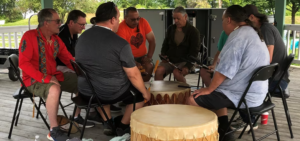
The Pembroke Campus celebrated National Indigenous Peoples Day with adrummers sit in a circle at Pembroke campus marking National Indigenous People's Day special ceremony on June 21. The ceremony included Indigenous teachings about the importance of feasting a drum by an Elder who spoke about need for the “drum to never eat alone,” and the importance of the drum in Indigenous culture. The feast includes wild rice and fresh berries that were shared with College employees who attended the special ceremony.

The ceremony was also built into a full day of activities held by the city of Pembroke at its waterfront park, next door to the Pembroke Campus. Employees were able to participate in the ceremony through dancing as the drummers played special songs including a “food song” as part of the drum feast. The employees also brought gifts for the drums, items that could be given to people in need in our community such as colouring books for children.

College welcomes two Indigenous Pedagogy and curriculum consultants

While most folks were able to enjoy a bit of a slower pace this summer, new employees Shelia GranthamShelia Grantham (left) and Kerry Potts (right) headshots on a dark green background and Kerry Potts started their new roles at Algonquin College and hit the ground running, quickly becoming part of the College community, hosting events and being interviewed by local media.

Grantham and Potts are Indigenous Pedagogy and Curriculum Consultants, new roles created within Learning and Teaching Services (LTS). The goal of LTS aims to foster a culture of teaching innovation and excellence at Algonquin College and build relationships with faculty, academic schools and Applied Research that support strategic collaboration, pedagogical and technological exploration, and ideas sharing. With these new roles, LTS will further advance the TRC’s Calls to Action relating to Indigenous education.
Continue reading

Blanket exercise in Pembroke highlights loss of Indigenous land and life

On the National Day of Truth and Reconciliation, participants at Algonquin College in Pembroke took part in the KAIROS blanket exercise.

It’s an immersive, interactive experience that educates participants on the history and culture of Indigenous people in Canada, as well as the loss of their land and life.

“It takes you through the entire Indigenous history in a couple of hours,” says Aimee Bailey, a spokesperson at the Circle of Turtle Lodge in Pembroke, who helped lead the blanket exercise Friday.

Continue reading

How an Indigenous tourism training program allowed Paula Naponse and her family tell their story through coffee beans and beads

Paula Naponse never thought she would own her own store, a lifelong dream she had since she was eight years old.

For a decade, Naponse’s business selling fashion, beadwork and artisanal goods like candles was an ad hoc affair. She had a name, Ondarez — a name inspired by a similar phrase she would see often on Facebook (it was 2008, peak Facebook) posts from her home community: “I’m on the rez.”

But a storefront seemed out of reach. Naponse sold her wares at cultural gatherings and by mail order. But thanks to a tourism training program and a push from her eldest daughter, Naponse’s business expanded to her childhood dream of a storefront and café.

“I have a sign now! I never ever thought that it could happen to me,” Naponse told Canada’s National Observer.

The Beandigen Café, a coffee-pun play on the Anishnaabemowin word biindigen, or welcome, opened in November 2021 and serves as a storefront for Indigenous artisans and a community space for beading circles, Indigenous open mic nights, and NDN taco pop-ups.

Continue reading

Animals spotted on campus

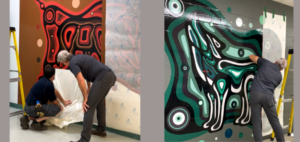
Those visiting the Four Corners, B, C, or D Buildings may soon discover Bear, Wolf, Blue Jay, Moose or Deer.

The vibrantly coloured murals were installed this week as part of an Indigenous pathways wayfinding project. These are the work of Miskomin Twenish, a local self-taught Algonquin artist from the Kitigan Zibi community, and 2018 Algonquin College graduate.

The murals are part of a larger wayfinding project. Names were provided by the Indigenous Education Council in order of cultural significance and each pathway was assigned a colour for wayfinding and signage accents. Signage has been created by Algonquin’s Marketing team, using inspiration from the current wayfinding system, DARE district aesthetics and existing Indigenous themes on campus.

More information about is available at https://www.algonquincollege.com/tri/indigenous-pathways/

Algonquin College kicks off National Indigenous History Month with garden event

With a good mind and several green thumbs, Algonquin College President and CEO Claude Brulé and Vice President of Truth, Reconciliation and Indigenization Ron McLester marked the start of National Indigenous History Month with an event this morning in the College’s Three Sisters Garden.
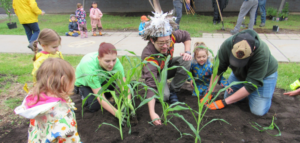
Joined by students from the horticulture program and eager young visitors from the Early Learning Centre, McLester told the story of the Three Sisters; the significance of the crops of corn, bean and squash and how they feed and sustain the community. Students big and small joined in the planting after a ceremonial song, where everyone in attendance participated in the call and response.

The beds in the garden were prepared by the horticulture students, who planted today and will tend to the crops, adding additional plants over the coming weeks. They will weed and maintain the garden until fall when the crops will be harvested.

About the Three Sisters Garden

2019 saw the creation of a Three Sisters Garden of corn, beans and squash. The Sisters symbolize peace, friendship and respect. This traditional Haudenosaunee style community garden project quickly took on a life of its own. 

The Three Sisters Garden is an extension of the large Indigenous garden planted in the DARE District’s Ishkodewan courtyard. That ongoing project will see more than 100 species of flowers, shrubs and trees planted — from black-eyed susan and chokecherry to rosy sedge and yellow wood poppy. All of the plants are native to southern Ontario and many of them have cultural, ceremonial, or even medicinal significance for some Indigenous Peoples.

Algonquin College wins two silver CICan Awards

TRI recognized for outstanding leadership and innovation with national Awards of Excellence

On Tuesday, April 26, Algonquin College was awarded two silver designations at the CICan annual Awards of Excellence.

The Awards showcase the extraordinary contribution of individuals to their college/institute communities and highlight the role of our institutions in social, cultural and economic development. There are three levels of recognition: Gold, Silver and Bronze.

The College received a silver award in two categories; the Indigenous Education Excellence Award and the Excellence in Equity, Diversity and Inclusion Award (You can read the award entry covering letter submissions from Algonquin President and CEO Claude Brulé at the two highlighted links above).

“It is because of dedicated people working hard every day, to improve educational programs and campus life, that colleges and institutes are able to offer such remarkable student-experiences and training opportunities,” said Denise Amyot, CICan President and CEO. “This strong leadership was on full display this year, as COVID-19 forced all of us to adapt and innovate to meet unprecedented challenges. We are thrilled to honour these leaders and innovators who make the entire system stronger, more inclusive, and more responsive to the needs of students as well as employers.”

Congratulations to all for a job well done.

Review the full list of award winners.