Paramedicine Research Lab Shares Insights at the 2026 CIPSRT Conference
Posted on Tuesday, May 12th, 2026
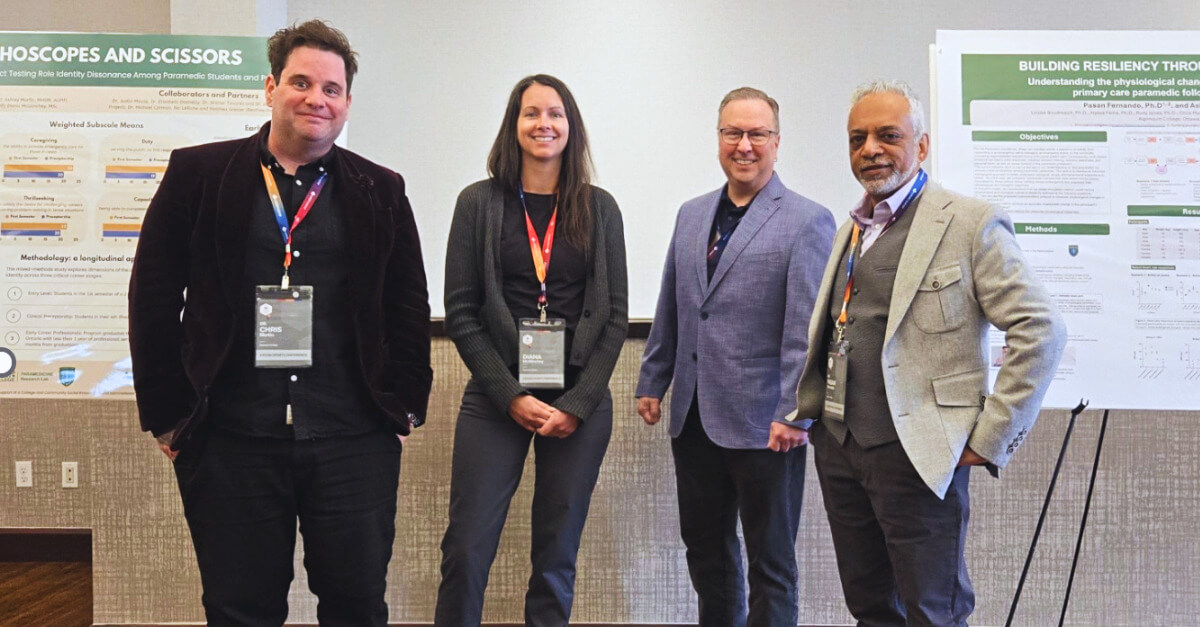
On May 5-6, 2026, the 2026 Canadian Institute for Health Research and Treatment (CIPSRT) Conference brought together industry and community leaders in the public safety community from across Canada to share ideas and strengthen support for mental health and wellness. Algonquin College took part by presenting two applied research projects from the Paramedicine Research Lab in collaboration with the Victimology Research Centre.
The AC Applied Research team connected with researchers, frontline professionals, and industry partners who are working to improve the well-being of public safety personnel. The event showed how applied research can support real change in the field.
Projects
Stethoscopes and Scissors: Understanding Role Identity in New Paramedics
This poster presentation presented some preliminary data and results of a longitudinal research project studying role identity development of new paramedics moving from learner to early career professionals. It explores new paramedic learners during their first semester, those at the end of their program who have completed clinical preceptorship, and those who are new professionals with less than 15 months as a working paramedic. This research is funded by a College and Community Social Innovation Fund, which is administered through the Canadian Institutes for Health Research.
Resiliency Through Stress Inoculation: Building Skills for High‑Pressure Situations
This project strives to understand how the physiological changes associated with stress in the primary care paramedic following scenario training. This research project uses a combination of Hexoskin Smart Shirts (Hexoskin Smart Shirts – Cardiac, Respiratory, Sleep & Activity Metrics) and stress markers in saliva to determine how stress inoculation training helps learners learn to cope with stress. The ability for paramedic learners to modulate their own stress response while responding to emergency situations is key to their success. This work was completed in a new Immersive Lab that brings a level of realism that simulates real-world responses.
Why This Matters for Industry Partners
Both projects highlight the value of applied research in shaping the future of paramedicine and public safety. They also show how collaboration with colleges can support innovation, training, and workforce readiness.
Industry partners who want to explore applied research opportunities with the Paramedicine Research Lab and/or the Victimology Research Centre can connect with the Office of Applied Research to start a project here.
Acknowledgements
Thank you to:
- Ashley Murfin, MHSM, ACP(f), Paramedic Program Coordinator/Professor, Police and Public Safety Institute and Principal Investigator, Paramedicine Research Lab
- Dr. Chris Martin, Professor of Social Sciences, Police and Public Safety Institute and Principal Investigator, Paramedicine Research Lab
- Diana McGlinchey, MSc, Principal Investigator, Victimology Research Centre
- Dr. Pasan Fernando, Professor, Allied Health