algonquin college

Polytechnics Canada Showcase: Democratizing AI with Algonquin College

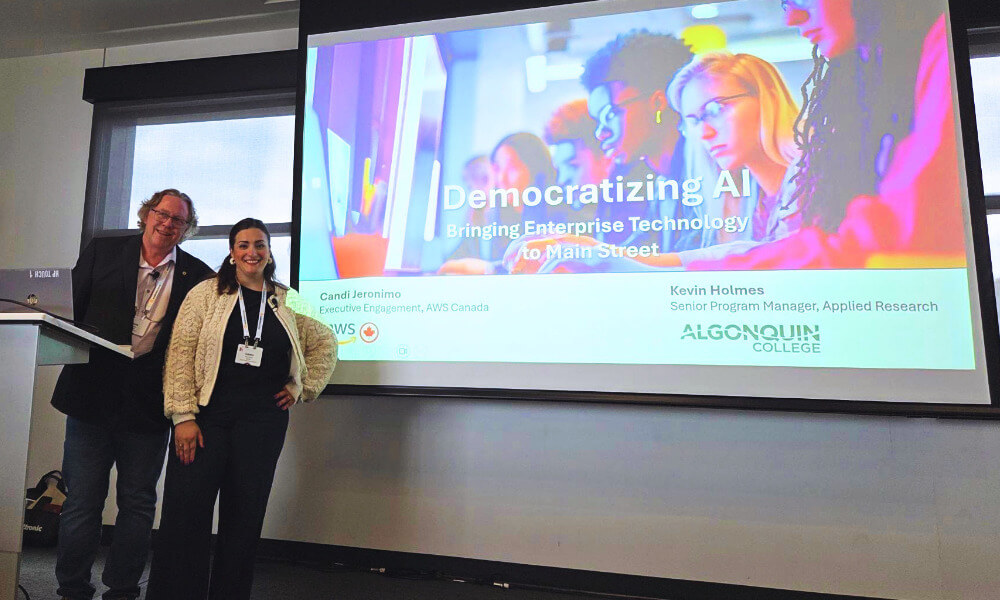
Two presenters stand at the front of a conference room beside a large screen displaying a slide titled “Democratizing AI: Bringing Enterprise Technology to Main Street.” The slide lists Candi Jeronimo of AWS Canada and Kevin Holmes of Algonquin College, with a background image of people working at computers. The room is set up for a professional talk.

Kevin Holmes, Senior Program Manager, Applied Research and Candi Jeronimo, Executive Engagement, Amazon Web Services Canada.

On May 13, Kevin Holmes, Senior Program Manager, Applied Research, and Candi Jeronimo, Executive Engagement, Amazon Web Services Canada, led a discussion at the Polytechnics Canada Showcase on democratizing AI and making enterprise technology accessible to main street business and social sector organizations.

The presentation focused on how small businesses and community organizations have the most to gain from AI, but often lack the time, resources, and technical expertise to adopt it. Without that support, many organizations miss opportunities to improve services, strengthen operations, and stay competitive in a rapidly changing digital landscape.

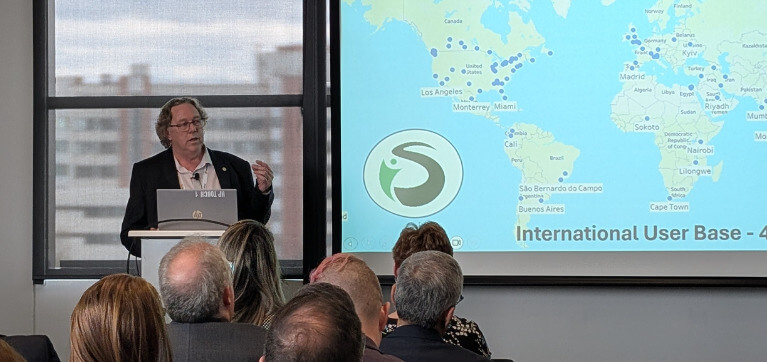
Kevin Holmes presenting at Polytechnics Canada Showcase.

Kevin Holmes presenting at Polytechnics Canada Showcase.

Holmes highlighted how Algonquin College’s AI Accelerator Hub, powered by AWS Canada, is working to close the gap by offering an AI-enabled platform to support the AI adoption journey. The Virtual Intelligence Business Enabler, aka VIBE, was introduced as a student-developed AI platform designed to help small organizations understand AI adoption opportunities that fit their specific needs.

“Colleges and Polytechnics are particularly well suited to help support adoption of AI in Canadian small business and social sector organizations across the country,” said Holmes, who leads the Algonquin College initiative with AWS Canada. “We have deep ties in our respective communities, and the amazing emerging talent in our students”.

Together, Holmes and Jeronimo demonstrated how applied research, student innovation, and industry supporters like AWS Canada are making AI more approachable for organizations.

To learn more about the Algonquin College AI Accelerator Hub, visit: https://www.algonquincollege.com/applied-research/ai-accelerator-hub

Paramedicine Research Lab Shares Insights at the 2026 CIPSRT Conference

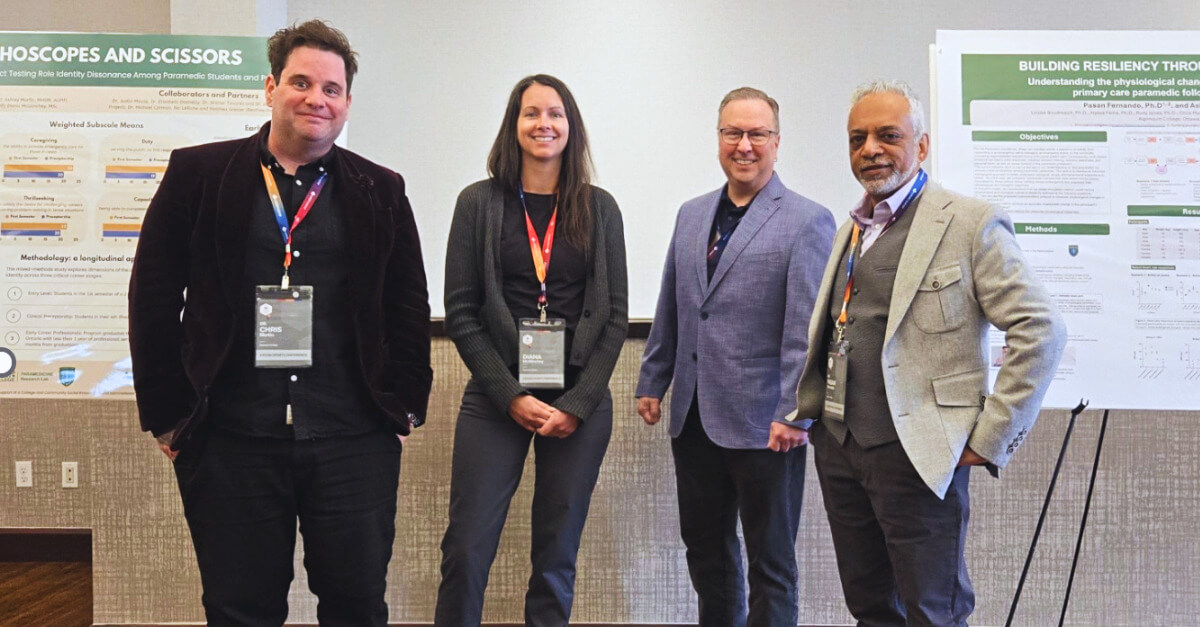
Four people stand indoors in front of two research posters displayed on easels at a conference. All smiling at the camera. The posters behind them show charts, graphs, and text related to Paramedicine Research Lab

On May 5-6, 2026, the 2026 Canadian Institute for Health Research and Treatment (CIPSRT) Conference brought together industry and community leaders in the public safety community from across Canada to share ideas and strengthen support for mental health and wellness. Algonquin College took part by presenting two applied research projects from the Paramedicine Research Lab in collaboration with the Victimology Research Centre.

The AC Applied Research team connected with researchers, frontline professionals, and industry partners who are working to improve the well-being of public safety personnel. The event showed how applied research can support real change in the field.

Projects

Stethoscopes and Scissors: Understanding Role Identity in New Paramedics

This poster presentation presented some preliminary data and results of a longitudinal research project studying role identity development of new paramedics moving from learner to early career professionals. It explores new paramedic learners during their first semester, those at the end of their program who have completed clinical preceptorship, and those who are new professionals with less than 15 months as a working paramedic. This research is funded by a College and Community Social Innovation Fund, which is administered through the Canadian Institutes for Health Research.

Resiliency Through Stress Inoculation: Building Skills for High‑Pressure Situations

This project strives to understand how the physiological changes associated with stress in the primary care paramedic following scenario training. This research project uses a combination of Hexoskin Smart Shirts (Hexoskin Smart Shirts – Cardiac, Respiratory, Sleep & Activity Metrics) and stress markers in saliva to determine how stress inoculation training helps learners learn to cope with stress. The ability for paramedic learners to modulate their own stress response while responding to emergency situations is key to their success. This work was completed in a new Immersive Lab that brings a level of realism that simulates real-world responses.

Why This Matters for Industry Partners

Both projects highlight the value of applied research in shaping the future of paramedicine and public safety. They also show how collaboration with colleges can support innovation, training, and workforce readiness.

Industry partners who want to explore applied research opportunities with the Paramedicine Research Lab and/or the Victimology Research Centre can connect with the Office of Applied Research to start a project here.


Acknowledgements

Thank you to:

  • Ashley Murfin, MHSM, ACP(f), Paramedic Program Coordinator/Professor, Police and Public Safety Institute and Principal Investigator, Paramedicine Research Lab
  • Dr. Chris Martin, Professor of Social Sciences, Police and Public Safety Institute and Principal Investigator, Paramedicine Research Lab
  • Diana McGlinchey, MSc, Principal Investigator, Victimology Research Centre
  • Dr. Pasan Fernando, Professor, Allied Health

HUBBUB 2026 Showcases Student Innovation and Community Collaboration

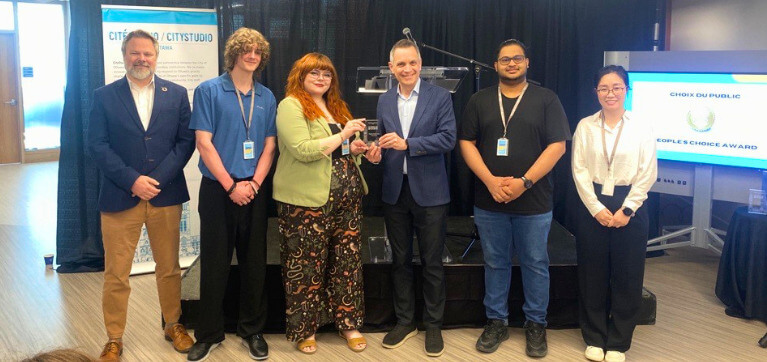
Student winners of HUBBUB 2026 with the Mayor of Ottawa

Every academic year, the HUBBUB Exhibition brings together the CityStudio Ottawa partnership with the City of Ottawa, community leaders, students and faculty from the University of Ottawa, Carleton University, Algonquin College and Collège La Cité. It is a chance to see how learners turn local challenges into ideas that support a vibrant, inclusive and sustainable future for Ottawa.

On May 1, the CityStudio Ottawa community gathered to explore student work created for the City of Ottawa. Each project responded to priorities in the City’s Community Safety and Well-Being Plan and the Strategic Plan 2023 to 2026.

Algonquin College’s President and CEO, Claude Brulé, Dr. Ian Zinck, Director of Applied Research, and Mary Grammatikakis, Director of Experiential Learning & Entrepreneurship, were in attendance, joining students, faculty, staff and community partners in celebrating the impact of this work. Their presence highlighted the importance of collaboration and the role Applied Research plays in strengthening our city.
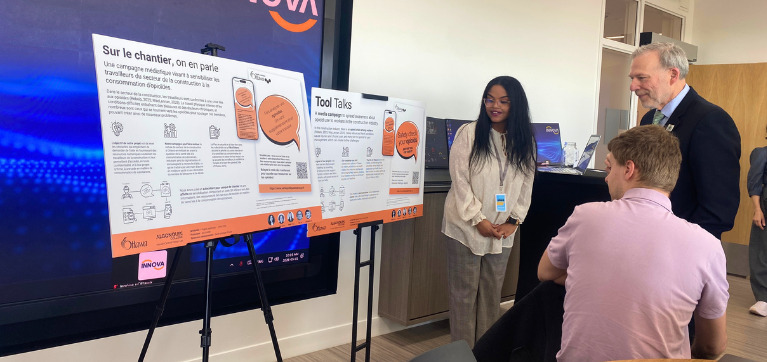
HUBBUB Project

Algonquin College’s newly appointed Director of Applied Research, Dr. Ian Zinck, reflected on the event, noting, “What stood out at HUBBUB is how quickly collaboration can move from concept to impact. It reinforces that Applied Research isn’t just about generating ideas. It’s about connecting talent, partners, and real problems to deliver solutions that matter to our communities.”
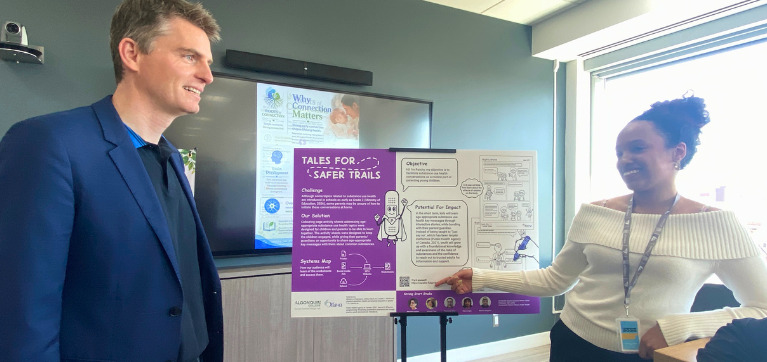
HUBBUB Project

After the showcase, attendees gathered for the awards ceremony, recognizing teams whose work stood out for creativity, clarity and community impact.

Algonquin College’s Raising the Bar project earned the People’s Choice Award, presented by Mark Sutcliffe. Visitors cast their votes by placing marbles in jars at each exhibit while touring the HUBBUB showcase, making this recognition a true reflection of community engagement.

Raising the Bar tackles a familiar challenge with a creative lens: how to make public health messaging more engaging in social settings such as bars and restaurants. The team’s approach invites patrons to connect with Ottawa Public Health’s Party Safer resources in a way that feels natural, accessible, and low-pressure.

Their solution transforms everyday bar items, including coasters, napkins, and placemats, into subtle touchpoints for safety messaging. By incorporating playful, game-like elements, these materials encourage hydration and safer choices without disrupting the social experience. They meet people where they are and influence behaviour in a thoughtful, unobtrusive way.

Raising the Bar team member Kate Drohan shared that her biggest takeaway was that “it was eye-opening working with an actual client because you get to experience a project that benefits many people. You have to remain humble, be able to iterate, and do things you wouldn’t think to do for yourself but that truly benefit the people it’s for.”

Congratulations to AC learners Kate Drohan, Bing Bai, Hiruth Kariyawasam, Cysron Bugingo, and Evan Snider, and to their professor, Jed Looker, with the Human‑Centred Design Lab at Applied Research.
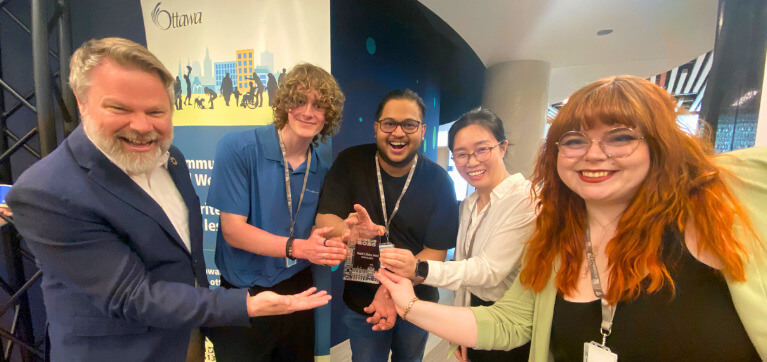
Student winners of HUBBUB 2026

This was followed by an interactive panel titled “How Does Community–Campus Engagement Enhance Our Communities? Lessons from CityStudio Ottawa and Thunder Bay.” Panellists, including Algonquin College’s Institutional Champion CityStudio Ottawa, Kevin Holmes, reflected on three years of shared learning across both cities and spoke about how community and campus partnerships can advance safety, well-being and long-term sustainability.
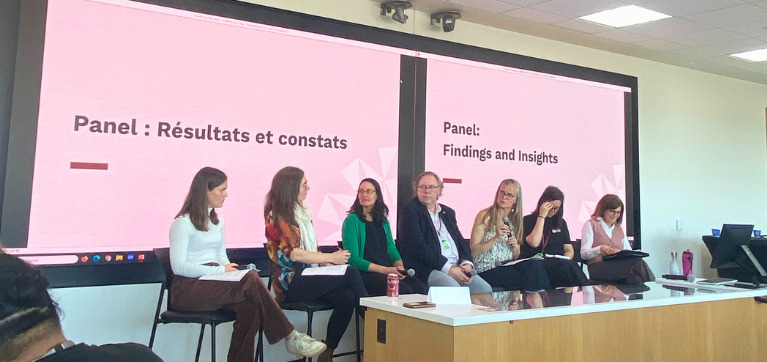
HUBBUB 2026 Panel

HUBBUB once again showed the power of bringing the community together. By connecting students with real challenges facing the City of Ottawa, the event continues to inspire new ideas and strengthen the relationship between local post‑secondary institutions and the community they serve.


Faculty, Get Involved!

Want to take part in groundbreaking projects? Discover more about the groundbreaking work achieved at CityStudio Ottawa by students and explore project opportunities to advance research opportunities in the upcoming academic year.

To learn more about CityStudio and explore collaboration opportunities, please contact Matthew Jerabek, Associate Manager, Innovation & Entrepreneurship at jerabem@algonquincollege.com.
7 years of The Social Innovation Lab

7 years of The Social Innovation Lab

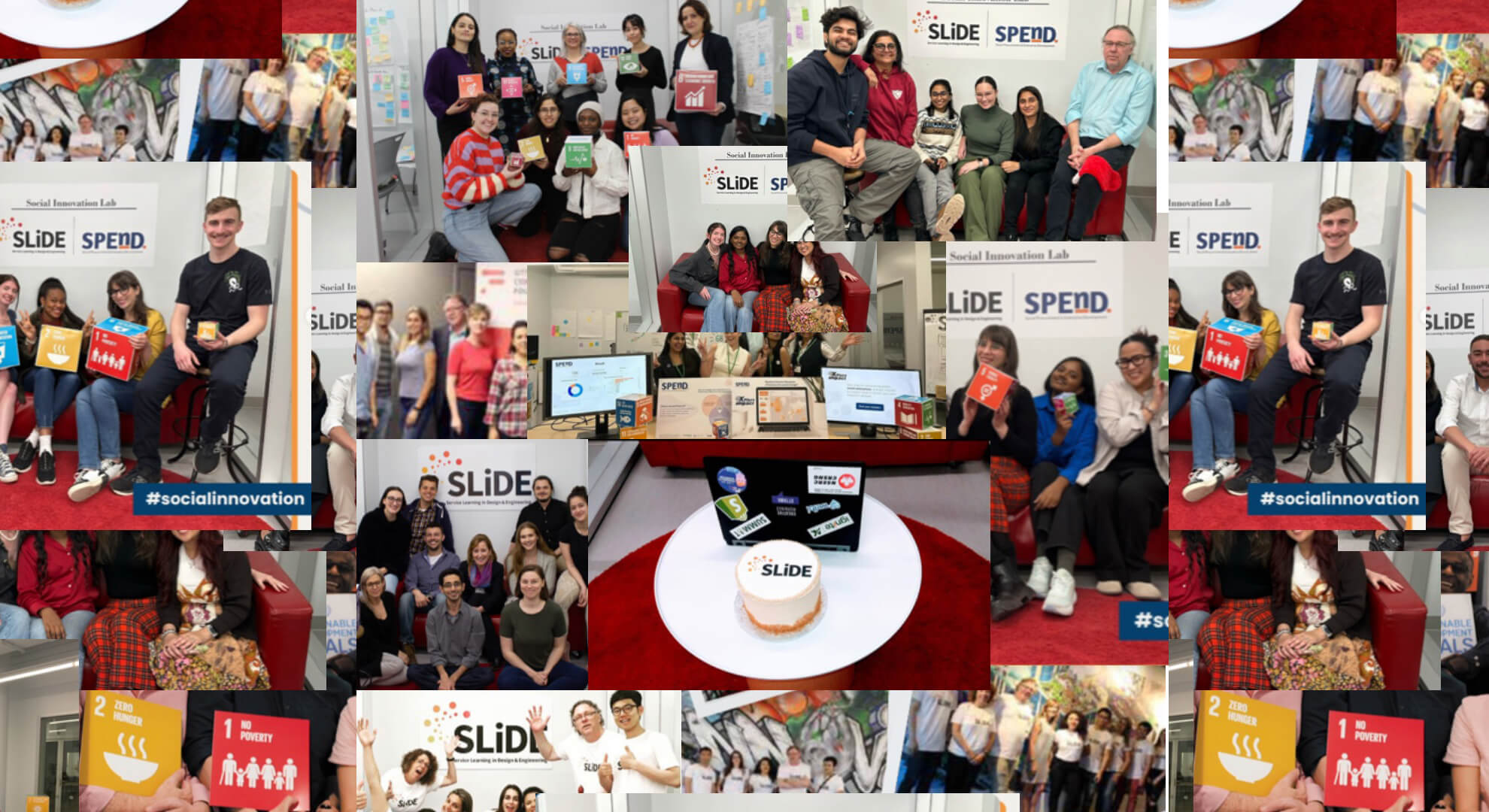
It doesn’t feel like seven years have passed. It’s as if it were just yesterday that the Social Innovation Lab became a home for student-led social innovation. Since its opening, it has evolved from a promising idea into a vital hub for social innovation in Canada’s capital.

Over the years, numerous initiatives have emerged from the Lab. Some of our projects include:

  • SLiDE: Our inaugural program, designed to harness the talents of Algonquin College students from the Schools of Media and Design and Advanced Technology, supporting community-based organizations through digital technology.
  • SPEnD: A research initiative focused on exploring the capacity of Canada’s colleges for social procurement and finance, while developing market-driven social enterprises.
  • AWS AI Accelerator Hub: A new initiative aimed at helping local businesses and community organizations adopt cloud and artificial intelligence technologies.

And many more projects have benefited the community in ways we never imagined. This success stems from a simple yet powerful idea: meaningful change happens when students are empowered to lead from the ground up. Rather than relying on top-down innovation, our Lab invites students to become genuine changemakers, working alongside mentors and dedicated community partners.

The Lab has been a home to many interns, and just as much, those interns have made the Lab a part of themselves. It’s a unique experience, one that continues to shape you even after you leave, echoing the impact every intern, mentor and partner has had on our community. At the heart of our mission is a commitment to helping this very community through student creativity and technological knowledge to create lasting social change.

None of this would have been possible without our generous community of supporters, mentors and funders who believed in our mission and walked alongside us every step of the way. As we celebrate this milestone, we eagerly anticipate the innovations still to come. The next chapter will deepen our commitment to student-led innovation, collaboration and meaningful social impact.

Thank you to everyone who has made the past seven years possible.

Interested in becoming part of our next chapter? Explore the Social Innovation Lab projects:

Visit the Social Innovation Lab homepage for more details.

Contribute to the Algonquin College Research Repository

Updated Applied Research Repository

At Algonquin College, we take pride in scholarly work, research achievements and intellectual contributions of our faculty and employees. To recognize and support these efforts, the library, in collaboration with the Applied Research Office, has established the Algonquin College Research Repository, a digital platform designed to preserve, showcase and provide access to the academic output of our community.

How to Get Started

Contributing is easy! If you’re a faculty or employee member at Algonquin College, you can submit your research and scholarly output through our simple online submission portal. Your research matters… Share it. Safeguard it. Celebrate it!

Please ensure you review the Declaration of Copyright under the Policies section before submitting.

What is the Research Repository?

The Research Repository is more than a storage space—it’s a searchable showcase of the academic, creative and research contributions of Algonquin College’s faculty and employees. Hosted online, it enables faculty and employees to share their work widely, helping to:

  • Highlight the scholarly and research achievements of faculty and employees.
  • Enhance academic visibility and discoverability.
  • Facilitate collaboration with other researchers and institutions.
  • Encourage interdisciplinary collaboration within and outside the College.

What Can Be Submitted?

A wide variety of scholarly and creative works are welcome in the repository. Submissions can include (but are not limited to):

  • Research papers and technical reports.
  • Peer-reviewed journal articles.
  • Conference papers and presentations.
  • Theses and dissertations.
  • Creative works, multimedia and project documentation.
  • Case studies.

Why Contribute?

Participating in the repository offers several key benefits:

  • Increased Discoverability: Your work becomes more visible to colleagues, students and the broader academic and professional community through search engines like Google Scholar.
  • Long-Term Preservation: Ensure your contributions are archived securely and remain accessible over time.
  • Professional Recognition: Strengthen your academic profile with a centralized, citable source of your publications.
  • Institutional Pride: Help demonstrate the breadth and depth of research and innovation happening at Algonquin College.

Questions? Contact us at library@algonquincollege.com for support or clarification.

Embracing Tradition and Reconciliation Around the Fire

Pikwakanagan First Nation Cultural Ground

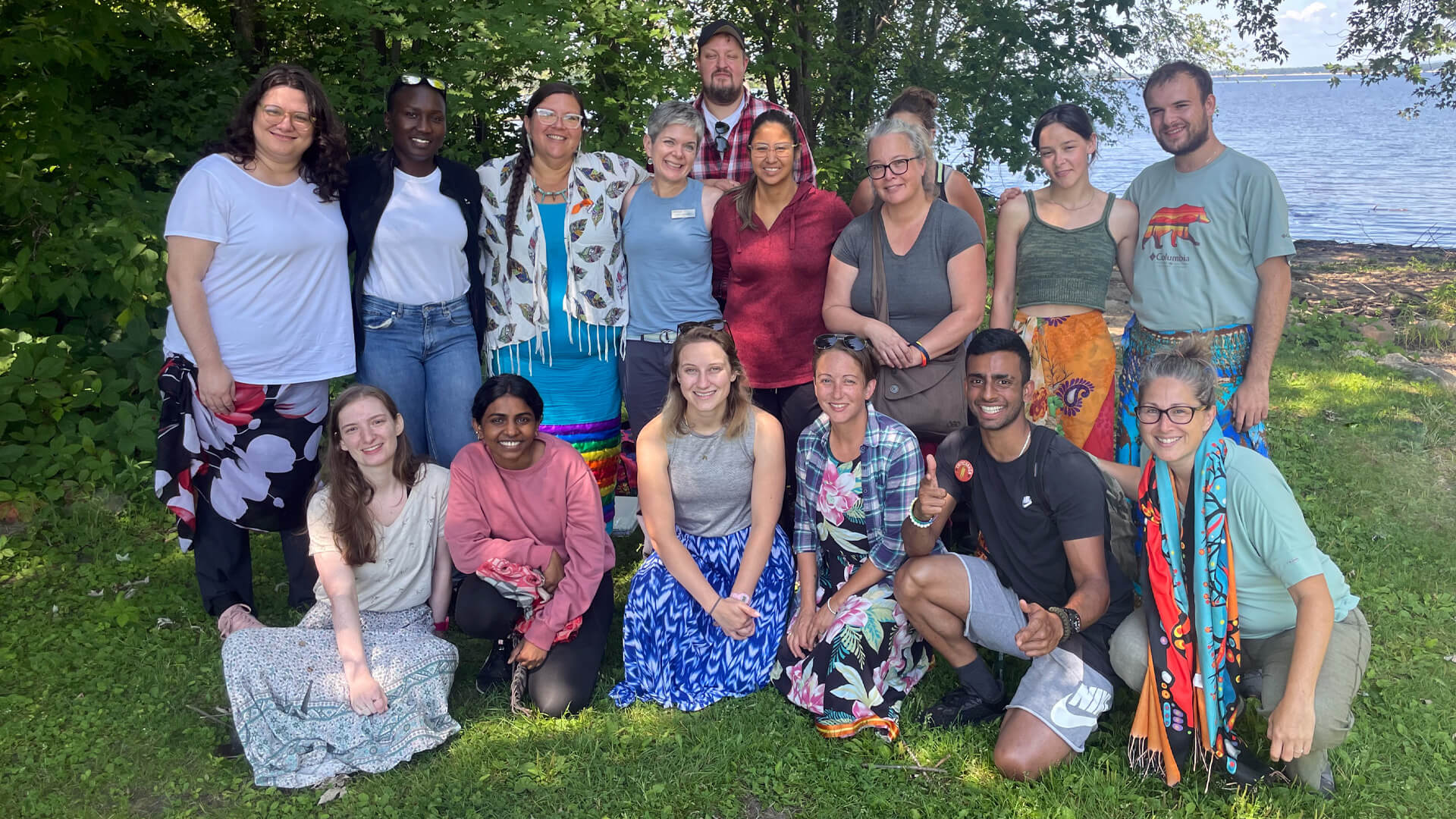
Summer is a time when many people enjoy the great outdoors. For a group of 13 incoming and current Algonquin College students, six days in late August was more than just campfires and starry nights. It was a foundational and transformative time to learn more about truth and reconciliation.

Hosted by the Pembroke Campus, the first Indigenous Cultural Camp took place from Aug. 22-27. Led by an Indigenous cultural teacher and two staff, this deeply profound experiential learning opportunity was initiated by the Applied Research office through the Government of Canada Social Sciences and Human Research Council (SSHRC) grant as part of the college’s Mamiwi Maadaadizi project.

“The Cultural Camp was a very significant and profound time for all with much learning, healing and looking forward,” said Joanne Haskin, Executive Director of Mashkiwizii Manido Foundation, a partner on this project. “The potential for continued immersed learning as we continue the journey of truth and reconciliation must be foundational and the College must continue in these ways to allow for all Indigenous students to know there is a place for them, and for partnership in the journey.”

Haskin and her team also included Elders, Knowledge Keepers and special guests, who worked with participants as they listened, reflected, engaged and thought about ways to act.

Ontario Parks provided access and usage of Foy Provincial Park which allowed for meaningful connection to the land. “This was an impactful experience that touched me spiritually and emotionally. It challenged me to move away from thinking about allyship towards acting in allyship, always with ‘nothing about us without us’ in mind. The College and broader community can expect a more concerted effort from me to move us forward in understanding the truth and pursuing acts of reconciliation. It was my honor to participate, ” said Kate Monahan, a professor at the Pembroke campus.

Activities included a visit to Pikwakanagan First Nation, a Kairos Blanket Exercise and discussions and learnings with special Elders and guests. There was also time for painting, self-reflection and journaling and experience on the land.

Areas of learning were centered around Residential Schools & Sixties Scoop, The Seven Grandfather Teachings, the clan system, self-governance, forestry management and of course, TRC Calls to Action.

Student feedback was incredibly positive. “I cannot express the depth of my gratitude for this experience, for learning about Indigenous culture and for being so changed by being on the land,” said one learner. “This was life changing for me,” said another.

Established in the spring of 2020, the Mamiwi Maadaadizi project was created to advance Indigenization efforts at Pembroke Campus through collaboration with The Circle of Turtle Lodge, Pikwakanagan First Nation and other Indigenous community members. The mandate included identifying best practices for embedding Indigenous Knowledge across Pembroke’s services and academic programming and working towards Reconciliation for all students and community members. Another goal was to examine how to better support Indigenous learner needs and develop learning interventions through a field school and Indigenous-led training.

“In 20 plus years of working in higher education, it has been a while since I have seen such a cohesive, thoughtful, kind group of people gather,” said Brenda Slomka, Algonquin College Program manager, Applied Research. “This was deeply meaningful to witness and be part of. The impact from our SSHRC grant, allowing us to focus on Indigenization within our rural campus has been so important and we are thankful. We are deeply hopeful that this will be the first of many more Cultural Camps to come.”

To read the full report about the Indigenous Culture Camp click this link.

Interactive Media Design (IMD) is now accepting Applied Research Project Applications for Winter 2022 In-Class Projects

On behalf of the Office of Applied Research, Innovation & Entrepreneurship (ARIE) at Algonquin College, I am pleased to announce this call for proposals for in-class client projects for the Winter 2022 semester.

Interested companies can apply using the application form HERE. Our onboarding practice is to screen the online applications and invite the most promising proposals to a ‘Pitchfork’ session. Candidates are asked to do a 15-minute pitch via Zoom Meetings with interactive Q&A. The review panel is comprised of ARIE project managers, facilitators, and professors from the School of Media and Design who collectively select the projects that are ‘best-fit’ for our programs.

Key dates for Winter 2022 projects:

  • The deadline for applications is Friday, December 10th
  • ‘Pitchfork’ sessions will be scheduled between December 20th – 31st for invited candidates
  • Chosen candidates will be notified by January 7th
  • Projects starting the week of January 28st
  • Projects to be completed by end of term (mid-April)

Types of projects considered:

  • Websites (New designs and re-designs)
  • User interface prototypes for web and mobile apps
  • Animated videos

If your organization is looking for any of the above, we encourage you to submit an online application. In addition to registered for-profit businesses, we will be able to support a limited number of not-for-profits and social enterprises.

Have any questions? Contact David Solomon, Professor & IMD Applied Projects Facilitator – solomod@algonquincollege.com

Algonquin College’s Social Innovation Lab is now recruiting for Winter 2022 positions

We're Hiring! SliDE - Social Innovation Lab

Want to Make our World a Better Place? Join Algonquin’s Social Innovation Lab – SLiDE is Hiring for Winter 2022 positions.

The Lab operates SLiDE (Service Learning in Design & Engineering) with a mission of “Empowering our community by sharing student creativity and technological knowledge to drive social change”. We are looking for students that demonstrate Authenticity, Integrity, Ambition, Curiosity and Humility and want to help others in our community. #slideintoimpact Open Positions: All positions are part-time (~20 hours a week) for current Algonquin College Students and paid at Ottawa’s current Living Wage ($18.60/Hour).

The target start date for Winter Interns is January 10, 2022.

Note* All positions offer flexibility to meet students’ schedules and tentatively will include both in-person (Social Innovation Lab, Woodroffe Campus) and remote work components. All positions will be subject to the College’s Mandatory COVID-19 Vaccination Policy.

To apply, email your CV and a cover letter by the deadline of December 10, 2021: SLiDE@algonquincollege.com

Details can be seen on HireAC – Job ID 70117: https://hireac.algonquincollege.com/home.htm


IBM/SLiDE Intern – Social Sector Client Projects (5 Positions)

Applicable for students with digital technology skills (design, development, mobile, integration, adoption) or communications skills (branding, marketing, social media, written word, and videography).

Please note Intern Eligibility Requirements:
  1. Proof of full-time enrollment at Algonquin College in an Arts, Humanities, Social Sciences, STEM or Business program during the internship period
  2. Proof of Canadian Citizenship/ Permanent Residency/Refugee Status, Unfortunately, due to 3rd party funder requirements, International Students are not eligible for these positions at this time.

Students who self-identify within one of the following under-represented groups are encouraged to apply: Women in STEM (Science, Technology, Engineering and Mathematics), Indigenous students, Newcomers (immigrants who immigrated within the last 5 years), students with disabilities, visible minorities and first-year students.

Victim Services and Vicarious Resilience Study Online Survey

Online Survey Victim Services and Vicarious Resilience Rethinking Well-being 2020-2023

Victimology Research Centre would like to invite you to take part in our survey to help assess the wellness and working conditions of service providers who work with victims and survivors of crime in Canada. You will be asked about your well-being, your job satisfaction, vicarious resilience, strategies for self-care, and how your organization makes you feel. Participation in the online survey will require approximately 20-30 minutes of your time. Please note that all participation in our study is voluntary and you can withdraw at any time.

To participate in our study, you must:

  • Be at least 18 years old
  • Be an employee or volunteer working with victims or survivors of crime in Canada

If you would like to know more about the study, you can click on this link for background information. To complete the survey, click on your preferred language. [English] [Français]

Who can participate?

This is for employees and volunteers who work with victims and survivors of crime in Canada. You need to be 18 or older. More than one person from an organization can take the survey.

Why am I being asked these questions?

We want to learn more about people working in services for victims and survivors of crime in Canada. We want to learn about your well-being, how you feel about your work, how you take care of yourself, how your organization affects your wellness, and any harm as well as growth you may have experienced as a service provider. We will share the results in a public report in 2023 and what we learn will be used to create training materials. We will also publish academic papers.

How will I be protected?

You will not be asked for your name. If you are quoted, we will change details that could identify you. We will not share your survey with your employer. We will not use your computer’s IP address. Actions like signing out of your accounts, closing your browser, and locking your device when not in use can help protect your safety. For information on deleting your browsing history, see http://www.computerhope.com/issues/ch000510.htm.

What if I don’t want to answer a question?

You can choose “prefer not to answer” and continue. Share only what you want to.

What if a question upsets me and I need help?

If you need support, you can access free crisis help through Wellness Together Canada: Text 741741 https://wellnesstogether.ca/en-CA.

The Hope for Wellness Help Line offers immediate help to all Indigenous Peoples across Canada. It is available 24 hours a day, 7 days a week to offer counselling or crisis support. Call the toll-free helpline at 1-855-242-3310 or connect to the online chat at www.hopeforwellness.ca. Help is available in English, French, Ojibway, Cree, or Inuktitut.

What if I have questions about the research?

You can contact Dr. Benjamin Roebuck (Research Chair) at the Victimology Research Centre by email roebucb1@algonquincollege.com or by phone (613) 727-4723 ext. 6328. If you have questions about the ethical conduct of this study, you can contact the Algonquin College Research Ethics Board by email REBAdmin@algonquincollege.com or phone: (613) 727-4723 ext. 5213.


Victim Services and Vicarious Resilience being conducted by the Victimology Research Centre at Algonquin College in partnership with the Victim Justice Network (VJN), Canadian Resource Centre for Victims of Crime (CRCVC), and a wide range of other community partners. This research is funded by the Social Sciences and Humanities Research Council (SSHRC), and designed with leaders in victim services from across Canada.

SLiDE Partners, CHEO and Eco-equitable (EE) are levelling up the mask game!

AC Student in mask

Last year, Algonquin College helped respond to the Ottawa/Canada PPE shortage assisting with efforts to create and decontaminate shields, and medical-grade mask. As part of this response two SLIDE partners, CHEO and Eco-equitable (EE) also initiated research into the design of a high performing re-usable mask for the community. After almost a year of development and testing, we would like to get the masks to the Ottawa public, with the goal of reducing COVID transmission during the third wave. To achieve this masks will be sold as part of a fundraiser for CHEO.

The masks are very comfortable, have an amazing fit and achieve > 80 % particle penetration (new) while retaining > 70% particle filtration after 50 machine washes. The mask easily meets the 50% particle filtration efficiency specification recently set by the ASTM for consumer/community masks. The vast majority of community masks only achieve 30-50% PFE.

CHEO and EE have manufactured an initial lot of 1000 masks and will be selling them through Ecoequitable’s website. They will also be available at Kardish Health Food stores.

Purchase a mask here: https://ecoequitable.ca/collections/ecoequitable-products/products/cheo-fundraiser-mask

Check out the full article in the Ottawa Citizen: https://ottawacitizen.com/news/local-news/cheo-doc-and-local-sewing-organization-help-tame-the-wild-west-of-masks