WAR – The Great Forgetting with Gwynne Dyer
Feb 19, 2026 |7:00-9:00
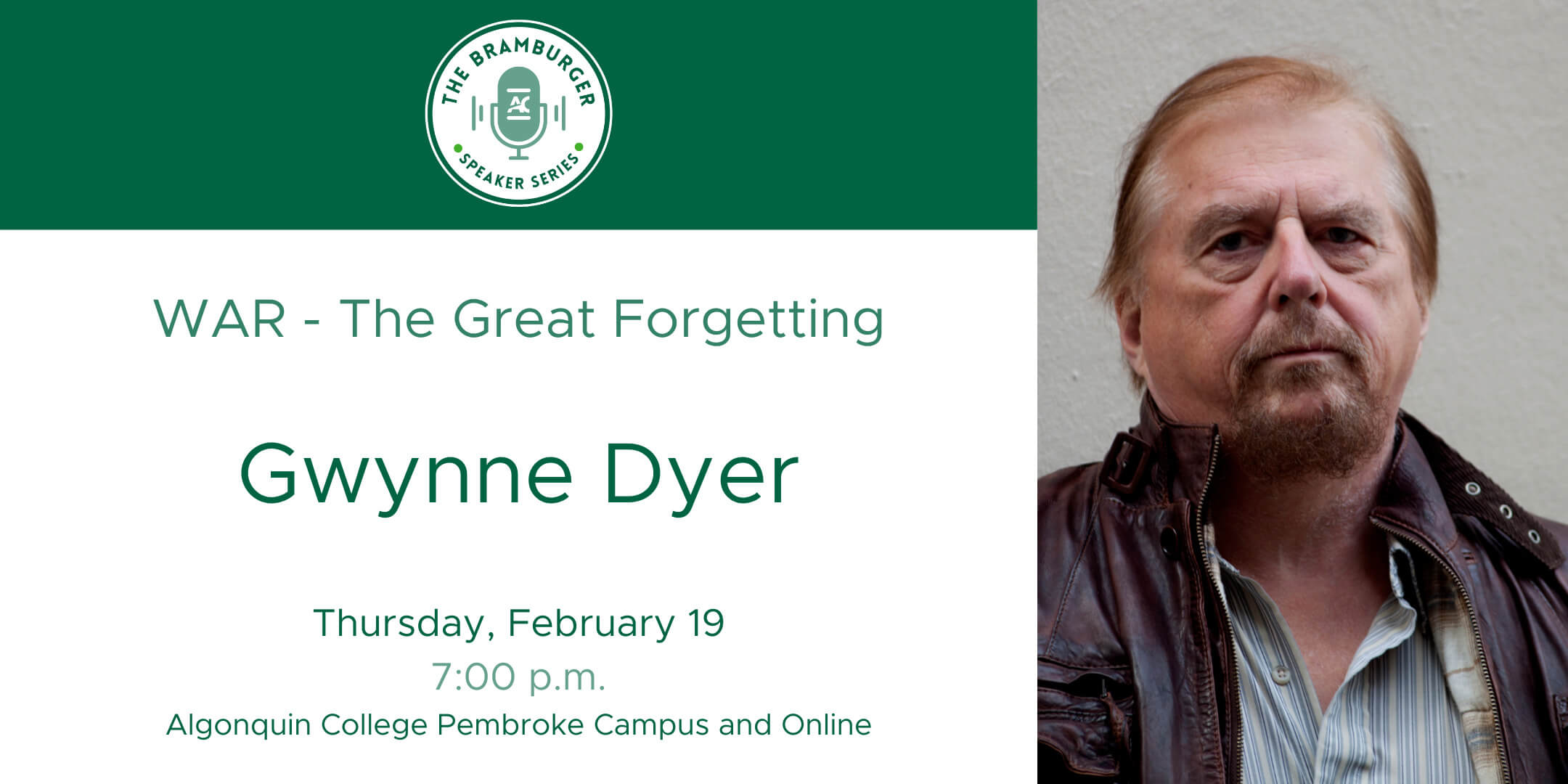

Gwynne Dyer’s WAR – The Great Forgetting
As William Faulkner said, ‘The past is never dead. It’s not even past.’
It was the Americans, after the Second World War, who led the way in creating a new international system in which aggressive war became a crime and it was illegal for even the greatest powers to change borders by force. And it worked: no great power has directly fought any other great power for the past eighty years.
Their proxies have clashed occasionally and lots of little countries have fought little wars, but no nuclear weapon has been used in war since August 1945. Few people alive then would have dared to believe we could do so well. Alas, it is also the Americans who are leading the way back towards the undead, perpetually violent, rule-free past.
From tragedy to farce – from George Bush invading Iraq to Vladimir Putin invading Ukraine to Donald Trump stumbling around in Venezuela – the old ways are coming back and the new rules are being trampled into the dirt. Whether we blame just a few foolish leaders or an entire generation that has forgotten the bitter lessons of the 20th century, we are in deep trouble now.
The global cooperation that is needed to cope with climate change is sliding out of reach, and great-power war is thinkable again. We can still change course, but the key thing is to understand the nature of war. We inherited it from our human and pre-human ancestors, but Einstein was right: nuclear weapons have already changed everything except the way we think. We could always change our minds, too
We are engaged in an involuntary planet-wide experiment. Can the human species, which evolved to live only in small groups but now lives in groups up to a billion strong, eliminate the deeply rooted and universally shared cluster of behaviors involving territoriality and violence that we call ‘war’?
Those behaviours were functional for hunter-gatherers, but now they threaten our future. Human beings recognised that problem in the mid-20th century and came up with some useful responses. Some high-profile major players are now seeking to destroy the ‘international rule of law’, but not all is lost. The great majority of countries and of people still support it, and the outcome is still in doubt.
BIO
GWYNNE DYER has worked as a freelance journalist, columnist, broadcaster and lecturer on international affairs for most of his adult life, but he was originally trained as an historian. He was born in Newfoundland and received degrees from Canadian, American and British universities, finishing with a Ph.D. in Military and Middle Eastern History from the University of London.
He served in three navies and held academic appointments at the Canadian Forces College, the Royal Military Academy Sandhurst and Oxford University before giving up the day jobs in favour of a twice-weekly column on international affairs that is published in more than 20 countries.
His first television series, the seven-part documentary ‘War’, was aired in 45 countries. One episode, ‘The Profession of Arms’, was nominated for an Academy Award. His more recent television works include the Gemini Award-winning series ‘The Human Race’.
He has written eleven books (most of them Canadian best-sellers) on war, international politics and climate. The most recent ones are ‘The Shortest History of War’ (2022) and ‘Intervention Earth’ (2024). He has spoken in most BC high schools, some of them many times.
Dr Dyer lives in London. In 2010, he was made an officer of the Order of Canada.
Event Info
- More Info: mancelm@algonquincollege.com
Event Location
- Algonquin College's Pembroke Campus and Online
-