Posted on Friday, September 30th, 2022
On the National Day of Truth and Reconciliation, participants at Algonquin College in Pembroke took part in the KAIROS blanket exercise.
It’s an immersive, interactive experience that educates participants on the history and culture of Indigenous people in Canada, as well as the loss of their land and life.
“It takes you through the entire Indigenous history in a couple of hours,” says Aimee Bailey, a spokesperson at the Circle of Turtle Lodge in Pembroke, who helped lead the blanket exercise Friday.
Read more >
Posted on Tuesday, September 27th, 2022
Paula Naponse never thought she would own her own store, a lifelong dream she had since she was eight years old.
For a decade, Naponse’s business selling fashion, beadwork and artisanal goods like candles was an ad hoc affair. She had a name, Ondarez — a name inspired by a similar phrase she would see often on Facebook (it was 2008, peak Facebook) posts from her home community: “I’m on the rez.”
But a storefront seemed out of reach. Naponse sold her wares at cultural gatherings and by mail order. But thanks to a tourism training program and a push from her eldest daughter, Naponse’s business expanded to her childhood dream of a storefront and café.
“I have a sign now! I never ever thought that it could happen to me,” Naponse told Canada’s National Observer.
The Beandigen Café, a coffee-pun play on the Anishnaabemowin word biindigen, or welcome, opened in November 2021 and serves as a storefront for Indigenous artisans and a community space for beading circles, Indigenous open mic nights, and NDN taco pop-ups.
Read more >
Posted on Tuesday, July 19th, 2022
After a three-year hiatus, Northern Youth Abroad (NYA) has returned to Algonquin College. Inuit and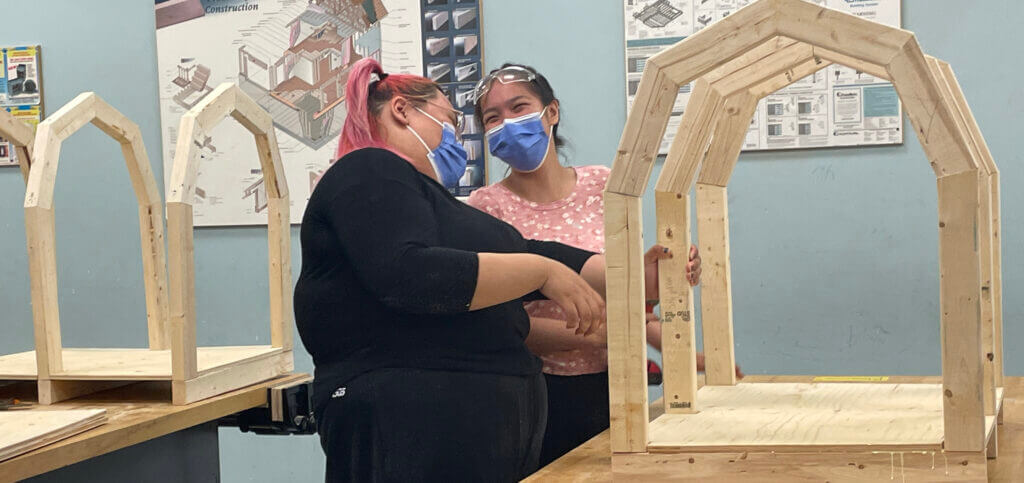 Dene students from Nunavut and the Northwest Territories (NWT) are learning carpentry skills and getting a taste of college life throughout the month of July. On hold due to the COVID-19 pandemic, this is the first NYA program at the College since 2019.
NYA is an Ottawa-based charitable organization offering programming in education, career building and community leadership to northern youth. They offer three core programs: the NYA Canadian Program, NYA Next and the NYA International Program. After completing NYA’s Canadian Program, youth aged 1622 are eligible to participate in NYA Next, which takes place at the College’s Ottawa Campus.
Read more >
Posted on Monday, June 27th, 2022
Saturday’s ‘Community Unity’ Indigenous fashion, music and arts show was a huge success! The event took place in Algonquin College’s Indigenous Learning Commons, Nawapon, and was presented by Anangosh Model and Talent Management — a non-profit Indigenous model management and talent agency developed by activist, educator and model, Kyrstin Dumont.
Celebrated Inuk actress Anna Lambe hosted the event, while the production team for Aboriginal Peoples Television Network (APTN) filmed the event for episode five of APTN’s new Warrior Up! series, set to air in early 2023. Read more >
Posted on Thursday, June 23rd, 2022
Walking down a runway wearing one-of-a-kind Indigenous designs was the first time that Kyrstin Dumont felt she could fully embody her beauty as an Indigenous woman.
Now, she uses her modelling experience to uplift and amplify other Indigenous youth who are struggling to navigate the Western beauty standards set upon them. Read more >
Posted on Tuesday, June 21st, 2022
June 21 marks the beginning of summer and to mark the day, the Algonquin College community was invited to attend a special event in partnership with PCL, part of the DARE6 initiative, which supports Indigenization efforts. June 21 also marked National Indigenous Peoples Day.
While the weather put a damper on sitting by the fire, guests had the privilege of listening to Chief Kukpi7 Rosanne Casimir from Tk’emlúps te Secwépemc near Kamloops, B.C. Read more >
Posted on Thursday, June 9th, 2022
Those visiting the Four Corners, B, C, or D Buildings may soon discover Bear, Wolf, Blue Jay, Moose or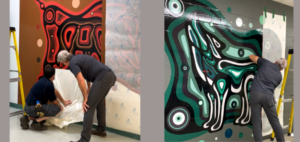 Deer.
Deer.
The vibrantly coloured murals were installed this week as part of an Indigenous pathways wayfinding project. These are the work of Miskomin Twenish, a local self-taught Algonquin artist from the Kitigan Zibi community, and 2018 Algonquin College graduate.
The murals are part of a larger wayfinding project. Names were provided by the Indigenous Education Council in order of cultural significance and each pathway was assigned a colour for wayfinding and signage accents. Signage has been created by Algonquin’s Marketing team, using inspiration from the current wayfinding system, DARE district aesthetics and existing Indigenous themes on campus.
More information about is available at https://www.algonquincollege.com/tri/indigenous-pathways/
Posted on Friday, June 3rd, 2022
With a good mind and several green thumbs, Algonquin College President and CEO Claude Brulé and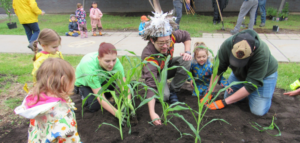 Vice President of Truth, Reconciliation and Indigenization Ron McLester marked the start of National Indigenous History Month with an event this morning in the College’s Three Sisters Garden.
Joined by students from the horticulture program and eager young visitors from the Early Learning Centre, McLester told the story of the Three Sisters; the significance of the crops of corn, bean and squash and how they feed and sustain the community. Students big and small joined in the planting after a ceremonial song, where everyone in attendance participated in the call and response.
The beds in the garden were prepared by the horticulture students, who planted today and will tend to the crops, adding additional plants over the coming weeks. They will weed and maintain the garden until fall when the crops will be harvested.
About the Three Sisters Garden
2019 saw the creation of a Three Sisters Garden of corn, beans and squash. The Sisters symbolize peace, friendship and respect. This traditional Haudenosaunee style community garden project quickly took on a life of its own.
The Three Sisters Garden is an extension of the large Indigenous garden planted in the DARE District’s Ishkodewan courtyard. That ongoing project will see more than 100 species of flowers, shrubs and trees planted — from black-eyed susan and chokecherry to rosy sedge and yellow wood poppy. All of the plants are native to southern Ontario and many of them have cultural, ceremonial, or even medicinal significance for some Indigenous Peoples.
Posted on Wednesday, April 27th, 2022
TRI recognized for outstanding leadership and innovation with national Awards of Excellence
On Tuesday, April 26, Algonquin College was awarded two silver designations at the CICan annual Awards of Excellence.
The Awards showcase the extraordinary contribution of individuals to their college/institute communities and highlight the role of our institutions in social, cultural and economic development. There are three levels of recognition: Gold, Silver and Bronze.
The College received a silver award in two categories; the Indigenous Education Excellence Award and the Excellence in Equity, Diversity and Inclusion Award (You can read the award entry covering letter submissions from Algonquin President and CEO Claude Brulé at the two highlighted links above).
“It is because of dedicated people working hard every day, to improve educational programs and campus life, that colleges and institutes are able to offer such remarkable student-experiences and training opportunities,” said Denise Amyot, CICan President and CEO. “This strong leadership was on full display this year, as COVID-19 forced all of us to adapt and innovate to meet unprecedented challenges. We are thrilled to honour these leaders and innovators who make the entire system stronger, more inclusive, and more responsive to the needs of students as well as employers.”
Congratulations to all for a job well done.
Review the full list of award winners.
Posted on Friday, December 10th, 2021
Algonquin College and Ottawa Tourism will launch the second iteration of its Indigenous Tourism Entrepreneurship Training (ITET) in January to support Indigenous entrepreneurs in the creation and development of their own business and tourism ideas.
“When we created this training, we wanted it to be different,” said Andre O’Bonsawin, Algonquin College’s Director of Indigenous Initiatives. “We really wanted to develop an authentic, tourism- focused, entrepreneurial training that will support surrounding Indigenous communities, businesses and most importantly Indigenous peoples. We have also created an advisory board with Indigenous entrepreneurs, community members and subject matter experts to help ensure the content for the training is respectful and culturally safe.”
Read more >