A new approach to teaching: Algonquin College Professor Joel Shemrock brings drawing to life with 3D-printed tools
Posted on Tuesday, September 15th, 2026
Learn more about innovative teaching tools bringing creativity and technology together as part of our Back-to-School 2026: Student success in action series.
For Immediate release
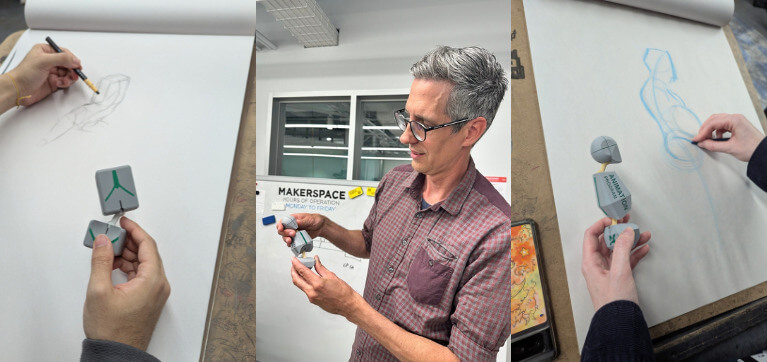
OTTAWA (Sept. 15, 2026) – At Algonquin College, innovation in teaching is often rooted in a simple but powerful idea: make learning tangible. As a new semester begins for Algonquin College Animation students, that philosophy is being brought to life, through the work of Professor Joel Shemrock. Shemrock worked with the Algonquin College MakerSpace to develop 3D-printed tools that transform how students understand form, anatomy and depth in drawing.
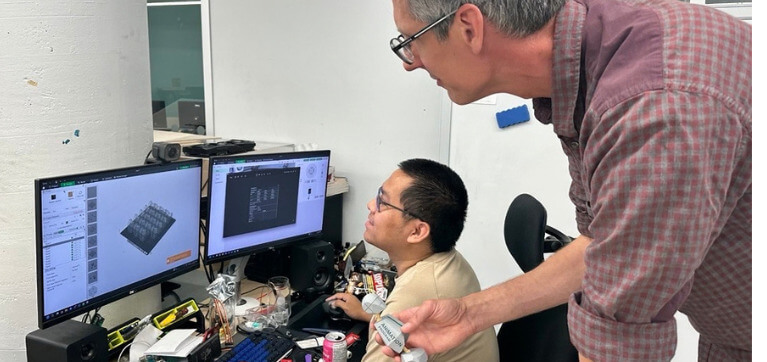
One of the most impactful tools that Shemrock has introduced is based on the concept of the “RoboBean”, a theoretical construction widely used in figure drawing. Traditionally, the RoboBean exists only as a drawing exercise; a simplified representation of the human torso made up of two volumes. Recognizing an opportunity to make this abstract concept more accessible, Shemrock collaborated with Davis Nguyen from the MakerSpace at Algonquin College to design and 3D-print it.
“I saw the potential to make [the RoboBean] more useful,” Shemrock explains. “So, I added a spine, a structural link between the two volumes representing the rib cage and pelvis.”
This small addition allows students to better understand not just shape, but movement, alignment and anatomical relationships. The result is a tool that bridges the gap between construction drawing and real-world observation.
A key challenge for animation students is translating three-dimensional objects onto a two-dimensional surface while maintaining the illusion of depth. Shemrock’s tools directly address this problem.
By holding a physical model in their hand, students can observe how forms rotate, overlap and compress in space. Before even touching pencil to paper, students are asked to pose their RoboBean model. This step allows them to troubleshoot perspective and proportion early in the process, reducing guesswork and building confidence.
The models are marked with guiding lines that help students understand angles, orientation and “registration points” — reference markers used to break forms into smaller, manageable parts.
Over time, the tool has evolved to incorporate more detailed elements, helping students progress from basic construction to more refined anatomical studies. Including the addition of 3D-printed skulls to the design, these models now allow the students to break down the structure of the head into clear, understandable planes and volumes.
What begins as a simplified block form, gradually becomes a nuanced understanding of the human figure. This layered approach supports learners at all stages, from beginners grappling with perspective to advanced students refining their craft.
Shemrock’s innovation isn’t limited to teaching tools; it also reflects his own learning journey. To get a better understanding of how to make these ideas into a reality, he taught himself 3D modeling. This willingness to learn new technologies mirrors the mindset he encourages in his students; adaptability, curiosity and problem-solving.
Each model costs approximately $1.50 to $2.00 to produce, making them highly scalable for classroom use. Shemrock has even begun distributing them as part of student drawing kits, ensuring that every learner has access to the same hands-on resources.
Shemrock’s work exemplifies how innovation in teaching doesn’t always require complex systems or expensive technology. Sometimes, it comes down to reimagining how students interact with fundamental ideas.
By transforming theory into physical tools, Shemrock has created a learning experience that is tactile, intuitive and deeply engaging. His 3D-printed models are more than just classroom aids, they are catalysts for understanding — helping students see, feel and ultimately master the art of drawing in three dimensions.
At Algonquin College, this approach is shaping not only better artists, but more confident and capable problem-solvers; one layer, one line and one printed model at a time.
Learn more about Animation at Algonquin College and the Algonquin College MakerSpace.
This story is part of Algonquin College’s Back-to-School 2026 series highlighting innovative programs, partnerships and supports that help learners succeed both in the classroom and beyond.
Other stories include:
-30-
For further information:
Meg Fraser
Communications Officer
Algonquin College
613-302-0138
fraserm2@algonquincollege.com
About Algonquin College
The mission of Algonquin College of Applied Arts and Technology is to transform hopes and dreams into lifelong success. Algonquin College, an Ontario public sector community college, does this by offering hands-on, digitally connected, experiential learning in close to 170 programs. Algonquin College is the largest polytechnic institute in Eastern Ontario, with campuses in Ottawa and Pembroke, with fully online programming delivered through AC Online.
- Posted in
- News