FAQs
For Students
Getting Started
Why does Algonquin College care so much about academic integrity?
Academic integrity is one of the foundations of your education at Algonquin College. Employers, industry partners, and professional regulators expect graduates to demonstrate honesty, responsibility, accountability, and ethical decision-making. When you submit work that genuinely reflects your own learning, you build the knowledge, skills, and confidence needed for success in your field.
Academic integrity also helps maintain the value of an Algonquin College credential. When all students earn their grades honestly, employers and the community can trust that graduates have demonstrated the competencies required by their programs. This protects the reputation of both the College and its graduates.
What is academic misconduct?
Academic misconduct is any action that gives a learner an unearned advantage in matters affecting their academic standing. Academic misconduct may be intentional or unintentional.
What kinds of behaviour are considered academic misconduct?
Examples of academic misconduct include:
- Plagiarism
- Cheating
- Unauthorized use of generative AI
- Unauthorized collaboration
- Contract cheating
- Misrepresentation
- Aiding others in committing misconduct
- Submitting the same work in more than one course without permission
Assignments & Coursework
Can I use generative AI tools such as ChatGPT or Copilot for my assignments?
You may only use generative AI in ways permitted by your professor and assignment instructions. Responsible use of generative AI is encouraged, but AI-generated content must be cited or otherwise identified when required. Undocumented AI use is not permitted in academic work.
What is unauthorized content generation (UCG)?
Unauthorized Content Generation occurs when academic work is produced, in whole or in part, using unapproved or undeclared human or technological assistance for academic credit, progression, or an award. This includes the use of AI tools when their use is prohibited or not disclosed as required.
What is plagiarism?
Plagiarism is presenting someone else’s ideas, words, work, data, code, artistic expression, or other intellectual contributions as your own without proper acknowledgment. Plagiarism can occur intentionally or accidentally and may also include sharing your work with others when not authorized. Depending on course requirements, submitting work generated by artificial intelligence tools without authorization, attribution, or disclosure may also constitute plagiarism or another form of academic misconduct.
Can I work with classmates on an assignment?
Only if collaboration is permitted by your professor. Working with others on an individual assessment, sharing answers, allowing others to copy your work, or submitting substantially similar work without permission may be considered unauthorized collaboration.
Can I submit an assignment that I previously completed for another course?
Not without your professor’s knowledge and permission. Reusing your own previously submitted work may be considered unauthorized resubmission and could also be considered self-plagiarism.
Academic Misconduct Process
What happens if my professor suspects academic misconduct?
If your professor suspects academic misconduct, they will inform you of the concern, explain the perceived breach, and share the evidence supporting the allegation. You will have an opportunity to review the evidence and provide your perspective, either through a meeting or in writing. Under Policy AA48, you are expected to respond within three (3) working days of being notified.*
After considering the available information, the professor may determine that no academic misconduct occurred and that no further action is required. In some cases involving minor academic misconduct, the professor may recommend a Formal Learning Opportunity (FLO). In other cases, where there is a reasonable belief that academic misconduct occurred, an Academic Misconduct Report may be submitted for formal review by an Academic Administrator.
*If you do not respond within three (3) working days of being notified, the professor will proceed with reporting the incident based on the available information. Choosing not to respond will not prevent the matter from moving forward.
What is a Formal Learning Opportunity (FLO)?
A Formal Learning Opportunity (FLO) is a learning-focused response to a minor academic integrity concern. Rather than proceeding directly through the formal academic misconduct process, eligible students may be offered a FLO as an opportunity to strengthen their understanding of academic integrity and avoid similar issues in the future.
A FLO is not a sanction. It may include activities such as an academic integrity module, workshop, or reflection exercise. If you accept the finding and complete the required activities, the matter is considered resolved. If you decline the FLO or do not agree with the finding, the concern will proceed through the formal academic misconduct process.
FLOs are typically considered for first-time, lower-level concerns where an educational response is appropriate. Examples may include citation or referencing errors, unauthorized collaboration, or inappropriate use of generative AI.
Can I be accused of academic misconduct based solely on an AI detection score?
No. Under Policy AA48, results produced by generative AI detection tools are not supported as the basis for an academic misconduct allegation. Any allegation must be based on other evidence and evaluated through the College’s academic integrity process.
Can academic work be reviewed after it has already been graded?
Yes. Under Policy AA48, where there is a compelling reason to conclude that undetected academic integrity violations may have occurred, the College may conduct a retroactive review of academic work at any point within the current academic year. Where academic misconduct is subsequently established, academic sanctions may be applied.
What is an Academic Integrity Incident Report and what happens when one is filed?
An Academic Integrity Incident Report is a report submitted by a professor when they believe a breach of academic integrity may have occurred. Depending on the circumstances, the report may be submitted as either a Formal Learning Opportunity (FLO) Report or an Academic Misconduct Report.
If a report is filed, you will be informed of the concern and the next steps. If you are eligible for a FLO, you may be offered a learning-focused resolution. If the concern requires formal review, an Academic Administrator will contact you within three (3) working days and provide an opportunity to share your perspective before a decision is made.
Can I bring someone with me to a meeting about an academic integrity allegation?
Yes. You may request a support person to attend the meeting with you. A support person may provide emotional support, reassurance, or accommodation assistance during the meeting. Support persons are generally not permitted to speak on your behalf or participate directly in the discussion. In extenuating circumstances, usually medical in nature, exceptions may be made at the discretion of the Academic Administrator.
Who should I contact if I have a question about academic integrity or an academic misconduct allegation?
Questions about academic integrity, academic misconduct allegations, sanctions, or the academic integrity process should be directed to your School, Faculty, or Campus Academic Integrity Lead. Your Academic Integrity Lead can provide information about the process, available supports, and next steps related to your case.
Contact information for Academic Integrity Leads is available below.
- Algonquin Centre for Construction Excellence/Perth Campus – Robbie Atchison
- Faculty of Arts, Media and Design – Jason Summers
- Online and Professional Learning – Gail Horvath
- Pembroke Campus – Jodi Bucholtz
- School of Advanced Technology – Renay Dixon
- School of Business and Hospitality – Sandra Wu
- School of Health Sciences – Amilcar Fuentes
- School of Wellness, Public Safety and Community Studies – Rebecca Wakelin
- Co-op Prep Courses (GEP) – Thandiwe Ncube
I’m A Visual Learner. Is There A Visual Guide To The Academic Integrity Process?
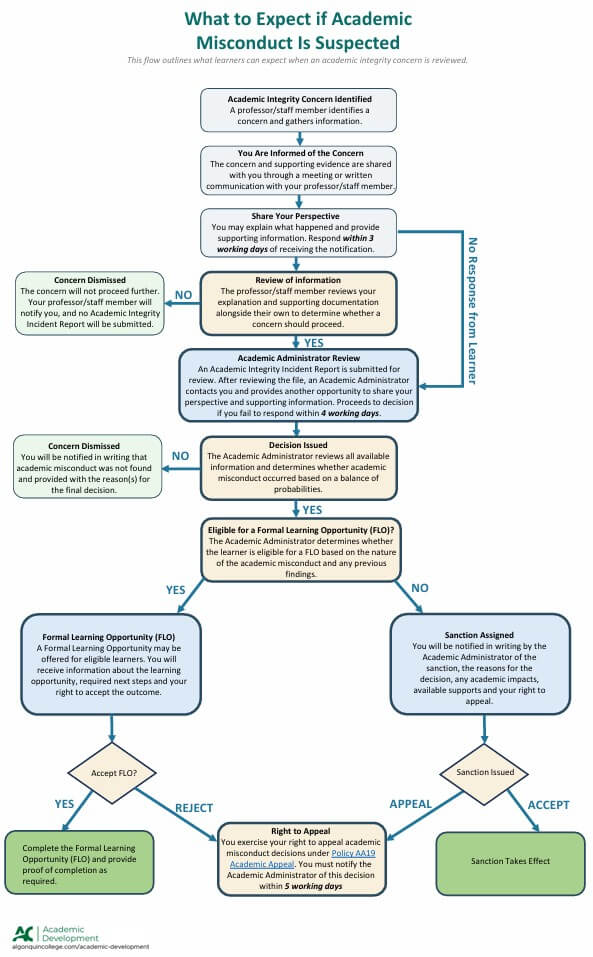
Yes. The diagram below provides a step-by-step overview of what learners can expect when an academic integrity concern is being reviewed. It explains the key stages of the process, important timelines, opportunities to respond, and possible outcomes.
Click the thumbnail to access the full-size version.
Decisions & Outcomes
How does Algonquin College decide if academic misconduct occurred?
What sanctions can be applied for academic misconduct?
Algonquin College follows an educational and progressive disciplinary approach. Repeated violations or failure to demonstrate corrective behaviour may result in increasingly serious sanctions. However, a severe first offence may also lead to significant sanctions.
Possible outcomes range from educational measures and assignment resubmissions to mark deductions, a zero on an assessment, failure of a course, loss of academic privileges, withdrawal from a program, suspension, or expulsion, depending on the severity and history of the misconduct.
When will I receive a decision?
The Academic Administrator will normally issue a written decision within five (5) working days of meeting with you, or within five (5) working days of a non-response to the meeting request. The decision will explain the outcome, the reasons for the decision, any sanctions or learning requirements that apply, available supports, and your right to appeal under Policy AA19 Academic Appeal. If the allegation is not substantiated, you will be notified that the matter has been dismissed.
What if I disagree with the decision?
You have the right to appeal academic misconduct decisions under Policy AA19 Academic Appeal. Information about your appeal rights will be included in the decision letter.
Does withdrawing from a course stop an academic integrity investigation?
No. Academic integrity allegations may continue to be investigated even if you withdraw from the course in which the allegation occurred. Records of confirmed violations may still be maintained by the College.
Will an academic misconduct finding appear on my transcript?
Most academic misconduct findings do not appear on your academic transcript. However, the College maintains confidential records of all academic misconduct findings and sanctions. Program suspensions, College suspensions, and expulsions are recorded on a student’s official record, and College expulsions remain on the Permanent Student Record indefinitely.
For Faculty & Staff
Identifying Possible Academic Misconduct
My Turnitin Similarity Report is showing a high percentage. Does this mean the student has plagiarized?
Not necessarily. It is important that you understand what a similarity report is saying. Just because a student has a high percentage of similarity, it doesn’t mean they have plagiarized. Training on how to interpret Turnitin results can be found here:
Can I file an academic misconduct allegation based solely on an AI detection score or AI report?
No. Under Policy AA48, results produced by generative AI detection tools are not supported as the basis for an academic misconduct allegation. AI detection tools may raise questions that warrant further review, but they should not be treated as proof that academic misconduct occurred.
Academic misconduct allegations must be based on other evidence and evaluated through the College’s academic integrity process using the balance of probabilities standard. Faculty should focus on the work submitted, assignment requirements, student explanations, supporting documentation, and any other relevant evidence when determining whether a concern should be reported.
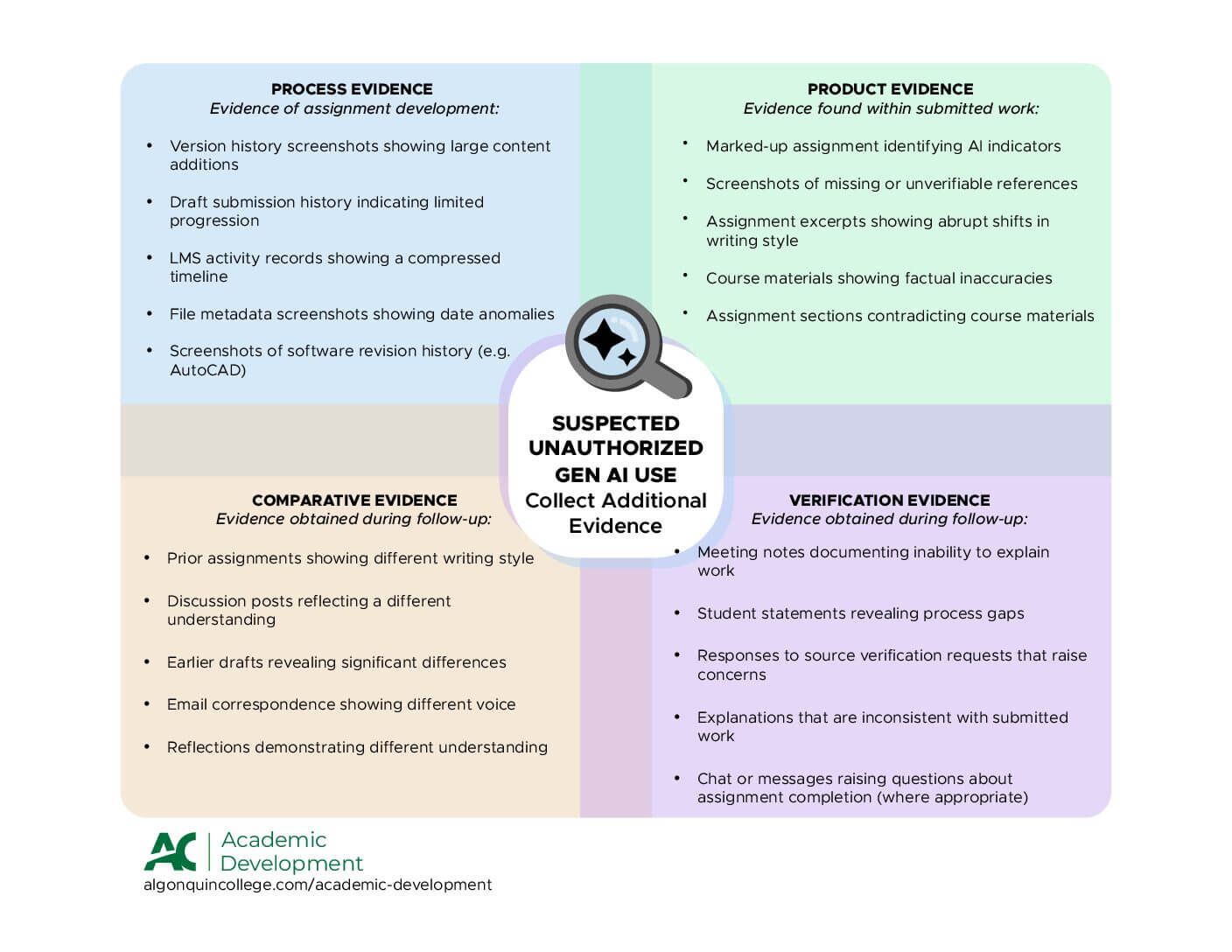
Types of evidence that may support a concern regarding suspected unauthorized GenAI use:
What if I see academic misconduct occur during an exam, and I notify the student at the time of the incident that I’ll be filing an academic incident report, do I still need to formally communicate in writing with the student?
Yes. It documents the situation that occurred as exam environments typically do not allow for opportunity for a fulsome discussion and, for the student to provide their perspective and share any information to disprove the concern for a breach of academic integrity. The email to the student is to summarize the proctor’s observations, any dialogue that occurred with the student, inclusion of supporting evidence and a statement that you will be filing an academic integrity incident report unless the student is able to share new information to disprove the allegation.
I suspect a possible act of academic misconduct has occurred. What should I do?
If you suspect academic misconduct, you should communicate with the student as soon as reasonably possible and provide them with an opportunity to respond before taking further action [See sample email]. Explain the concern, identify the perceived breach of academic integrity, and share the evidence supporting your concern. This may occur through a meeting, in writing, or both.
Students must be given an opportunity to review the information and provide their perspective. Under Policy AA48, students are expected to respond within three (3) working days of being notified. If a student does not respond within that timeframe, you may proceed based on the available information. A lack of response does not prevent the matter from moving forward.
After considering the available information, you may determine that no academic misconduct occurred and that no further action is required.
Where a concern appears to be minor, educational in nature, and appropriate for a learning-focused response, you may recommend a Formal Learning Opportunity (FLO) by submitting a Quick Report – Formal Learning Opportunity (FLO). FLOs are generally intended for low-level concerns where the learner would benefit from additional education and support in understanding academic integrity expectations. As a general guideline, FLOs are best suited for assessments that occur earlier in the semester and are worth between 0% and 10% of the final course grade.
If there is a reasonable belief that academic misconduct occurred and the matter requires formal investigation, potential sanctioning, or College-level tracking, you should submit an Academic Misconduct Reporting Form. An Academic Administrator will review the report, investigate the matter, provide the student with an opportunity to respond, and determine whether academic misconduct occurred and what outcome is appropriate.
Faculty should ensure they retain all relevant evidence and documentation related to the concern, including communications with the student, as these materials may be required during the review process.
Formal Learning Opportunities (FLOs)
What is a Formal Learning Opportunity (FLO) and when should I recommend one?
A Formal Learning Opportunity (FLO) is an educational response to certain instances of academic misconduct. It is intended to help learners better understand academic integrity expectations and develop the knowledge and skills needed to avoid similar issues in the future. A FLO is not an academic sanction.
Faculty should consider recommending a FLO when a concern appears to be minor, educational in nature, and appropriate for a learning-focused response rather than a disciplinary one. FLOs are generally available only for a learner’s first academic misconduct finding and are typically used for lower-stakes assessments worth less than 10% of the final course grade that occur earlier in the semester.
Examples may include first-time concerns related to citation or referencing, minor unauthorized collaboration, limited unauthorized use of generative AI, or situations where a learner appears to have misunderstood academic integrity expectations and accepts the finding and Formal Learning Opportunity.
To recommend a FLO, faculty should submit the Quick Report – Formal Learning Opportunity Reporting Form. The Academic Administrator will review the circumstances, including the learner’s academic integrity history, and determine whether the learner is eligible for a FLO.
A FLO may require the learner to complete academic integrity training, workshops, reflective activities, or other educational requirements. If the learner accepts the finding and successfully completes the required learning activities, the matter is considered resolved. If a FLO is not appropriate, the learner is not eligible, or the learner does not accept responsibility, the concern may proceed through the formal academic misconduct process.
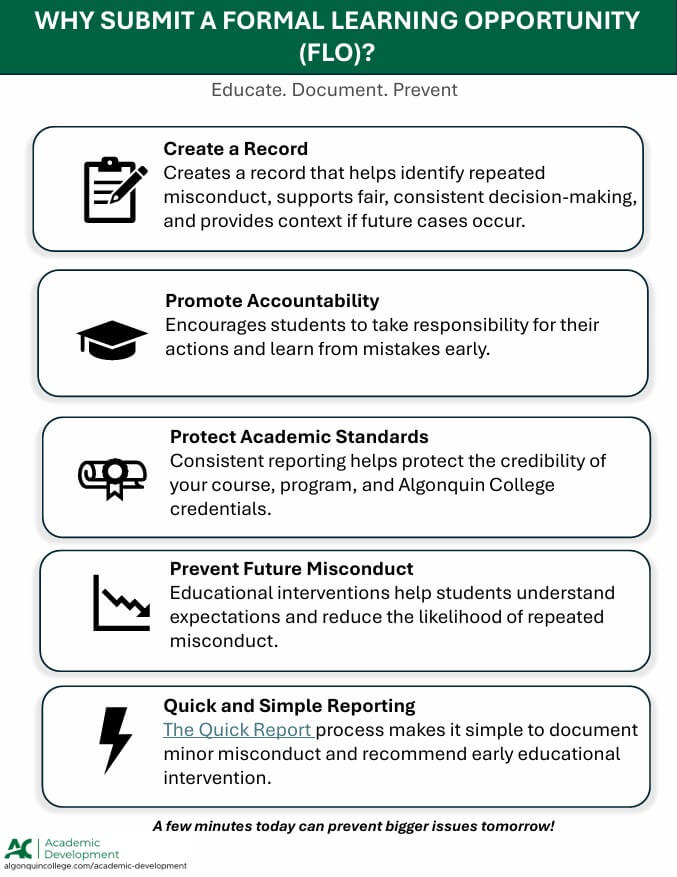
I am really busy. Why am I being asked to complete a Quick Report for a Formal Learning Opportunity (FLO)?
The Quick Report is a key part of the Formal Learning Opportunity (FLO) process. While faculty manage the conversation with the student and address the concern directly, the report creates a centralized record of the incident.
This is important because faculty do not have access to a student’s academic integrity history. A concern that appears isolated in one course may be part of a broader pattern that is only visible through centralized tracking. The Quick Report allows the College to identify repeat behaviours, assign academic integrity training when appropriate, and determine whether future concerns require escalation.
In short, the report helps ensure that minor concerns can be handled quickly by faculty while still providing the institutional oversight needed to support students and respond consistently to repeated misconduct.
Click the thumbnail to access the full-size version.
Reporting an Academic Integrity Incident
Who Is My Academic Integrity Lead?
| School/Faculty/Campus Academic Integrity Lead | Contact |
| Algonquin Centre for Construction Excellence | Robbie Atchison |
| Faculty of Arts, Media and Design | Jason Summers |
| Online and Professional Learning | Gail Horvath |
| Pembroke Campus | Jodi Bucholtz |
| School of Advanced Technology | Renay Dixon |
| School of Business and Hospitality | Sandra Wu |
| School of Health Sciences | Amilcar Fuentes |
| School of Wellness, Public Safety and Community Studies | Rebecca Wakelin |
| Co-op Prep Courses (GEP) | Thandiwe Ncube |
Do I have to file an academic integrity incident report even if I am just providing a warning to the student?
Yes, to properly track how many learning opportunities a student is being provided, it is essential that all incidents be recorded. Please specify in the space for faculty recommendations that you have provided the student with a learning opportunity. If the Academic Administrator notices that a student has already been provided with a learning opportunity or an academic sanction, they will contact you to notify you about this information and discuss the next steps regarding the incident.
Why can’t I fill in multiple students on the same academic integrity incident form?
Individual report submissions are a requirement of the reporting procedures. For tracking purposes, it is important that only one student be identified in a form submission. Even though students may have committed an offence together, their personal student record requires that information be recorded separately.
Additionally, reports are generated from the information submitted in the form and are provided to the student. For privacy purposes, it is important that students only see their information.
After I submit the form for an Academic Integrity Incident, is there anything else I need to do?
Not immediately. Once you have submitted your academic integrity incident report, an Academic Administrator will take the case and will investigate and manage the incident. Dependant on the outcome, you may need to support the final decision by applying the sanction. Example: assigning a grade of zero or allowing a student to resubmit and then grade the resubmission.
What happens if a student does not respond to my email regarding an academic incident?
If a student does not respond within three business days, then submit the academic incident report and note that you did not hear back from the student.
When an Academic Integrity Incident Report is filed, who do students hear from?
Students will receive an email from the Academic Administrator assigned to their case and will communicate with that person until their case is closed.
Sanctions and Academic Decisions
Who decides what the academic sanction will be on an academic misconduct case?
Once an Academic Integrity Incident Report has been submitted, the case is reviewed by an Academic Administrator. The Academic Administrator considers all available information, including the evidence provided, the student’s response, and any relevant contextual factors.
Decisions are made on a balance of probabilities, meaning the Academic Administrator determines whether it is more likely than not that academic misconduct occurred.
If academic misconduct is established, the Academic Administrator will determine or recommend outcomes in accordance with Policy AA48. Certain sanctions require additional authorization by the Chair, Dean, Senior Vice-President Academic, or President, depending on the severity of the outcome. Based on the circumstances, this may include a Formal Learning Opportunity (FLO) or an academic sanction. Factors considered may include the nature and severity of the misconduct, the student’s level of academic experience, evidence of intent, acceptance of responsibility, mitigating circumstances, and any previous academic integrity findings.
The Academic Administrator will communicate the decision to the student and advise faculty of the outcome and any actions required to implement the decision.
What do I do if I am not happy with the academic decision applied to my student’s academic integrity incident?
If you are concerned with the outcome of the academic incident you filed, you are welcome to talk with the Academic Administrator in charge of your incident to discuss further.
What goes into determining the level of academic sanctions applied to a students academic integrity incident?
The College follows an educational and progressive, disciplinary approach to maintaining academic integrity. This includes the assignment of formal learning opportunities and the provision of student support services to support learners’ academic success in understanding of academic integrity requirements, up to and including the assignment of academic sanctions for proven acts of academic misconduct.
Academic sanctions are assigned according to the nature, extent, and repetition of the act(s) of academic misconduct. Repeated violations of academic integrity where the learner was provided opportunity to learn and demonstrate corrective behaviour from a previous violation will result in progressive sanctioning. Equally, a severe first violation may result in an uppermost academic sanction. Factors considered in imposing an academic sanction include but are not limited to:
- Learner’s level of academic experience, expected familiarity with academic integrity and the College’s academic integrity standards
- Evidence of intention/and or deliberation and/or premeditation in engaging in the academic misconduct
- Clarity of assessment instructions and evaluation expectations
- Acknowledgement and acceptance of responsibility where evidence points to misconduct
- Previous record of one or more academic integrity violations
Why didn’t the Academic Administrator use my recommended sanction for the academic integrity incident I filed?
There are several factors that go into determining a sanction, and if a faculty members recommendation is not used it is likely because the Academic Administrator has found information that resulted in a need to apply a different sanction. If you have questions or concerns, please reach out to the Academic Administrator.
Resolution Timelines
Why do some academic integrity incident cases take more time to get resolved?
Each alleged academic misconduct situation is unique and range in complexity level resulting in resolution time differences. Severity of the incident, evidence review and additional learner/staff consultation requirements, extenuating circumstances impacting the learner(s) and staff involved can impact the time to resolve.
Please refer to the College’s AA48 Academic Integrity policy for more details.