Faculty Supports
Find resources, guidance, and strategies to promote academic integrity, engage students in conversations about ethical learning, and respond to concerns about academic misconduct.
Reporting Academic Misconduct
Academic Integrity Incident Reports are submitted using one of the following approved reporting mechanisms:
| Reporting Option | Use When |
|---|---|
| • Significant unfair academic advantage was gained or attempted • Unlikely a skills or knowledge gap • Assessment value is greater than 10% of the final grade • It aligns as a Level 1 or higher on the Academic Misconduct Sanction Matrix |
|
| • Limited scope; little or no unfair advantage was gained • Misunderstanding, inexperience, or error is evident • Typically seen in first-level courses where students are developing academic skills (not exclusive) • Assessment value is equal to or less than 10% of the final grade |
Academic Integrity Reporting Pathway (New)
Click the thumbnail to access full size.
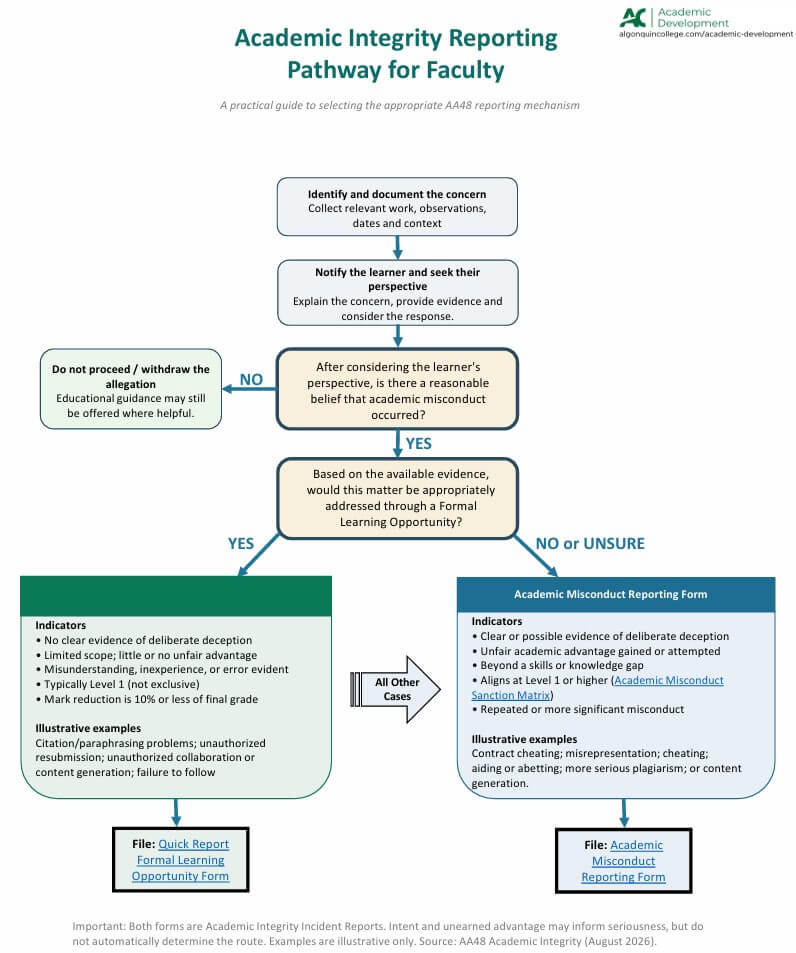
Reporting Academic Misconduct (Updated)
- Academic Misconduct Reporting Guide
Step by step process of how to submit an alleged incident of academic misconduct via Microsoft Forms. - Turnitin 101
Describes how to use TurnItIn as a faculty member as a tool to help flag possible plagiarism. This includes how to interpret reports, what to do if you suspect plagiarism, as well as training video links. - Academic Incident – Sample Email to Students for Professors
A sample email faculty can use to complete the first step in the academic incident reporting process, which is communication with the student regarding an alleged act of academic misconduct prior to formal reporting.
VIDEO: How to Initiate a Formal Learning Opportunity (New)
Watch this video for an explanation of what a Formal Learning Opportunity is, when it should be applied, and how to complete the relevant form.
Academic Misconduct Sanction Matrix (Updated)
The Sanction Matrix is a guidance tool intended to support faculty and academic administrators in assessing the severity of academic misconduct and recommending proportionate educational interventions and sanctions. Faculty should use the matrix, together with Academic Policy AA48, to inform their recommendations.
Final academic integrity findings and sanctions are determined through the AA48 process and approved by the appropriate decision-maker in accordance with the authority levels outlined in the policy.
Faculty Notifications and Sample Emails (New)
Faculty receive different automated notifications depending on whether a matter is addressed through a Formal Learning Opportunity (FLO) or proceeds through the formal Academic Misconduct process. Sample excerpts from these communications are provided below.
|
Formal Learning Opportunity (FLO)
|
Academic Misconduct Reporting Form
|
| Minor academic misconduct eligible for an educational resolution. | Formal investigation process under Academic Integrity Policy AA48 |
| Acknowledgement Notification | Acknowledgement Notification |
| When faculty receive this: Immediately after submitting a Formal Learning Opportunity Report.
Email excerpt: “This message confirms that a Formal Learning Opportunity Report has been submitted and the details recorded are outlined below. The Academic Administrator may contact you if additional information or clarification is required …“ |
When faculty receive this: Immediately after submitting an Academic Misconduct Incident Report.
Email excerpt: “This message confirms that an Academic Misconduct Incident Report has been submitted and the details recorded are outlined below. The Administrator copied on this email is the primary contact for this case and will review the information provided. The Administrator may reach out with questions…” |
| Notice of Escalation After Review of FLO by Academic Administrator | Notice of Decision – Academic Misconduct Sent to Learner (Faculty CC’d) |
| When faculty may receive this: If the matter is escalated to a formal academic integrity case following review.
Email excerpt: “Following review of the FLO case submitted for [Student Name], it has been determined that this matter requires escalation to a formal academic integrity case. You will be copied on the final decision report once the review is complete.” |
When faculty receive this: When the learner has been informed of the final decision.
Email excerpt: “This email is to formally inform you of the final decision pertaining to your Academic Misconduct Incident in [course code]. Please keep this email as part of your personal records.” |
Academic Integrity Policy (AA48)
Review the College’s Academic Integrity Policy (AA48), including faculty responsibilities, academic misconduct reporting procedures, investigation processes, sanctions, and guidance related to the use of generative AI in academic work. This policy outlines the College’s expectations for promoting and upholding academic integrity across all learning environments.
Generative Artificial Intelligence (GenAI) and Academic Integrity (Updated)
- Faculty Resource Guide: Generative AI In Teaching
Explore the Guidelines for Teaching with Generative AI, a faculty resource developed by Learning and Teaching Services (LTS). LTS provides support for instructors in areas such as teaching practice, learning design, assessment, educational technology, and emerging tools like Generative AI. This resource will help you develop an informed approach to incorporating AI into your courses while promoting effective, ethical, and responsible use. - Still Have Questions About Generative AI?
Book a one-on-one appointment with LTS for personalized support and practical advice tailored to your course and learning outcomes.
Assessments (Updated)
- Assessment Design and Rubrics
Developed by Learning and Teaching Services (LTS), Algonquin College’s teaching and learning support team, this resource provides guidance on designing effective assessments, aligning assessments with learning outcomes, and developing clear, consistent rubrics. - Still Have Questions About Assessment Design?
Book a one-on-one appointment with LTS for personalized support and practical advice tailored to your course and learning outcomes.