New Pìwànak murals highlight Indigenous culture and science education
Posted on Tuesday, November 4th, 2025
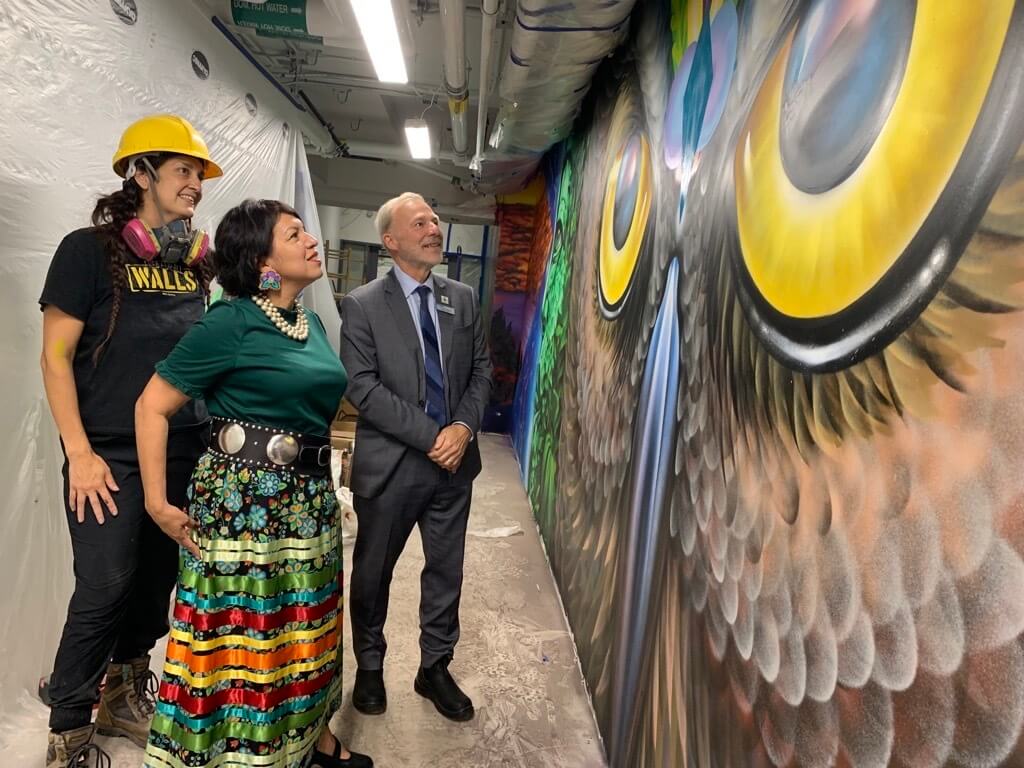
The new Pìwànak — Algonquin Centre for Science and Innovation is designed to provide students a state-of-the-art science education, giving hands-on experience with the same technology they can expect to encounter in the workplace. In addition to the technical side, the Centre is also alive with Indigenous imagery and knowledge.
Pìwànak, meaning “flint” in the Anishinàbe Algonquin language, represents the start of something new. Pìwànak features two large murals, incorporating design elements that have significant meaning to Indigenous culture, with the overall design guided by Brenda Odjick, Lionel Whiteduck, Anita Tenasco and Rene Tenasco. The murals themselves were designed and painted by artist Shalak Attack, with her partner Bruno Smoky of Clandestinos Art assisting her on the larger mural.
“Every inch of the murals has a meaning, we had Knowledge Keepers, scientists, architects and the administration [involved],” said Shalak. “The feedback was very thorough and descriptive; it was a challenging back and forth process that ended with a very satisfying collaborative project in the end. Within the two murals, there is a mix of perspectives through the lens of the Knowledge Keepers and the scientific community, uniting different cultures, histories and concepts. The two murals are reflective of each other but hold their own space through the storytelling as well the different artist approaches.”
The two artists have made their mark around the world, having worked everywhere from Canada and the U.S. to Europe, Latin America, the Middle East and Africa. In 2018, they worked with the College to create the three-storey mural outside of Nawapon in the DARE District.
According to Shalak, her journey into muralism was inspired by her travels to Latin America and its hip hop subculture, where she met people in the graffiti scene. Already a lifetime painter, this new medium allowed her to move beyond the canvas and to create even greater works of art. She did her first street art pieces in 2005, while living in Montreal. Now, 20 years later, her experience gained on streets around the world has given her immense opportunities, including the creation of a mural for the United Nations in Manhattan, New York.
This new Pìwànak mural work presented an opportunity to embrace both the world of science and the world of Indigenous culture and knowledge. Featuring strands of DNA, human anatomy and atoms on the right and a campfire, animals and scenes of nature on the left, the mural’s centre — a large owl — represents Two-Eyed Seeing, showing the importance of both sides and the interconnection between Indigenous history and traditions and the modernized science education being provided in the lab spaces.
Pìwànak is currently open to students and will have a grand opening ceremony early in the new year.