National Nursing Week and the future of nursing
Posted on Tuesday, May 12th, 2026
National Nursing Week serves as an annual reminder of the importance of the nursing field and to recognize the skills and dedication of nurses throughout Canada. It highlights both the celebration of the present and the possibilities of the future in the field, allowing a time to reflect on how nursing education is delivered both today and tomorrow. 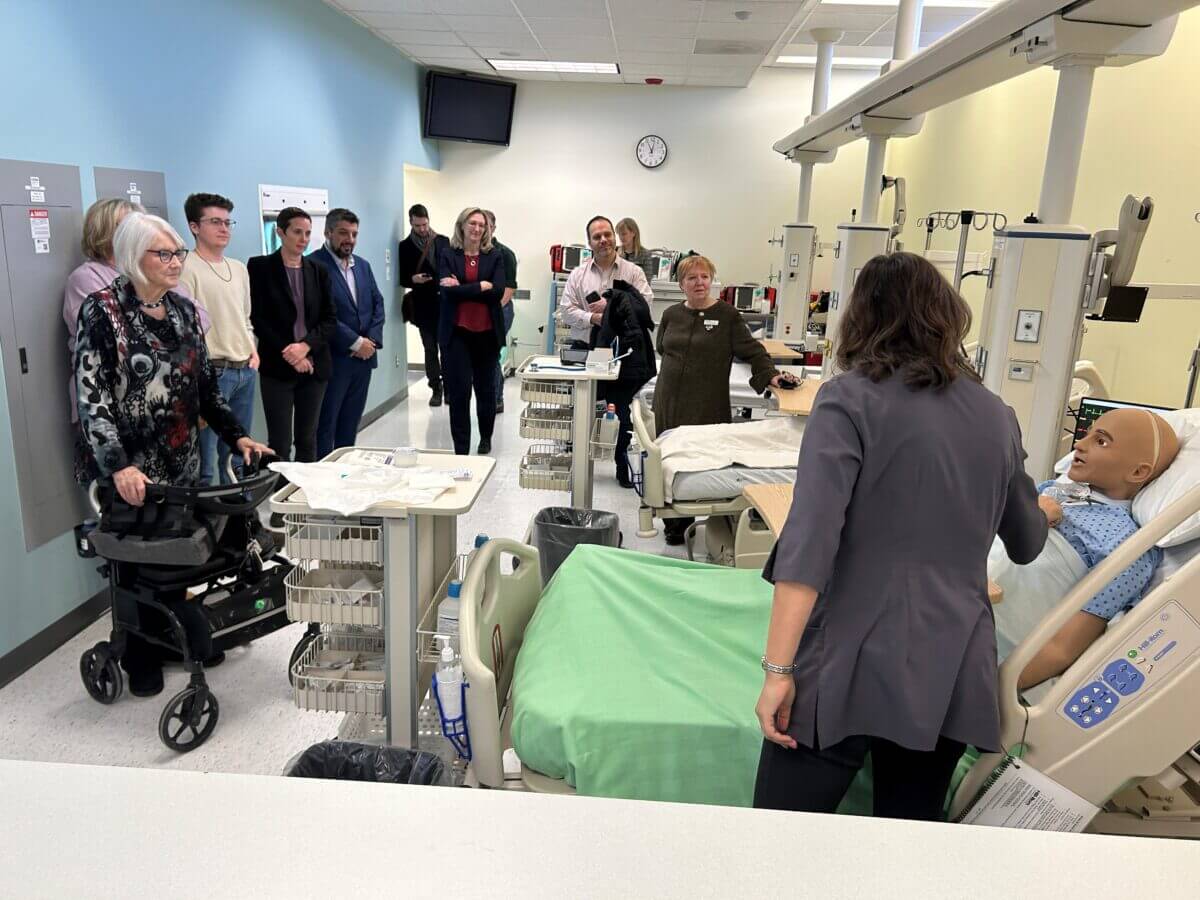
At Algonquin College, educators like nursing professor Elizabeth Delavan are using simulation technology, one of the most powerful learning tools in modern healthcare education, to prepare learners for the complexities of the healthcare field. The College’s simulation labs provide learners with an approximation of what a real healthcare environment would be like, giving them firsthand experience with the work they will do in their future career.
“The purpose of simulation is for students to practice practical nursing skills in a safe learning environment,” said Delavan. “We can replicate certain human characteristics, like a heartrate, or breath sounds, or bowel sounds, pulses in the wrists and the feet, eyes that can blink. The simulators can mimic a lot of that. We can then set up scenario-based learning for our students, which allows for active, hands-on engagement, especially for emergency-based situations, which is not always possible in an acute healthcare setting.”
According to Delavan, simulation technology allows new nursing learners to gain foundational skills, like finding and counting a heartbeat or understanding different lung sounds, and to understand both normal and abnormal patient medical states.
The College has a suite of simulators and an immersive lab designed to facilitate realistic healthcare scenarios, ranging from emergency medical care situations to something as simple as maneuvering a manikin (a heavy simulator dummy) on a hospital bed to learn how to change the sheets of bedridden patients. These simulators range from “low fidelity,” which are simple tools like a simulated torso for CPR or an arm to practice IV insertion, to “high fidelity,” which are simulators with heartbeats, pulse points, a chest that rises and falls and more.
“We have a number of these and the tech is really well supported for us,” said Delavan. “We have embedded those in almost every nursing course. We build skills with the low fidelities in the first few years of programming and advance to the higher fidelities in levels three and four.”
Simulation is just one tactic to train the nurses of tomorrow. As healthcare evolves, the methods needed to educate medical practitioners evolve as well. The hands-on simulation and classroom learning combination provided by Algonquin College ensures future nurses have the confidence and competence that are necessary in modern healthcare. This National Nursing Week, it is important to recognize not only the continuing efforts of current nurses, but the innovation that will shape the next generation.
- Posted in
- Words
- Tags: