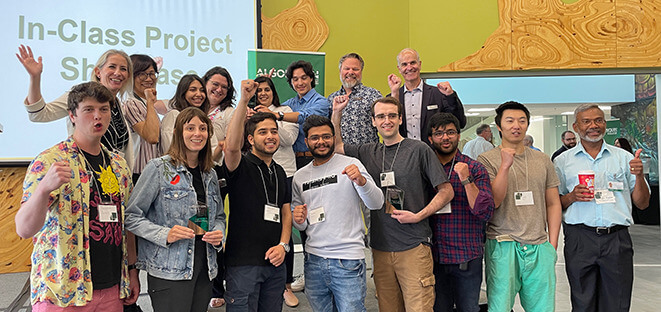
Soaring food costs in recent years may drive budget-conscious decisions when making a grocery list. An app under development by Computer Programming learners will help users make the most of the items in their kitchen. Cooking Chef is a full-featured, Android-based app that generates recipes based on selected ingredients. The project will be one of 50 student-led research projects on display at the In-Class Projects Showcase, held on the Ottawa Campus on Aug. 3.
Continue reading
Research

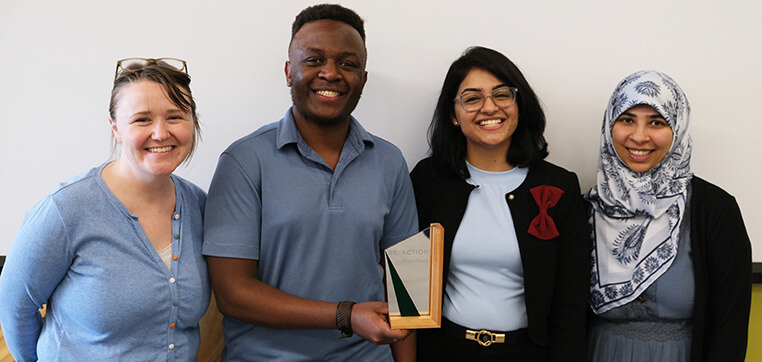
Alexandra Massie, Dhanashree Dama, Noha Abdelrahman and Jay Donde Ericsson with their first-place trophy.
Learners from the Interdisciplinary Studies in Human-Centred Design (ISHCD) program captured first-place at the RE/ACTION Showcase on April 14, the first to take place fully in-person since 2019.
Students Alexandra Massie, Dhanashree Dama, Noha Abdelrahman and Jay Donde Ericsson developed their project, titled “Communicating Timely Measures for Type-2 Diabetes,” over the last six months. According to professors Su Cheng Lee and Lanre Jerry-Ijishakin, the group’s efforts serve as a confirmation of the skills that they have developed throughout the course of their studies, and as a testament to the overall strengths of the ISHCD program.
The RE/ACTION Showcase highlights applied research projects led by student teams in partnership with real industry clients. This event — the first to take place in-person since the start of the COVID-19 pandemic — saw more than 50 projects displayed by nearly 200 AC students from 11 different programs of study, as well as some examples of the initiatives funded through the AC Innovation Fund. The Showcase is held in support of funding agencies including the Natural Sciences Engineering Research Council of Canada, the Ontario Centre of Innovation, the Social Sciences and Humanities Research Council and Mitacs.
Continue reading
As part of sustainable, integrated pest management initiatives, learners in the Biotechnology – Advanced program are researching safe and effective alternatives to conventional chemical pesticides in the form of microscopic roundworms known as nematodes. By working with DNA fingerprinting, third-year students Dara Palmer and Autumn Henry are creating diagnostic profiles to identify different nematode species. They will debut their research findings in the upcoming RE/ACTION Showcase on April 14.
Nematodes are roundworms that exist naturally in nearly every ecosystem worldwide. As part of their life cycle, nematode larvae enter into a pest insect through naturally occurring openings, then release bacteria and mature rapidly, thus killing the host insect. In this study, wax moth juvenile caterpillars are used as this moth species acts as the model system to efficiently assist in the nematode life cycle. As a form of pest control, nematodes can be used for many insect pests affecting ecosystems from home gardens to commercial agriculture.
Continue reading