Posted on Tuesday, November 25th, 2025
As part of Algonquin College’s commitment to expanding the traditional Anishinàbe (ah-nish-in-AHH-bay) Algonquin Nation language on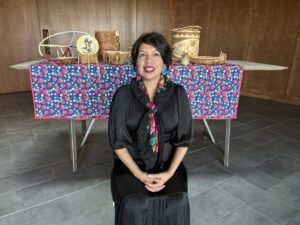 campus, we are sharing vocabulary, phrases and information to familiarize learners and employees with the traditional language.
For people passionate about entrepreneurship or delivering unforgettable guest experiences, the School of Business and Hospitality (kijewàdizi) focuses on innovation, customer service (anamikàge) and building skills that apply across many industries. Read more >
Posted on Friday, November 21st, 2025
On Thursday, Nov. 20, 2025, employees and learners got a head start on the holiday season as they took part in an Indigenous themed ornament-making workshop.
Anita and Jenny Tenasco guided participants though creating ornaments using traditional Indigenous crafting methods and natural land-based materials including wood pieces, pinecones, feathers, birchbark and leather.
The creativity abounded as participants enjoyed festive music, snacks and good conversation. Read more >
Posted on Thursday, November 20th, 2025
Two international youth are interning at the Algonquin College Ottawa Campus through the Fall 2025 Term. Te-Jung Tsai and Tzu-Ming Lin are part of the Taiwanese Ministry of Education’s Taiwan Global Pathfinders Initiative, which encourages Taiwanese youth to work abroad, exchange ideas and build cross-cultural connections with the international community.

(L-R): Te-Jung Tsai, Tzu-Ming Lin, Maria Montano (full-time research associate), Jed Looker, Danny Nhu (full-time research associate, TASTE team lead)
While at the College, Tsai and Lin are interning at the Human-Centred Design Lab under Principal Investigator Jed Looker, working on a community-based research project to address the challenge faced by Ottawa youth not in employment, education or training (NEET). In collaboration with Kevin Holmes in the Social Innovation Lab, the two-year project, titled Supporting Vulnerable Youth: A Transdisciplinary Approach to Service Transformation in NEET (TASTE), is funded by the Embark Student Foundation Grant in partnership with the Rideau-Rockcliffe Community Research Centre and aims to build pathways to post-secondary education by identifying the challenges faced by at-risk youth. Read more >