AC research highlights challenges faced by 2SLGBTQI+ international students in Ottawa
Posted on Monday, December 8th, 2025
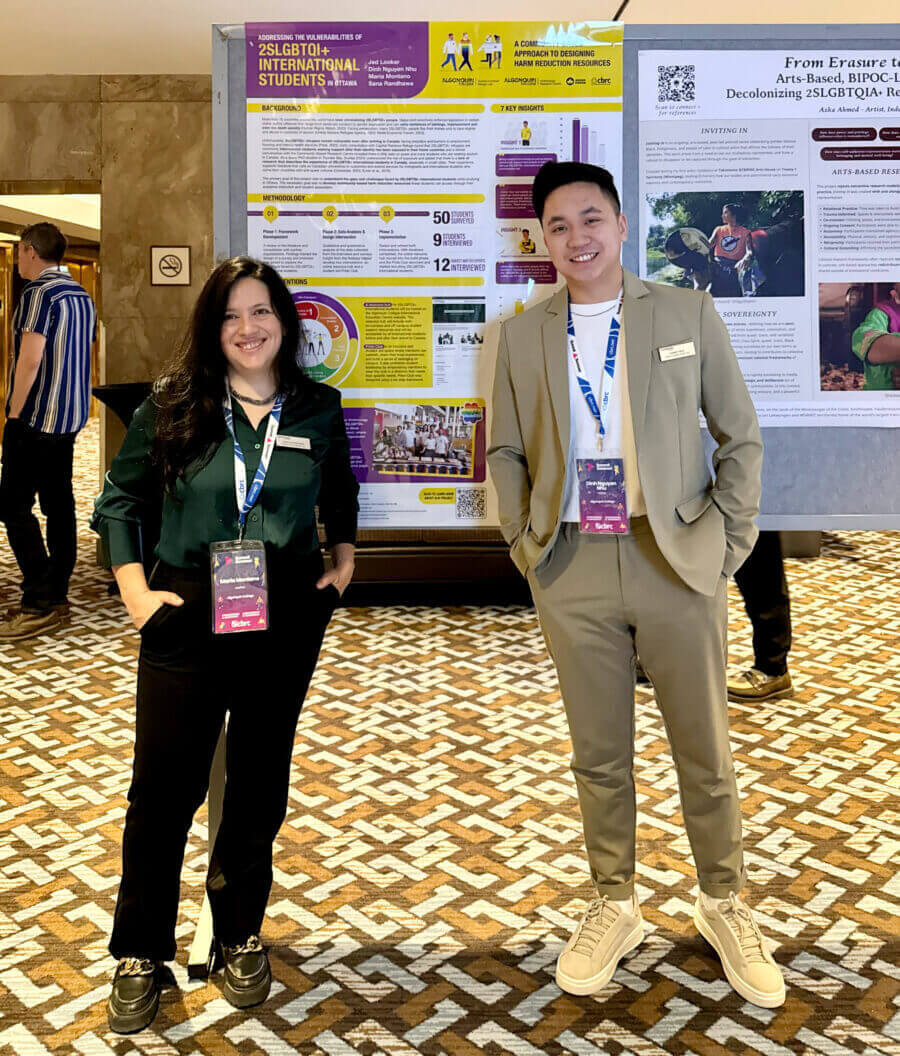
Dinh Nguyen (Danny) Nhu and Maria Montano at Summit 2025.
Researchers at the Human-Centered Design Lab recently presented their findings on a first-of-its-kind study outlining the challenges faced by 2SLGBTQI+ international students in Ottawa. Research associates Dinh Nguyen (Danny) Nhu and Maria Montano shared key insights at Summit 2025, an annual conference hosted by the Community-Based Research Centre (CBRC) which focuses on the health of 2SLGBTQI+ people.
Funded by the Natural Sciences and Engineering Research Council of Canada via the Algonquin College Research and Innovation Development Institute, the project, titled ‘Addressing the Vulnerabilities of 2SLGBTQI+ International Students in Ottawa’ explores the gaps and challenges experienced by 2SLGBTQI+ international learners. “At Summit 2025, we saw a lot of research focused on 2SLGBTQI+ Canadians and refugees, but ours was the only one focusing on 2SLGBTQI+ international students specifically,” said Nhu. “Our findings describe an often overlooked segment of the [2SLGBTQI+] community, especially with regards to the services and supports they need.”
Under the direction of Principle Investigator Jed Looker, the researchers worked in collaboration with the Algonquin College Victimology Research Centre and the CBRC to design a mixed-methodology approach for gathering data from 2SLGBTQI+ international students as well as leading subject matter experts (SMEs) from community organizations. In all, 50 international students of various ethnic backgrounds and sexual orientations participated in a survey – with nine of these students and an additional 12 SMEs interviewed – assessing barriers to settling in an Ottawa-based post-secondary community.
As former international students and recent graduates from the Interdisciplinary Studies in Human-Centred Design program at Algonquin College, Nhu and Montano leveraged their community connections to source participants.
“We put up posters at Algonquin College and also relied on word-of-mouth and social media to share it with 2SLGBTQI+ international students at other universities and colleges around Ottawa,” said Montano. “Not all the students are out of the closet yet, so we had friends in the community help us connect with them and feel comfortable that their identity would not be shared.”
Based on the data gathered, the researchers found seven key insights on the experiences of 2SLGBTQI+ international students:
- Isolation and lack of community connection.
- Disconnection between 2SLGBTQI+ domestic and international students.
- Impact of home country and navigating stigma.
- Limited visibility and accessibility of resources.
- Lack of mental health and culturally relevant support.
- Pressure to hide identity when returning to home country.
- Fear triggered by immigration policy changes.
From these insights, the research team developed two interventions: 1) an online resource hub for 2SLGBTQI+ international students that will be hosted on the International Education Centre website and 2) a student-led Pride Club.
“The online resource includes on- and off-campus student supports. International students can have a look before they arrive in Canada and see the resources at the College and recommended resources outside the College,” said Nhu. “We launched Pride Club to have an expanded focus that includes both domestic and international students.”
The researchers understand the importance of studying under-recognized groups and giving voice to the experiences of 2SLGBTQI+ international students. Montano recalled another presenter at Summit 2025 who said that as a former international student, identified with this project and had experienced all the insights in the project findings.
Similarly, Nhu remarked on the importance of representation in research.
“Because I also come from the community, I wanted to tell international students’ stories. I feel like it’s not only about the research, but also about how we care about our community and how we implement the research … that is the key and why being a researcher is my dream job.”