Most people know Algonquin College’s Outdoor Adventure (ODA) program for what happens on the river, in the backcountry, and along rugged trails. They picture students learning resilience in unpredictable weather, working as teams in demanding conditions, and discovering their capacity for leadership through challenge and experience. What many don’t realize is that this flagship Pembroke Campus program doesn’t just prepare graduates for the outdoors; it also serves as a launchpad, opening doors to university degrees and professional careers students never imagined possible.
Much of this confidence comes from learning in real environments, supported by real industry leaders. For more than 25 years, the ODAprogram has proudly partnered with Wilderness Tours, one of Canada’s premier adventure tourism organizations. This long-standing partnership provides students with exceptional training grounds, mentorship from industry professionals, and opportunities to learn where world-class whitewater and outdoor leadership come to life.
For many learners, ODA is the program that changes how they see themselves. Some come unsure whether college, let alone university, is the right fit. But through hands-on learning, mentorship, and personal growth, ODA builds discipline, maturity, confidence, and purpose. Suddenly, students begin to see education differently. They begin to see themselves differently.
That sense of transformation is exactly what Jayden Spylo describes. After working for two years post-high school, he joined ODA, unsure of the direction his life and education would take. The program gave him adventure, community, and momentum, and ultimately the confidence to continue to Thompson Rivers University (TRU) in British Columbia, where he is now thriving in his degree studies. Jayden says the experience helped him mature, opened doors he never expected, and gave him the self-belief he had never felt in his earlier schooling.
For Victoria Hodgson, ODA was also the beginning of something much bigger. She completed the program in 2020, transferred her credits to TRU, and ultimately completed a Bachelor of General Studies. Along the way, she guided professionally, studied at multiple institutions, and is now completing a post-degree teacher education program at the University of British Columbia. Victoria never imagined ODA would one day lead her to a teaching career with multiple degrees, but she now describes the pathway as life-changing, full of opportunity, movement, curiosity, and choice.
Katie Stetson’s journey shows just how unexpected these pathways can be. She completed ODA, continued to TRU, and there, through a course in legal risk management, discovered a passion for law she never anticipated. Today, she works in civil litigation and also teaches legal courses to the next generation of learners. She credits the ODA-to-TRU pathway with putting her on a professional path she never would have predicted, but one she deeply values.
For Adrian Clementino, ODA provided the ideal balance of hands-on challenge and academic preparation. He completed ODA in 2021 and then went directly to TRU, graduating with a Bachelor of Tourism Management, majoring in Entrepreneurship. Since then, his career has been as adventurous and dynamic as the program itself, from managing a remote accommodations operation on the West Coast to now serving as Club Manager of the Ottawa Rowing Club, where he leads operations, budgeting, events, and staff while still maintaining a personal connection to guiding. Adrian says the combination of ODA and TRU has shaped not only his career opportunities, but also the life he is proud to live today.
Even years later, the impact of ODA continues to ripple through graduates’ lives. Lauren Hammond, who completed ODA in 2006 before continuing at TRU, went on to earn a Bachelor of Social Work and then a Master of Social Work. Her career has included guiding, therapeutic wilderness work, and leadership in youth-focused programs, and she is now exploring how to integrate her expertise in mental health with her deep roots in outdoor experience through adventure-based therapy. She says the ODA–TRU pathway opened professional and academic doors that helped her build a deeply meaningful career — one she never would have anticipated as a young graduate.
Together, these stories share something powerful. Students who once questioned whether higher education was “for them” now speak about thriving at university. Graduates who began in rafts, canoes, and climbing harnesses now speak confidently about advanced degrees, leadership roles, community impact, and professional purpose. ODA did not just prepare them to guide trips; it prepared them to build lives, grounded in capability, belief, and opportunity.
Rooted here in Pembroke and reaching across Canada and beyond, the Outdoor Adventure program remains one of the most uniquely transformative learning experiences in the country. For some students, ODA is the destination. For many others, it becomes the trailhead; the beginning of a journey toward education, careers, and futures they never imagined but are incredibly proud to pursue.
If this story sparks curiosity, you can learn more about the Outdoor Adventure program and what makes it such a powerful, life-shaping experience by visiting algonquincollege.com/pembroke/program/outdoor-adventure. For those wondering what comes next after graduation, explore the many degree pathways available to Algonquin College students, including direct routes to universities across Canada and beyond, at algonquincollege.com/pathways. Whether your dream is to lead, teach, innovate, build community, or continue your studies, the next step may be closer than you think.
Algonquin College is proud and excited to open applications for its newly approved Bachelor of Science in Nursing (Honours) degree program, available at Pembroke and Ottawa campuses.
The launch comes as Algonquin College celebrates 50 years of nursing excellence—a milestone that reflects our long-standing commitment to preparing skilled, compassionate health-care professionals who strengthen care across our region and beyond.
The new program builds on our proven strengths in hands-on, high-quality nursing education. Graduates will be eligible to apply for registration as Registered Nurses (RNs) in Ontario and will be well prepared to serve in hospitals, long-term care facilities, community health organizations, and home and community care providers across the region and beyond.
“For communities in Ottawa, Pembroke, and surrounding areas, the program represents a meaningful investment in accessible, locally delivered nursing education that will help address current labour shortages and support healthier communities for years to come,” said Julie Beauchamp, Algonquin College’s Senior Vice President, Academic.
“Our outstanding faculty and academic teams, together with the strength of our long-term health-care partnerships, form the foundation of our nursing programs. It’s this collaborative network that allows us to deliver world-class education and clinical training—directly supporting the health and well-being of the communities we serve.”
Applications are also scheduled to open in Fall 2026 for an accelerated BScN (Honours) pathway which would see the four-year Honours degree delivered across 3 years and 4 months. This innovative option enables learners to complete their degree more efficiently while maintaining full academic rigor, comprehensive clinical preparation, and a strong emphasis on mental-health supports.
The College’s partners are also pleased to see the new program’s approval:
“Algonquin College’s expanded nursing degree pathways will help ensure a strong pipeline of skilled, compassionate nurses for our region. The Ottawa Hospital is proud to support the hands-on learning and clinical training that prepare graduates to deliver exceptional care to the patients and communities we serve.” – Janet Graham, Chief Nursing Executive and Executive Director, Medical Care, The Ottawa Hospital.
“Without the College, we wouldn’t be able to staff many of our units. Having students and recent graduates at Pembroke Regional Hospital (PRH) is a must as they come with the latest and greatest training and knowledge.” – Sabine Mersmann, CEO of the Pembroke Regional Hospital.
About the Programs
The Bachelor of Science in Nursing (Honours) program provides learners with a comprehensive foundation in nursing theory, clinical decision-making, and hands-on practice. Training occurs in modern classrooms, high-fidelity simulation environments, and applied nursing skills labs designed to replicate real-world health-care settings.
Learners are supported through a wide range of clinical placements and a final consolidation experience in diverse health-care environments, including:
Hospitals
Long-term care homes
Home and community care
Community health organizations
The curriculum integrates:
Evidence-informed practice
Indigenous Knowledge systems and multiple ways of knowing
Cultural humility and person-centred care
Intra- and interprofessional collaboration
Graduates are prepared to write both the NCLEX-RN and the CNO Jurisprudence Examination, enabling them to practice across Canada and internationally.
Admissions Requirements
Applicants must meet both College Eligibility and Program Eligibility requirements. Applications are open to learners with an Ontario Secondary School Diploma (OSSD) and to mature applicants who meet the specific academic prerequisites.
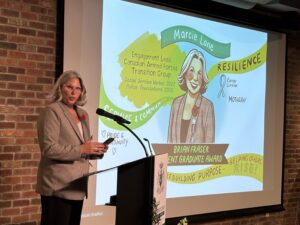
Every community has people whose stories quietly remind us what strength and purpose look like. This year, as part of the Algonquin College Alumni of Distinction Awards, the Pembroke Campus proudly honours Marcie Lane, recipient of the Brian Fraser Recent Graduate Award. Her journey, from military service to social service, reflects not only courage and reinvention but also the way education and community can intersect to change lives.
Marcie’s path began more than two decades ago when she enrolled in Police Foundations at Algonquin College. That experience led her into the Canadian Armed Forces, where she served as a military photojournalist, capturing stories of courage and sacrifice around the world. Her lens took her from training fields to deployment zones, where she chronicled the experiences of soldiers and their families.
But even the strongest among us face battles closer to home. When Marcie was diagnosed with stage-three breast cancer, she found herself confronting a new fight, one that tested her resolve and reshaped her perspective. After recovery, she returned to the classroom, this time in the Social Service Worker program at the Pembroke Campus, determined to translate her personal resilience into professional service. “These people are the experts in their own lives,” she says of her clients. “We can’t rely on assumptions or stereotypes.”
That philosophy now guides her work as Engagement Lead with the Canadian Armed Forces Transition Group, where she assists veterans and their families in navigating the often complex process of transitioning out of military life. She also continues her studies, completing a post-graduate certificate in Addictions and Mental Health, driven by her belief that informed, compassionate support can make all the difference.
Marcie’s story resonates because it feels familiar, not in its details, but in its essence. It’s the story of someone who has faced hardship and chosen to transform it into purpose. It’s a story that reflects the heart of the Ottawa Valley: perseverance, humility, and community care.
For the Pembroke Campus, her recognition represents more than a single success story. It’s a reminder of the ripple effect that occurs when graduates apply their learning to the world. Our alumni don’t just find jobs; they create impact. They become nurses, entrepreneurs, educators, environmental stewards, and advocates. People whose daily work strengthens the social and economic fabric of our region.
Marcie’s example also underscores the power of lifelong learning. Education isn’t always linear; sometimes it’s a second chance, a career pivot, or a healing process. Her return to Algonquin after years of service demonstrates what’s possible when determination meets opportunity, and how the support of a caring campus can reignite both purpose and possibility.
As we celebrate Marcie Lane as this year’s Alumna of Distinction, we celebrate every graduate who takes what they learned here and uses it to lift others. These are the stories that remind us why education matters, not just for individual achievement, but for the collective strength of our communities.
Marcie’s is one of many inspiring stories. Are you an alumnus of the Pembroke Campus? Please share your story with us here: algonquincollege.com/pembroke/alumni.
Posted by: Jodi Bucholtz, Acting Manager, Community & Student Affairs
Since 1967, our Forestry Technician program has stood as a pillar of applied education in the natural resources sector. Over nearly six decades, it has shaped countless graduates who walk into the woods, the mills, conservation agencies, and government environmental departments at all levels. In doing so, the program has strengthened our region and the broader stewardship of Canada’s forests. This fall, as students return to campus, the program is thriving, evolving, and more relevant than ever.
From the first cohort in 1967 to this year’s new students, the Forestry Technician program has been grounded in immersive, practical training. A significant amount of the curriculum is delivered in the field, giving students real forests to work in, inventory, practice best management, and nurture a deep connection to our forest ecosystems. Our students also benefit from learning experiences at the Petawawa Research Forest, a federally operated site with over a century of history in forest science and management. It offers unparalleled access to diverse forest types and research opportunities, reinforcing our program’s strong ties between education and the forestry profession.
Alumna Sionaid Eggett, now working with the Ontario Woodlot Association, recalls the importance of this hands-on approach, “I was greatly attracted to the amount of hands-on in the field learning Algonquin had to offer … Never have I worked in an environment that is so uplifting, where everyone cares about your journey.” Her words echo what students experience today, an environment where mentorship, applied skills, and community spirit make all the difference.
In Canada, the forest sector remains a major contributor to the economy and to sustainable development. The latest State of Canada’s Forests report gives a 2023 figure of $36.2 billion for Canada’s forest product exports, while Ontario’s Forest Sector Strategy calls for cultivating the next generation of professionals to ensure sustainable forest management. Forestry provides employment, ecological stewardship, and vital resources, making trained graduates more essential than ever.
As Program Coordinator Peter Arbour explains, “Our Forestry Technician program is built on decades of field tradition, evolving technology, and professional mentorship. Each year, I see students arrive with curiosity and leave with confidence, ready to step into roles managing forests, monitoring health, and contributing to sustainable landscapes. It’s not just about teaching forestry; it’s about creating stewards of the land who will serve our forests for years to come.”
Industry, too, continues to see the value in forestry education. This year, two of our current students, Reed Griese and Ava Newcombe, were named recipients of the prestigious Schulich Builders Scholarship. Their recognition not only celebrates their personal achievements but also affirms the importance of investing in skilled forestry professionals who will carry the sector forward.
What makes the program robust today is its adaptability. The curriculum integrates both traditional forestry foundations and modern tools such as GIS mapping, remote sensing, and forest health assessment. Our proximity to Algonquin Park and partnerships with organizations such as the Petawawa Research Forest and Canadian Nuclear Laboratories ensure that students encounter diverse and real-world conditions.
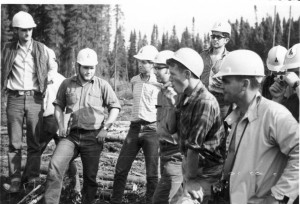
Photo Credit: Ontario Ministry of Natural Resources and Forestry
This combination of heritage and innovation has enabled graduates to secure meaningful employment across the Valley and beyond, contributing to municipal planning, ecological restoration, forest management, and renewable resource management.
As older generations of forestry professionals retire, the demand for skilled technicians is growing. Our program is uniquely positioned to meet that demand by producing graduates who not only understand forestry as an industry but also embrace it as a calling to care for the land. The stories of alumni like Sionaid, the recognition of students like Reed and Ava, and the leadership of faculty like Peter and all the Forestry professors actively working in the industry affirm that the future of forestry education at Pembroke Campus is both strong and sustainable.
From its founding in 1967 to the present, our Forestry Technician program has withstood the test of time with consistently high enrolments each year, not by resting on its legacy alone, but by evolving, adapting, and deepening its roots in both the land and the community. As forests face changing climates, pests, land pressures, and shifting socio-ecological demands, the connections and skills that the Algonquin College Forestry Technician Program offers are needed more than ever.
Eighty-two newly minted nursing graduates took their first professional steps this spring at the Practical Nursing and Bachelor of Science in Nursing (BScN) Pinning Ceremonies. The dual celebrations were extra‑special as 2025 marks the 50th anniversary of our Practical Nursing program and the 25th anniversary of our collaborative BScN degree. Together, these milestones remind us that for half a century, our campus has been a steady source of skilled, compassionate caregivers for our community.
Why the Pin Matters
Long before graduates write “RN” or “RPN” after their names, the pin signals entry into nursing’s global family. The tradition dates to the 1880s, when Florence Nightingale awarded a “badge of honour” to exemplary students. Today’s ceremony is both a rite of passage and a gesture of gratitude to the individuals who supported each student’s progress, including family members, mentors, and sometimes entire communities. During this year’s ceremonies, graduates spoke eloquently about why they chose a particular person to fasten that gleaming pin to their uniform.
Stories Behind the Pins
Behind every nursing pin is a story of resilience, encouragement, and the relationships that carried each graduate through. For many students, the person chosen to do the honours represented the heart of their support system throughout the long journey to becoming a nurse.
Ainsley Lee chose her mother, Jennifer MacIntosh, to pin her. Jennifer had been her constant cheerleader, offering wisdom and encouragement that helped Ainsley stay grounded through the challenges of nursing school. Similarly, Gabriella Bouffard selected her mom, describing her as her lifelong supporter who consistently encouraged her to be her best self. Her mom’s guidance over the past four years, Gabriella said, helped open the door to the next chapter of her life.
For Rebecca Langille, the decision was deeply rooted in family values. She asked her mother, Helen, to pin her, crediting her as the single most influential person in her academic journey. Rebecca also honoured her late grandmother, a longtime RN, through the gesture, saying her mom’s belief that “education is never hard to carry around” helped propel her through difficult times. Kimberley Foster was pinned by her aunt and godmother, Julie St. Denis, a critical care nurse for 45 years. Julie’s lifelong commitment to nursing was part of what inspired Kimberley to pursue a career in the profession herself.
Nurses inspired several graduates in their own families. Quincey Lane chose her mom, Erin Van Hoof, who is an RPN, calling her “the perfect candidate.” Paiton Prince echoed that sentiment, choosing her mom Pam for always being her rock and helping her in more ways than she’ll ever know.
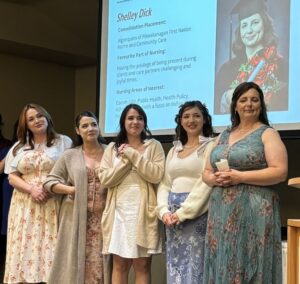
In one especially moving moment, Shelley Dick was pinned by her four daughters—Amber, Allison, Aleesha, and Angelina. Shelley described their grace, perseverance, and optimism as her greatest source of inspiration throughout her nursing journey, making the milestone even more meaningful.
Other students chose siblings or mentors who had walked alongside them through both school and life. Tiffany Matthews asked her brother, Jean-Luc Martin, to pin her, noting his steady presence and unwavering support. And Vicki Alexopoulos Read, the valedictorian of the 2025 Algonquin College graduating class, turned to someone who had shaped her nursing perspective in profound ways: her professor and program coordinator, Kerri-Lynn Weeks. Vicki shared that Kerri-Lynn had expanded her understanding of what nursing could be and had been a consistent source of guidance throughout the program’s ups and downs. “I hope to be as supportive a nurse to others,” she said, “as she has been to me.”
Each story underscores a truth we sometimes overlook: students rarely arrive at graduation alone. Partners cover childcare, elders share wisdom, peers trade lab notes, instructors open doors, and the entire community benefits when those efforts culminate in new nurses ready to serve.
This year’s 82 graduates will soon be caring for patients in acute-care wards, home-care agencies, and community health centres that will feel the immediate impact of their training.
As we celebrate golden and silver anniversaries side by side, the message is clear: our campus remains committed to educating nurses who are clinically excellent, culturally competent, and deeply rooted in community values. That commitment is evident in every pin clasped by a proud parent, sibling, mentor, or child, and in every patient who will soon feel the steady, confident hands of a 2025 graduate.
To the Class of 2025, thank you for choosing nursing, thank you for choosing our community, and thank you for reminding us that behind every polished pin lies a story of courage, love, and hope.
Posted by: Jodi Bucholtz, Acting Manager, Community & Student Affairs
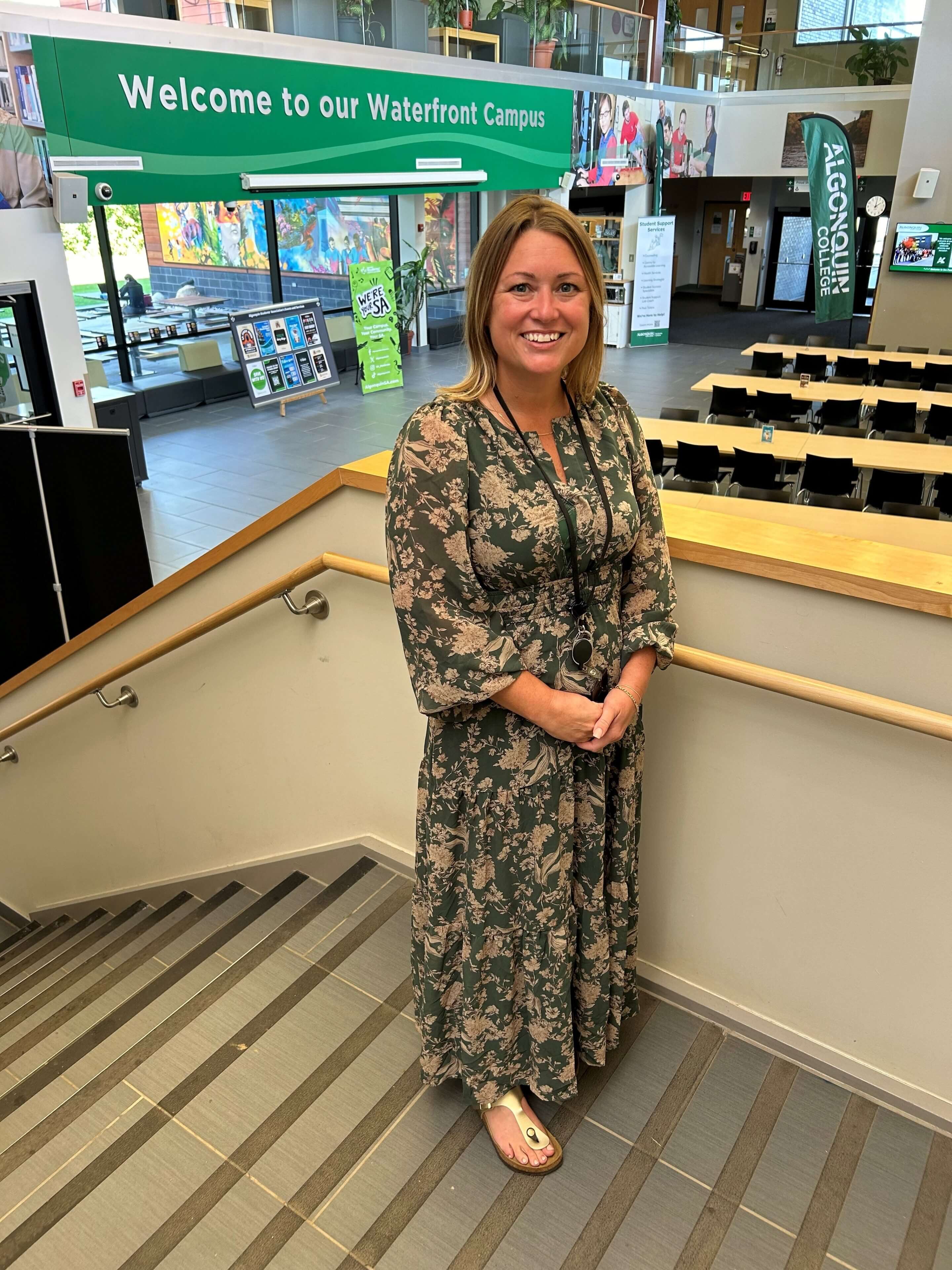
Jennifer White planned on becoming a teacher, but when she learned that some graduates of teaching programs were having trouble finding work, she took a step back and started thinking about other options. She was just finishing up high school and was trying to figure out what her next steps would be. She needed a job and was working in the hospitality industry when she accepted a part-time position supporting people who had physical disabilities or developmental challenges. It changed her life. She was 20 years old, and she was getting her first taste of being an advocate.
“It was through this role that I started to make the link between the social determinants of health and positive outcomes and began to truly appreciate the real impact of systemic inequities. At a really high level, I understood that there was a broader system of economic and political policies, and systems that were not always working in the best interest of the individuals or populations they are intended to serve,” says White.
Jennifer White graduated from the Bachelor of Science in Nursing program at Algonquin College’s Pembroke campus in 2010.
White understood that if she wanted to make a difference, she needed a post-secondary education, so in the Fall of 2006, she enrolled in the Bachelor of Science in Nursing program at Algonquin College’s Pembroke campus. After completing her first year in the four-year degree program, she secured a job working as a Personal Support Worker in long-term care. Again, she felt there were opportunities to remove systemic barriers that she felt were hindering the quality of care for residents. She wanted to influence policy change and dig deeper into addressing the root cause issues in a complicated multi-tier health care system.
“I remember thinking to myself, when I am a registered nurse, I can help fix this,” White recalls.
While in college, she especially enjoyed her community health nursing project. It helped her understand change management, the value of using data to measure outcomes, and the importance of intentional planning to ensure project success. She honed her critical thinking skills, questioning “why we do the things we do and why do we do them the way we do?”
Inquisitive and determined, White was finding her passion. The textbooks, lab work and clinical placements prepared her to be a nurse, but her enthusiasm for her work would stretch beyond patient care. She thoroughly enjoyed nursing and was committed to improving health outcomes by providing evidence based, person-centered, compassionate care to her patients, but she was looking for more. She was constantly challenging herself to think more broadly about how to do things better. White’s approach to patient care and her demonstrated leadership in quality improvement did not go unnoticed.
Soon, she was in management, becoming a nurse manager and later a Director of Nursing. She learned quickly that systemic change isn’t easy to implement, but through persistence and purposeful changes, improvements can be made. Making progress takes time and it takes resources, both people and in many cases financial investments. Again, it brought White back to her role as an advocate and being a voice for the most vulnerable people in society.
By the summer of 2023, White had been working in health care for more than a decade , including time spent in the not-for-profit sector. Like everyone else she had come through a worldwide pandemic that was challenging, particularly for those working in health care. She was open to change. She applied to become the Executive Director of Renfrew County Family and Children Services and was successful. It was a big move, one that would put her on a steep learning curve, but her values hadn’t changed. She wanted to help people.
Family and Children’s Services of Renfrew County delivers adult and children’s developmental services, and child welfare with the mission of helping families and communities in Renfrew County protect and support the development and well-being of children, youth, and adults through integrated services, prevention and social inclusion. The agency believes that every child and youth needs long-lasting relationships in safe environments to flourish. It was a position that appealed to White’s inner self, an opportunity to support the family unit and try to help children succeed in life.
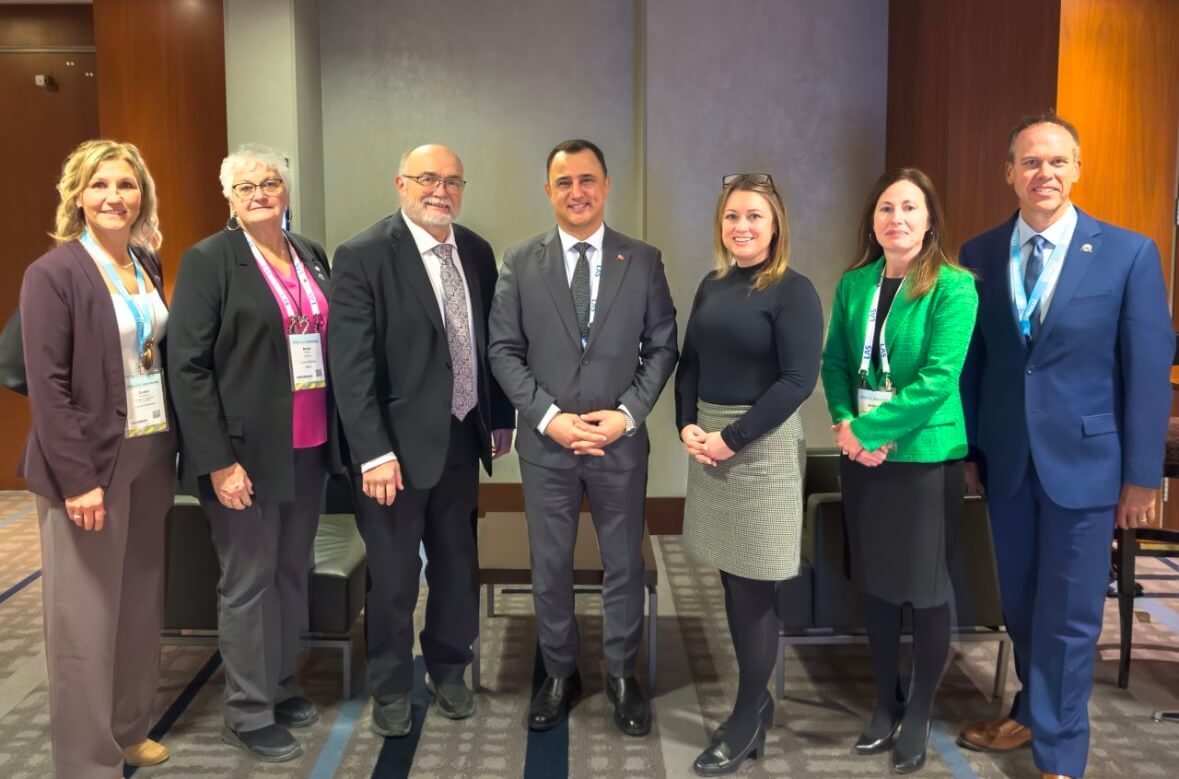
Family and Children’s Services Executive Director Jennifer White joined other Renfrew County representatives at the Rural Ontario Municipal Association Conference.
Since assuming the role, White has taken a deep dive into the multi-service organization to better understand where the pressure points are. That review has led her to the doors of government where she has joined a chorus of others who are pleading for a greater investment to support children and families, who are relying on her agency for help.
“Families are finding it extremely difficult to gain access to early supports, interventions and treatments for their children, especially children with developmental, behavioural, and complex needs. As a result, we are tragically seeing kids coming into care because families are exhausted and have reached a breaking point,” says White.
The goal of the work White leads is to support and strengthen children and families. Her teams work hard to ensure that developmental and behavioural needs are met, and to provide or connect families with the services they need to thrive and stay together – preventing children and youth from coming into care whenever possible.
The work isn’t easy. It’s tough on the front-line workers who are involved in challenging and often heartbreaking work. Agency workers need to work with families in difficult situations and rely on foster parents to provide the support needed to children who are displaced.
It requires an empathetic leader who can support people and build relationships while also navigating their way through the sometimes complicated circumstances that place children and families at risk. At a time when many families are struggling under the weight of socio-economic issues such as the high cost of the basic necessities of life, food and housing, relationships can break down. When children are involved, Family and Children Services are brought in to address challenging situations. The nature of the work can take be stressful and every situation is different, requiring White and her colleagues to assess and act in the best interests of everyone involved. That means tough decisions are often necessary to make, decisions that don’t please all parties.
White realizes she doesn’t have all the answers, but she’s getting pretty good at telling her organization’s story. Recently she was in Toronto with other County of Renfrew representatives, speaking to Ministers and government officials at the Rural Ontario Municipal Association conference. Her message was clear. “We need adequate and stable funding for the critical supports we provide as a multi-service organization supporting vulnerable children, youth and families in rural Renfrew County. It will help us ensure improved outcomes but also reduce the risk factors for involvement with child protection services.”
FCS Executive Director Jennifer White speaks to Renfrew County council.
As she settles in at Family and Children Services, White is making the connections she needs to advance her advocacy work, while also reflecting on her approaches and continually learning from both her successes and her mistakes. It’s a skill she learned while studying at Algonquin College where she journaled and embraced the power of reflecting on her day-to-day work.
White can be hard on herself, but with time she has become a more confident leader. “What I can say is that I do take the time to reflect on the small and large interactions and activities I engage in on a daily basis, try to give myself kudos for the good stuff – but also actively critically assess my actions and interactions to discover opportunities for improved practice,” says White.
Spoken like a nurse and a leader, always thinking critically and looking ahead to try to find solutions. From those early career experiences helping people with disabilities to her current role leading Family and Children Services, Jennifer White has found her voice. Just ask her. She’s an advocate and visionary. She has lots of ideas and is investing the time and energy needed to make things better in her community.
(Posted by Jamie Bramburger, Interim Dean of Pembroke Campus)
As 2024 comes to a close, Algonquin College’s Pembroke campus is looking back on another year of great accomplishments by its students, alumni and employees. Our year in review starts in January when the campus expanded its health care program offerings by adding new sections of the Practical Nursing and Personal Support Worker programs to help address labour shortages in our local health care sector.
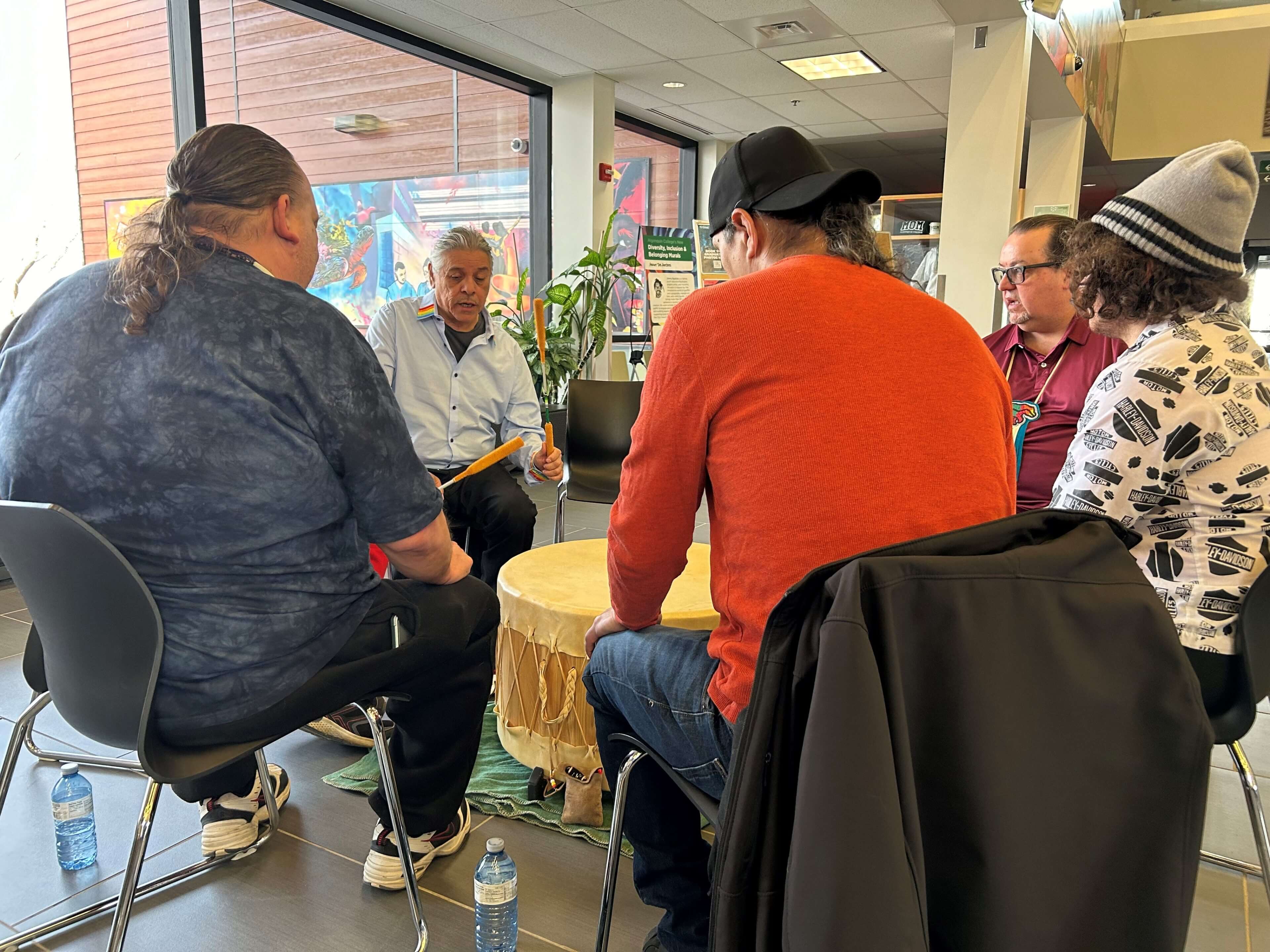
In February, the process of naming the campus drum began with a special ceremony led by Elder Barry Sarazin who later revealed that the Grandfather drum was to be named Mishomis Ashage Dwegan. The drum naming came six years after it was built by students under the direction of Elder Skip Ross and knowledge holder Pinock Smith.
Elder Barry Sarazin leads drumming at a special drum naming ceremony at Algonquin College’s Pembroke campus.
Former Federal Justice Minister Jody Wilson-Raybould visited the Pembroke campus in March as part of the campus speaker series. She spoke about how Canadians can become “inbetweeners” to help strengthen the relationships between Indigenous and Non-Indigenous peoples. After leaving politics, Wilson-Raybould has been an outspoken advocate for Indigenous peoples and has now written several books.
Tree climbing is physically demanding, but students in the Urban Forestry-Arboriculture program were highlighting their climbing skills at their year-end climbing competition in April. The event always attracts a lot of arborist employers who are eager to hire these very talented students.
The Options Skilled Trades Fair continued to promote apprenticeship training as a career option for young people when it was held in May at the Pembroke Memorial Centre. Hundreds of high school students from across Renfrew and Pontiac Counties participated in the event which again included several skills competitions among senior high school students in fields such as welding, carpentry, culinary arts, small engine repair and tire changing.
Pembroke campus alumnus Jason Blaine holds a key to the city of Pembroke after his charity topped $1-million raised at his annual concert and golf tournament.
June was a month of celebration. Alumnus Jason Blaine cracked the $1-million milestone in fundraising as his charity golf tournament and concert marked its tenth anniversary. Blaine was also awarded the key to the city of Pembroke, recognition for his talent and his philanthropic support for his hometown. Also in June, hundreds of graduates crossed the stage at our convocation ceremony and our campus Dean, Sarah Hall, was honored with a special coin presented by Garrison Petawawa commander, Colonel Jason Guiney for her tireless work strengthening the college’s relationship with the Canadian Armed Forces.
July brought good news to the campus as it was approved by the province to deliver the Arborist apprenticeship training program. Adding this apprenticeship program is complimentary to the full time Urban Forestry-Arboriculture certificate program that the campus has delivered for several years. The campus also offers carpentry and electrical apprenticeship training programs.
In August, the Pembroke campus sought public input on its master campus development plan. As it looks towards the future, the college is considering where investments will need to be made in its facilities.
Former Olympian figure skater and mental health advocate Elizabeth Manley returned to campus in September to be part of a tree planning activity with Forestry students. The activity was held on International Suicide Prevention Day, giving students and campus employees an opportunity to remember friends and family who have died by suicide. It also opened up a door for Manley to speak about the importance of mental health and wellness, as she shared her own personal journey battling depression during her skating career.
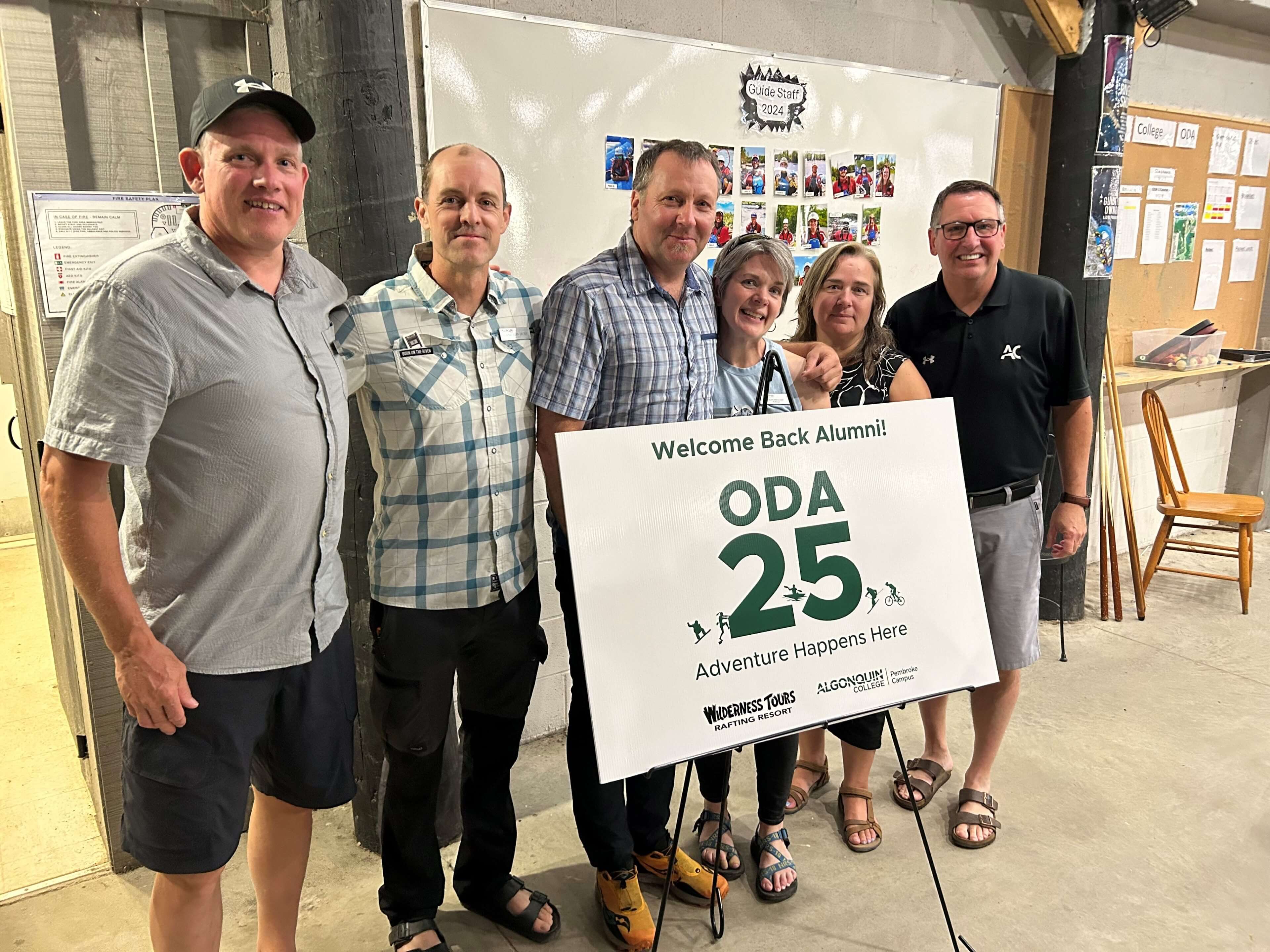
In September, the Outdoor Adventure program marked its 25th anniversary with a special homecoming weekend at Wilderness Tours. Alumni from the program returned to the Ottawa Valley from across the country to re-connect with former classmates and faculty while enjoying a weekend of whitewater rafting and other adventure activities.
Retired General Rick Hillier headlined our Fall Business Leadership conference in October. General Hillier helped the conference attract a large crowd as he shared his experiences leading Canadian troops and offered sound advice on leadership. Television and podcast personality Amber MacArthur returned to the conference to speak about artificial intelligence and its impact on the workforce.
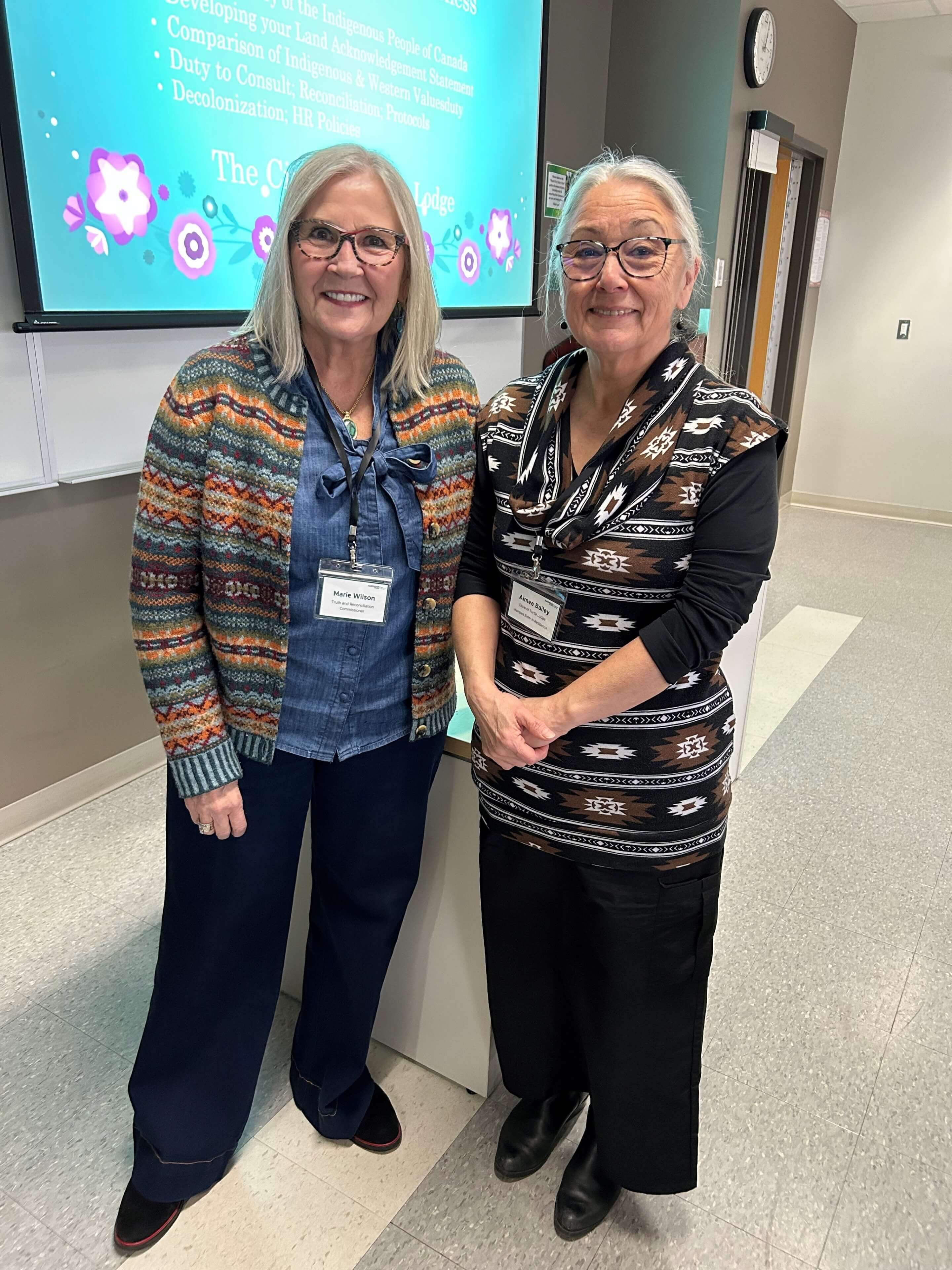
Truth and Reconciliation Commissioner Marie Wilson and Pembroke Campus Elder Marie Wilson.
Marie Wilson was one of three commissioners to lead Canada’s National Truth and Reconciliation commission. She came to the Pembroke campus in November to speak about her new book, North of Nowhere, which chronicles her experience working with His Honour, Murray Sinclair and Wilton Littlechild for more than six-and-a-half years as they listened and recorded testimony from survivors of Canada’s residential school system.
More than 20 campus employees visited the Chalk River labs of Canadian Nuclear Laboratories in December. CNL is a major employer of Algonquin College graduates and co-op students and the tour of the site helped faculty and staff consider future partnerships.
There was so much more that happened this year, but these few highlights show what a vibrant learning community exists at Algonquin College’s Pembroke campus. The college will close for the holiday season on December 24th and will re-open on January 2nd. The Winter term begins on Monday, January 6th.
(Posted by Jamie Bramburger, Interim Dean of Algonquin College’s Pembroke campus)
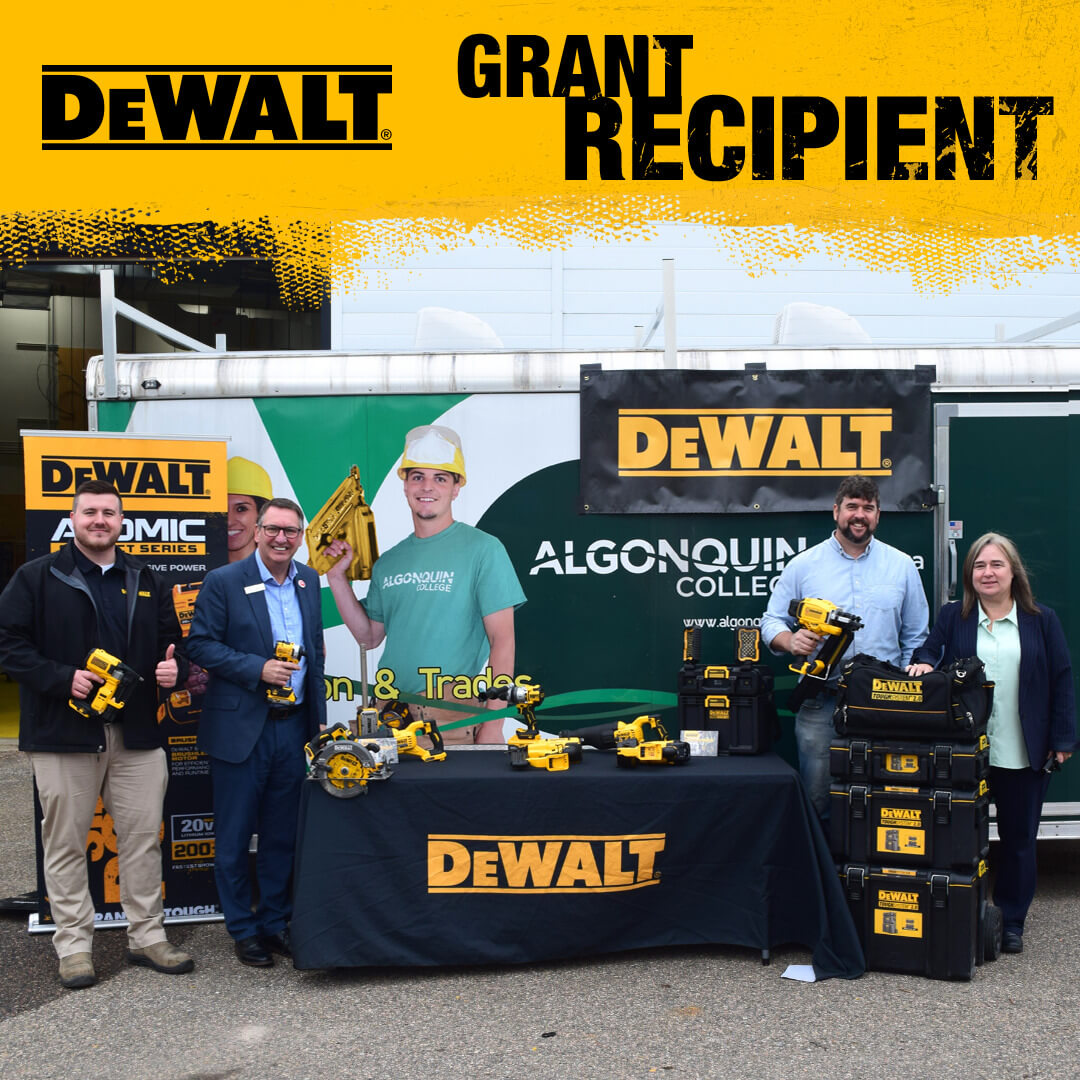
Building partnerships to support student learning experiences continues to be a priority of Algonquin College’s Pembroke Waterfront campus. The campus has been chosen as a DEWALT® Grow the Trades Grant recipient for its commitment to providing a skills labour force by training skilled trades students.
With an estimated 500,000 open construction jobs unfilled in North America, DEWALT’s Grow the Trades Grants aim to help close the skilled labour gap by supporting nonprofit organizations that are skilling, reskilling and upskilling tradespeople. Each year, the program awards funding and tool donations as part of a larger $30 million commitment over five years to close the skilled trades gap.
The Pembroke Campus was selected as one of 166 North American organizations providing greater accessibility and resources for trades training. The grant will benefit students in the Carpentry and Renovations Techniques program and the college’s Carpenter apprenticeship program.
“We are extremely proud to be recognized as a DEWALT Grow the Trades Grant recipient. This funding will further strengthen our ability to provide high-quality education and training to our skilled trades students, helping to meet the critical labour needs of our local construction industry,” said Jamie Bramburger, Interim Dean at Algonquin College’s Pembroke Campus.
“This support from DEWALT means our Skilled Trades programs will be able to upgrade our tool inventory, giving students hands-on experience with the same tools they’ll be using on the job site. Think of it as ensuring our learners get their ‘tool belts’ fully stocked and their skills sharpened for the future,” shares Adam Johns, Coordinator of the Carpentry and Renovation Techniques and General Carpentry Apprenticeship programs.
“DEWALT is immensely proud to support Algonquin College’s Pembroke Campus as they work to skill and reskill the tradespeople of tomorrow moving us closer to our shared goal of closing the trade skills gap,” said Allan Hawes, General Manager of Stanley Black & Decker Canada. “Funding educational programs and non-profits like the Pembroke Campus connects more people to training, resources and opportunities that will lead to successful careers in the trades.”
To learn more about the DEWALT Grow the Trades Grant, recipients and updates for the upcoming application period, please visit DEWALT Grow the Trades.
From left to right: Jordan Kell, PRO Contractor Specialist, Stanley Black & Decker; Jamie Bramburger, Interim Dean; Adam Johns, Program Coordinator; Bobbie Gormley, Business, Technology and Outdoor Training Department Chair
About Algonquin College’s Pembroke Campus
The Pembroke Campus currently offers 20 full-time programs, serving approximately 1,000 students. The campus also delivers apprenticeship and corporate training programming as well as several employment preparation and training programs for both the Ontario and Canadian governments. For more information, visit www.algonquincollege.com/pembroke or follow the Campus on Facebook, X, Instagram, and LinkedIn.
About DEWALT
DEWALT, a Stanley Black & Decker brand, celebrates 100 years in business by continuing to provide our customers with total jobsite and landscaping solutions. By applying its latest technology to the challenges of today’s skilled trades, DEWALT is leading the charge for the jobsite of the future and pioneering the next generation of tools, outdoor equipment and forward-looking technologies. DEWALT products. GUARANTEED TOUGH®. For more information, visit www.dewalt.ca or follow DEWALT on Facebook, X, Instagram, and LinkedIn.
About Stanley Black & Decker
Founded in 1843 and headquartered in the USA, Stanley Black & Decker (NYSE: SWK) is a worldwide leader in Tools and Outdoor, operating manufacturing facilities globally. The Company’s approximately 50,000 diverse and high-performing employees produce innovative end-user inspired power tools, hand tools, storage, digital jobsite solutions, outdoor and lifestyle products, and engineered fasteners to support the world’s builders, tradespeople and DIYers. The Company’s world class portfolio of trusted brands includes DEWALT®, CRAFTSMAN®, STANLEY®, BLACK+DECKER®, and Cub Cadet®. To learn more visit: www.stanleyblackanddecker.com or follow Stanley Black & Decker on Facebook, Instagram, LinkedIn and X.
The Shaw Woods Outdoor Education Centre near Lake Doré has become a special place for people of all ages, including students who study in the Forestry Technician program at Algonquin College’s Pembroke campus. The old growth forest that is part of the property is majestic, almost eerie, and sparks the imagination of visitors as they walk the paths that surround trees that are hundreds of years old.
During her time studying in the Forestry program, it was a special place for Sionaid Eggett, who had left a career in early childhood education to pursue her passion for the outdoors. It happened by accident. Eggett had worked in the field for more than a decade, primarily supporting children with special needs, but she was becoming restless and was planning to teach internationally. Then, the COVID—19 worldwide pandemic derailed her plans.
“I had done some backpacking trips in Algonquin Park and thought that if I had the opportunity I would become a park ranger as my favourite places to visit during my travels were the natural sites. The people who worked in the parks seemed to have the best time and it aligned with many of my personal interests and pursuits,” says Eggett.
One of the people she met in the Park was a woman who had graduated from the Forestry program at the Pembroke campus. She spoke glowingly about her experience and that was all Eggett needed to start doing some research about the program. She liked that the program could be completed in one calendar year and was inspired when she read about a female graduate who was doing well in her career as a forestry technician. “I was greatly attracted to the amount of hands on in the field learning Algonquin had to offer,” says Eggett.
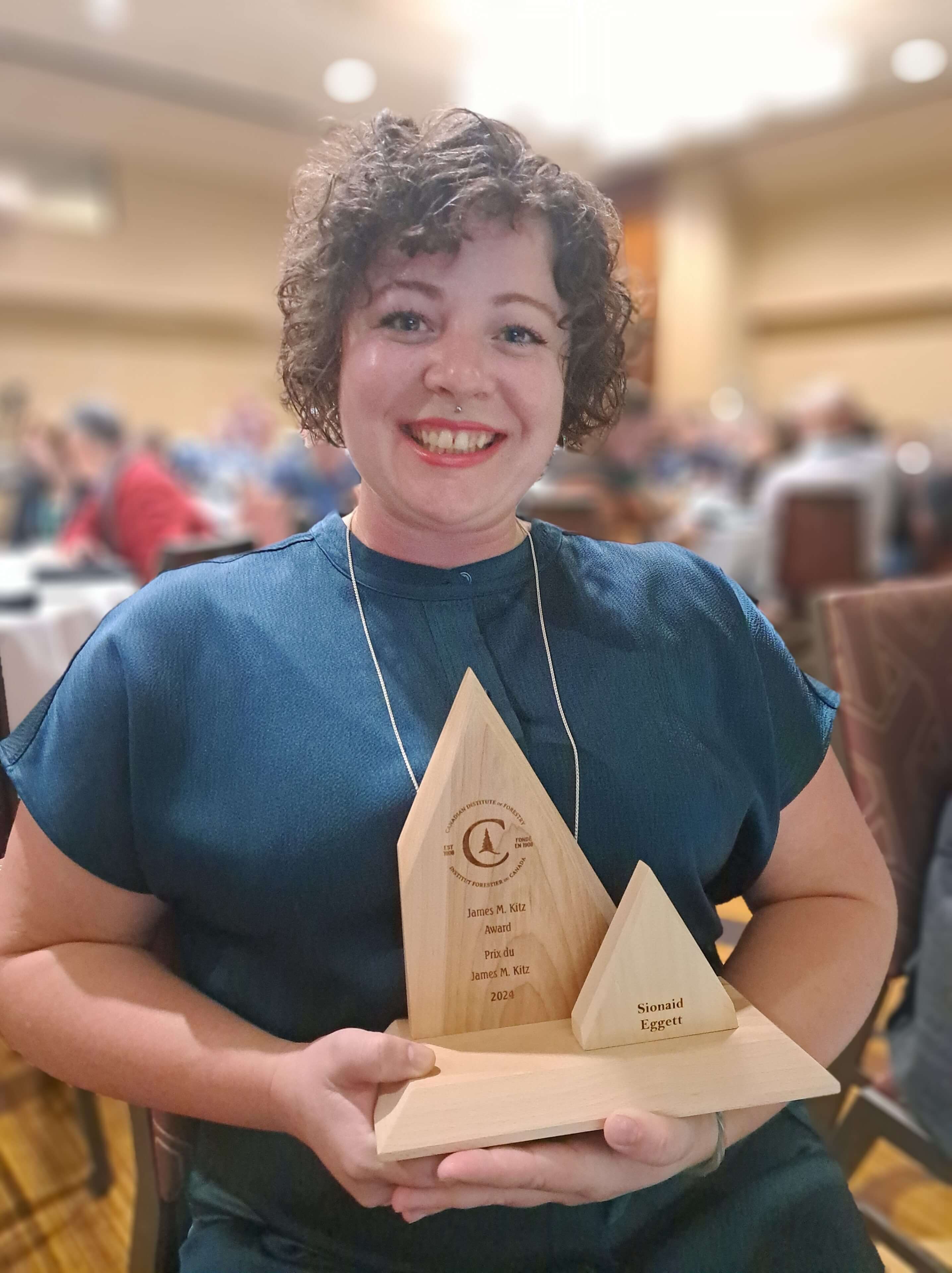
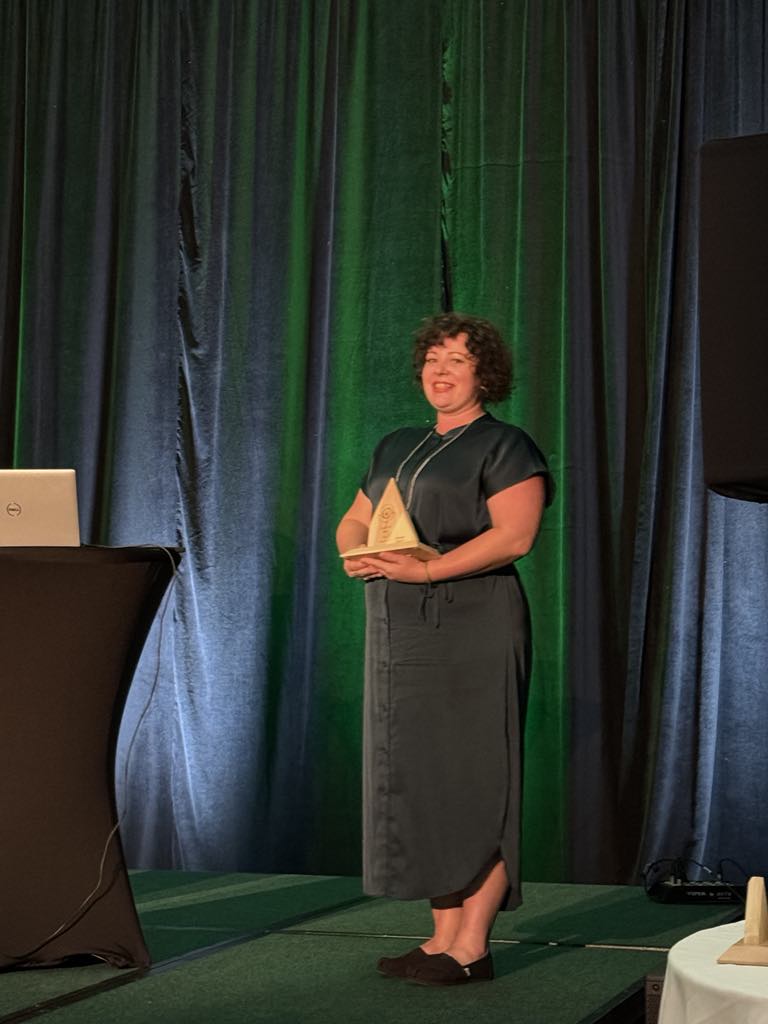
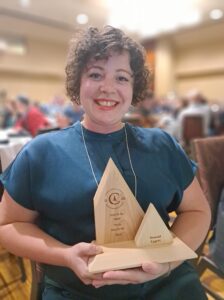
Forestry alumna Sionaid Eggett receives the James M Kitz award for her dedication to her profession as a recent forestry graduate.
She enrolled in the program while the pandemic was at its peak in the Fall of 2021. It was challenging with her theory courses taught by faculty online, but the college managed to allow students to take field trips so they could hone their practical skills in the rich forests of the Ottawa Valley. At a time when it was difficult to make human connections, the field trips filled a void, allowing her to be with her classmates and teachers in the tranquil spaces of some of the most diverse forests in Canada.
By the late summer of 2022, Eggett had graduated from the Forestry program and quickly found employment with the Ontario Woodlot Association, hired as a field operations coordinator. She quickly left an impression with her employer and took on a leadership role, promoting careers in forestry while also helping to build on the tradition of the industry.
One of those traditions is a year end ring ceremony, where students who complete the program receive a special ring from the Canadian Institute of Forestry. It’s a tradition that started in 1953, but up until 2002 it was only forestry graduates from universities who could receive the rings. When college graduates were brought into the fold, it became a source of pride for all colleges who offered forestry programs.
At its core, the ring symbolizes the commitment forestry graduates are making to their field of study, acknowledging their responsibility to act professionally in their day to day work. Eggett believes strongly in the power of the ring and has fully embraced her new career, earning her recognition as one of Canada’s leading new forestry professionals.
Forestry Technician alumna Sionaid Eggett is off to an excellent start in her career, having been recognized by her peers for her work.
She quickly took on a leadership role within the Canadian Institute of Forestry, chairing the Algonquin chapter of the CIF and has become a champion for the ring, sharing the importance of the values that is represents for all who are part of the fores try fraternity. That commitment has caught the attention of the industry and earned Eggett the prestigious James M Kitz awardthat recognizes the outstanding contributions of individuals who are just getting their forestry careers started. Eggett received the award at a special ceremony in Newfoundland, having been nominated by one of our professors in the program, John Pineau, who is now her colleague at the Ontario Woodlot Association, having hired Eggett shortly after she graduated from the program.
Eggett’s forestry career is off to a great start and as an alumnua she remains attached to the college. “I continue to work with the Algonquin Forestry students each year to help to give back to the institution that has greatly influenced and changed my life. I have never been so happy in a career or workplace and feel extremely supported by the whole forestry community. My line is “if we as people are doing well then the forest is doing well” which really resonates with me,” says Eggett.
When the graduating class of 2024 at Algonquin received their silver rings, it was Eggett who presented them, but at the ceremony she learned something was amiss and wanted to address what she thought was an unfortunate situation. The program coordinator, Peter Arbour, who was presiding over the ceremony had mentioned he didn’t have a silver ring. Arbour was Eggett’s primary teacher while she was in the program and she wanted to pay it forward, acknowledging the impact Arbour has had on her life and new career.
Algonquin College Forestry Technician coordinator Peter Arbour receives his silver ring from alumna Sionaid Eggett and Brittany McKenzie and CIF lead John Pineau.
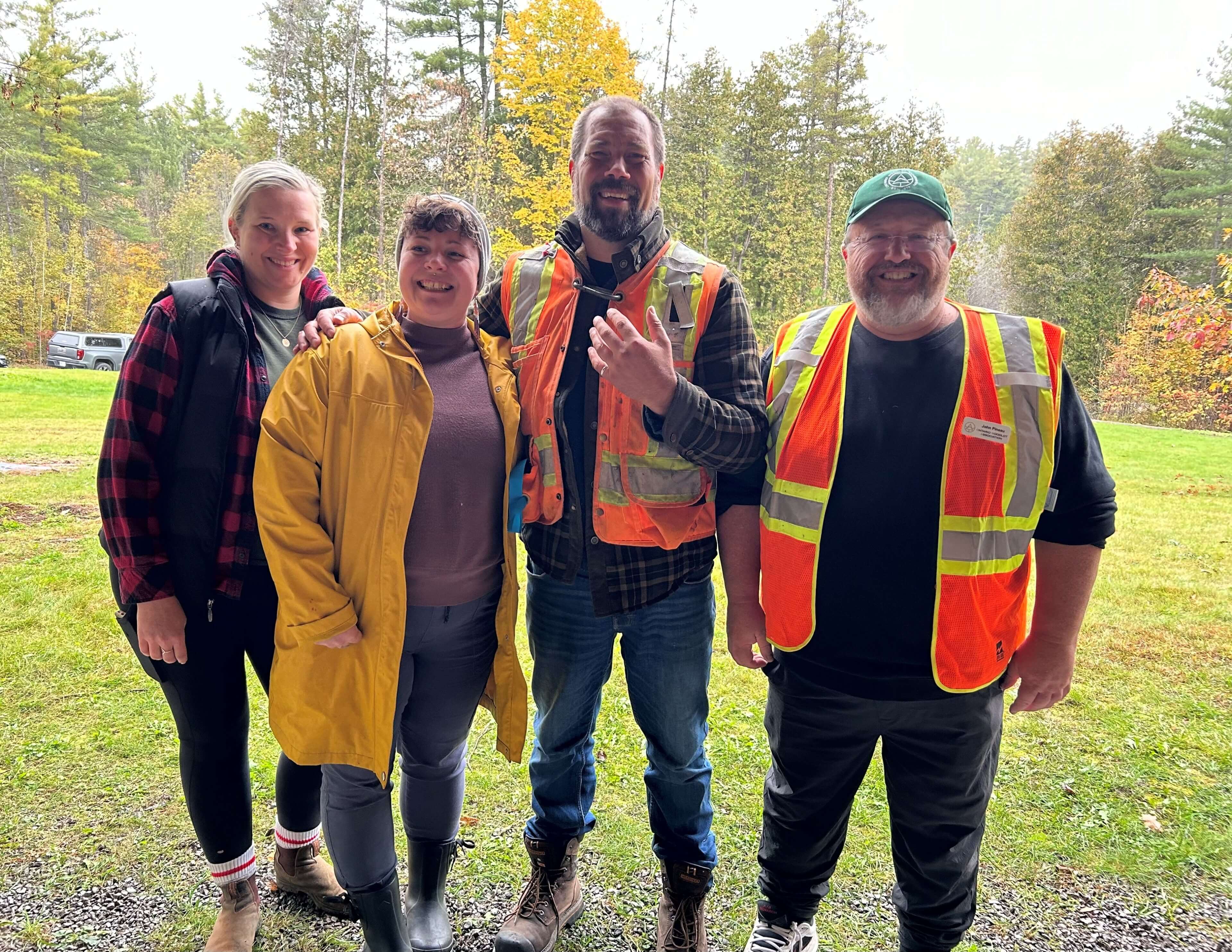
She worked with others including John Pineau, her employer at the Ontario Woodlot Association and a long time champion of the CIF and arranged for a special impromptu ring ceremony for Arbour at a meet and greet for industry partners to meet the new Forestry students. The setting was perfect. Arbour received his ring at the Shaw Woods Education Centre, in front of his current students. It was a full circle moment for Eggett, back in a place where her love of forestry was confirmed and while speaking about the significance of the silver ring she shared an important message with the new students who had gathered.
“Never have I worked in an environment that is so uplifting, where everyone cares about your journey,” said Eggett. It was an inspiring message from the heart that only someone who loved their job could share. It’s that enthusiasm that has made Eggett a leader in the field and while she is early in her career, Eggett has already proved she has a bright future ahead in one of our country’s most historic industries.
(Posted by Jamie Bramburger, Interim Dean of the Pembroke Waterfront campus)
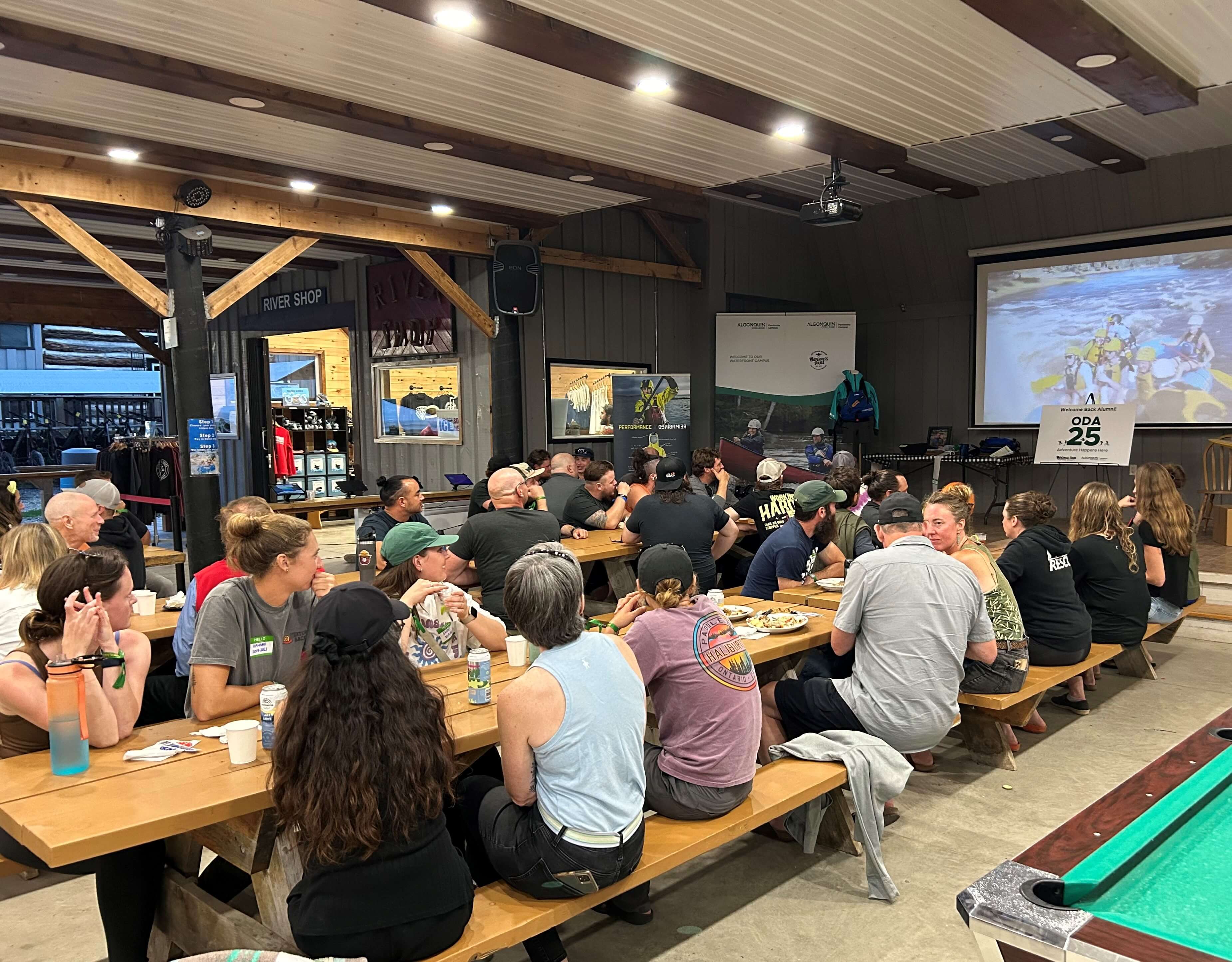
It had to involve whitewater rafting. 25 years after the Pembroke Campus launched its highly successful Outdoor Adventure diploma program, alumni from across Canada returned to the rapids of the Ottawa River to mark the significant milestone. More than 75 alumni participated in the two-day celebration, which included a Friday night reception at the Waterfront campus, some rock climbing in the campus gymnasium, and then an afternoon of rafting the following day at Wilderness Tours.
Program coordinator Jeff Jackson spoke passionately about how the program has changed the adventure tourism industry, producing graduates who now work around the globe. Jackson, who is highly respected as one of the world’s leading adventure tourism risk management experts, has a special rapport with the students he teaches. That resonated throughout the weekend as alumni re-engaged with him, some of whom he had not seen in decades.
Faculty and staff of Algonquin College’s Outdoor Adventure program pose for a picture at the program’s 25th anniversary celebration. (L to R: Chris Melmoth, Cam Dube, Jeff Jackson, Kate Monahan, Bobbie Gormley and Jamie Bramburger.)
The celebration was a time to reflect on the program’s origins as former Algonquin College President Kent MacDonald provided a video message that shared the program’s genesis. MacDonald is now the President of Northwood University in Michigan, but in 1999, when the program launch was announced, MacDonald was the Chair of the Business, Technology and Outdoor Training department at the Pembroke Campus.
“There is no doubt in my mind that it is the preeminent outdoor adventure program,” said MacDonald, who highlighted the unique partnership the college struck with Wilderness Tours to bring the program to fruition. “This type of partnership was new for a college to work with a private industry partner. I can’t imagine the multi-billion dollar tourism industry in Ontario and Canada if it didn’t have the Algonquin College Outdoor Adventure program to produce these graduates with the latest education and training and being prepared to lead this industry,” added MacDonald.
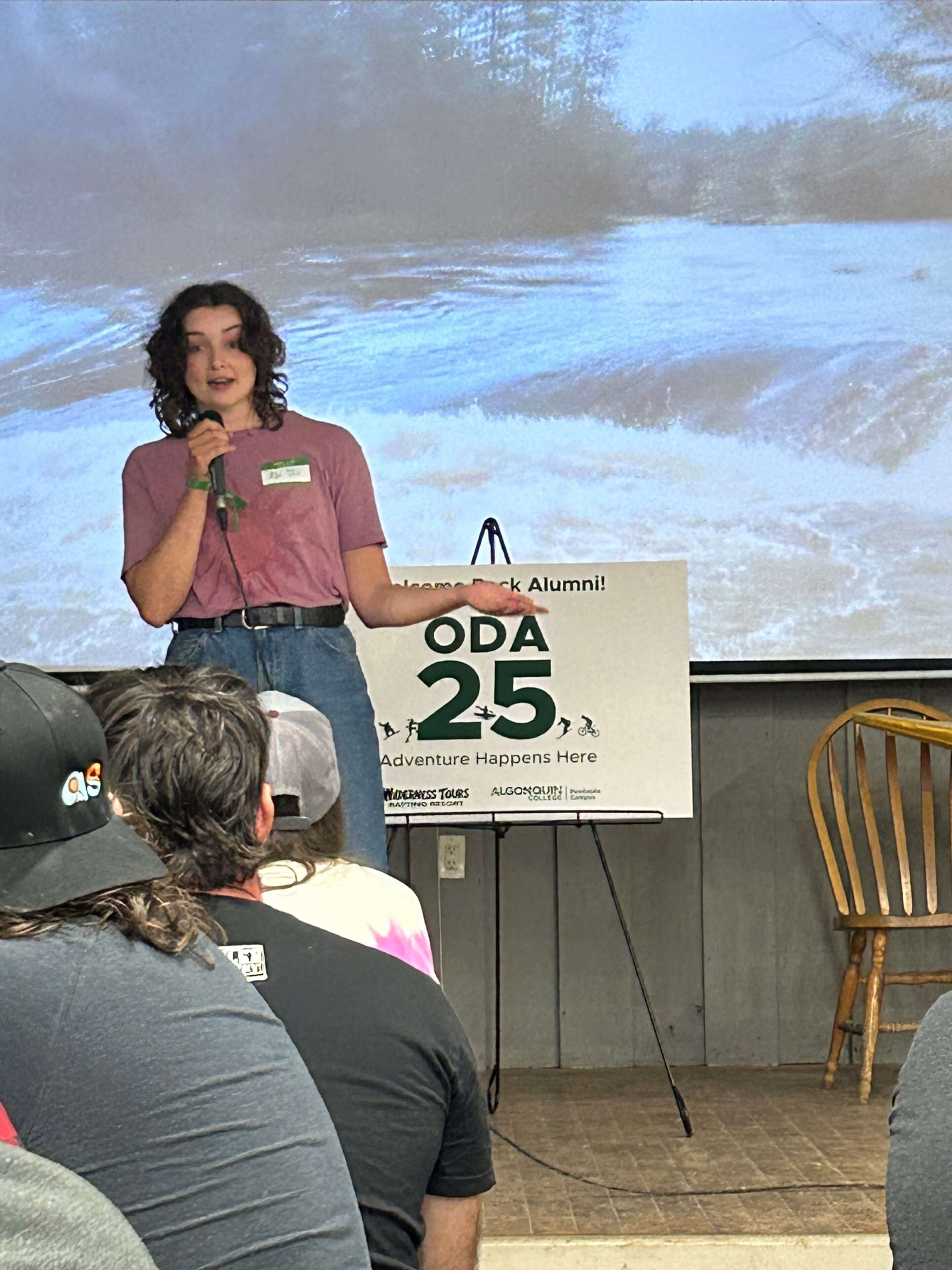
Representing alumni, Abigail Dunford, who graduated from the program in 2017, spoke about how the program has allowed so many students to do what they want to do. Dunford came to the program from the Toronto area. Like so many others, she relocated to Pembroke because of her passion for the outdoors and the opportunity to enroll in a program that would allow her to turn that passion into a career.
Wilderness Tours Founder Joe Kowalski spoke to the alumni, sharing his own story of starting his company in 1975 after he fell in love with the thrills of whitewater. Kowalski talked about how his business has changed, highlighted by his company’s relocation to a new site along the shores of the Ottawa River four years ago, a place many alumni were visiting for the first time. “I’m impressed that so many of you have come back to celebrate this special occasion,” said Kowalski, who will mark the 50th anniversary of his Wilderness Tours enterprise next year.
Outdoor Adventure alumni gather at Wilderness Tours to celebrate the program’s 25th anniversary.
The Wilderness Tours partnership with the college was paramount to the program getting off the ground. The company was well established in adventure tourism and had the expertise to deliver the hundreds of hours of practical training experiences that have been the cornerstone of the program since the first intake in the Fall of 2000. Wilderness Tours also had the required resources for the training, including rafts, kayaks and mountain bikes.
Not much has changed in terms of how the program is delivered. Students still spend two days each week at the Wilderness Tours resort or Mount Pakenham ski hill, where they hone their skills, earning several industry-recognized certifications. When on campus, students learn about risk management, accounting, finance, marketing and entrepreneurship, and communications. This recipe of courses has helped many alumni start their own adventure tourism businesses or position them for leadership roles within the sector.
Algonquin College alumna Abigail Dunford , who graduated from the Outdoor Adventure program in 2017, speaks to a group of Outdoor Adventure alumni at the program’s 25th anniversary celebration.
Interim Dean Jamie Bramburger spoke about the impact the Outdoor Adventure program has had on the Pembroke campus. “When the program was launched, it showed us that if we created unique programs, we could attract students from outside of our area. I believe this program played a significant role in our ability to build the new Waterfront Campus because it demonstrated we could be a destination campus for students,” said Bramburger.
To mark the 25th anniversary of the Outdoor Adventure program, the Pembroke campus announced the establishment of an endowment to support Outdoor Adventure students in financial need. The goal is to raise a minimum of $15,000, but it is hoped that the endowment will continue to grow to support more students by providing bursaries. Outdoor Adventure has one of the highest tuition of all programs offered by Algonquin College. Donations can be made at this link: Outdoor Adventure Bursary | Advancement and Strategy (algonquincollege.com)
Twenty-five years ago, the Pembroke Campus created one of the most exhilarating college programs in the world. By doing so, Canada’s multi-billion dollar tourism sector provided a skilled labour force focused on risk management and leadership skills. Since then, hundreds of graduates have taken their skills across the country and worldwide, starting up new adventure tourism businesses and strengthening the workforce in existing businesses. The program has left its mark and will continue to feed an evolving industry that remains vital to the nation’s economic prosperity.
The Algonquin College website uses cookies to enhance your browsing experience. The cookies categorized as "Essential" are stored on your browser and enable the basic functionalities of the website. We also use third-party cookies to help us analyze how you use the website to maximize performance, store your preferences, and provide you with relevant content and advertisements. You can choose to allow all cookies or only allow a selection, but disabling some of them may affect your browsing experience. View our privacy statement.
These cookies cannot be turned off as they are required to enable the basic features of this site. These cookies do not store any personally identifiable data.
These cookies are used to collect preferences, compile site usage information, and improve the efficiency of the website.
These cookies allow us and partner companies to make our marketing efforts more relevant and to optimize the effectiveness of our ads.

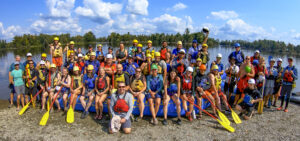
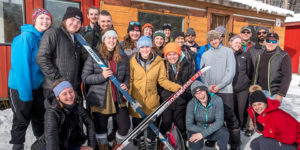 For Adrian Clementino, ODA provided the ideal balance of hands-on challenge and academic preparation. He completed ODA in 2021 and then went directly to TRU, graduating with a Bachelor of Tourism Management, majoring in Entrepreneurship. Since then, his career has been as adventurous and dynamic as the program itself, from managing a remote accommodations operation on the West Coast to now serving as Club Manager of the Ottawa Rowing Club, where he leads operations, budgeting, events, and staff while still maintaining a personal connection to guiding. Adrian says the combination of ODA and TRU has shaped not only his career opportunities, but also the life he is proud to live today.
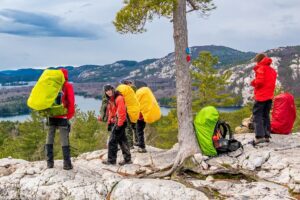 Together, these stories share something powerful. Students who once questioned whether higher education was “for them” now speak about thriving at university. Graduates who began in rafts, canoes, and climbing harnesses now speak confidently about advanced degrees, leadership roles, community impact, and professional purpose. ODA did not just prepare them to guide trips; it prepared them to build lives, grounded in capability, belief, and opportunity.
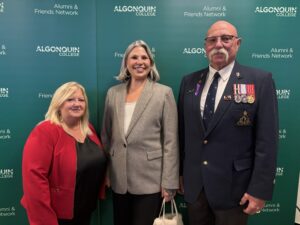 Marcie’s path began more than two decades ago when she enrolled in Police Foundations at Algonquin College. That experience led her into the Canadian Armed Forces, where she served as a military photojournalist, capturing stories of courage and sacrifice around the world. Her lens took her from training fields to deployment zones, where she chronicled the experiences of soldiers and their families.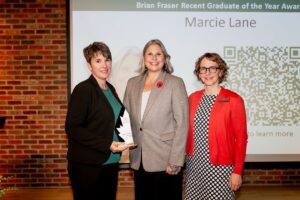
 Alumna Sionaid Eggett, now working with the Ontario Woodlot Association, recalls the importance of this hands-on approach, “I was greatly attracted to the amount of hands-on in the field learning Algonquin had to offer … Never have I worked in an environment that is so uplifting, where everyone cares about your journey.” Her words echo what students experience today, an environment where mentorship, applied skills, and community spirit make all the difference.
 Industry, too, continues to see the value in forestry education. This year, two of our current students, Reed Griese and Ava Newcombe, were named recipients of the prestigious Schulich Builders Scholarship. Their recognition not only celebrates their personal achievements but also affirms the importance of investing in skilled forestry professionals who will carry the sector forward.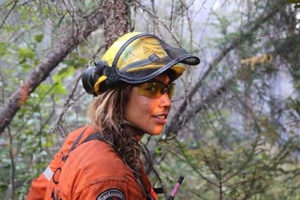
 For Rebecca Langille, the decision was deeply rooted in family values. She asked her mother, Helen, to pin her, crediting her as the single most influential person in her academic journey. Rebecca also honoured her late grandmother, a longtime RN, through the gesture, saying her mom’s belief that “education is never hard to carry around” helped propel her through difficult times. Kimberley Foster was pinned by her aunt and godmother, Julie St. Denis, a critical care nurse for 45 years. Julie’s lifelong commitment to nursing was part of what inspired Kimberley to pursue a career in the profession herself.